A Song Thrush has captured my heart
It must be love.
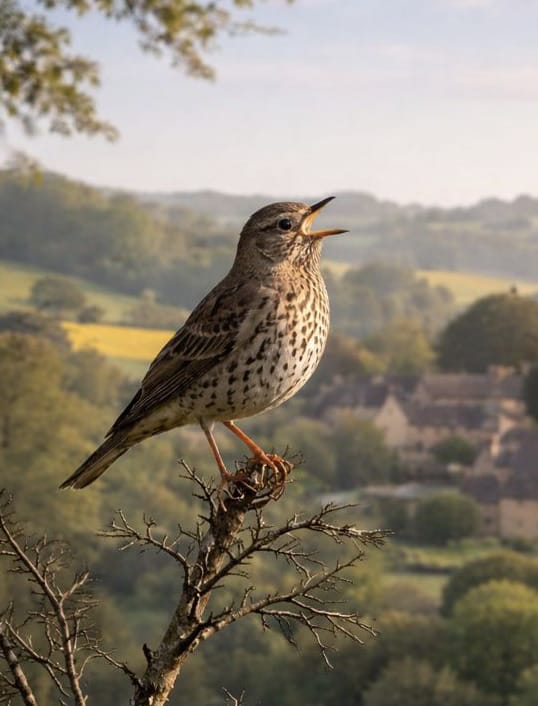
I mentioned in a previous post that in mid-January I heard a thrush start to sing from within some low bushes beside the Brook. This visually slightly nondescript bird, nothing more than blackbird-sized, captured my attention not with vision but with sound. The song is strange in its own way. Varied, but repetitive. Yet the repetition never becomes tiresome. In recent days the bird seems to have migrated upwards. It now sings from the top of a tall ash, about thirty yards from my bedroom window. More than that, it has migrated into my consciousness.
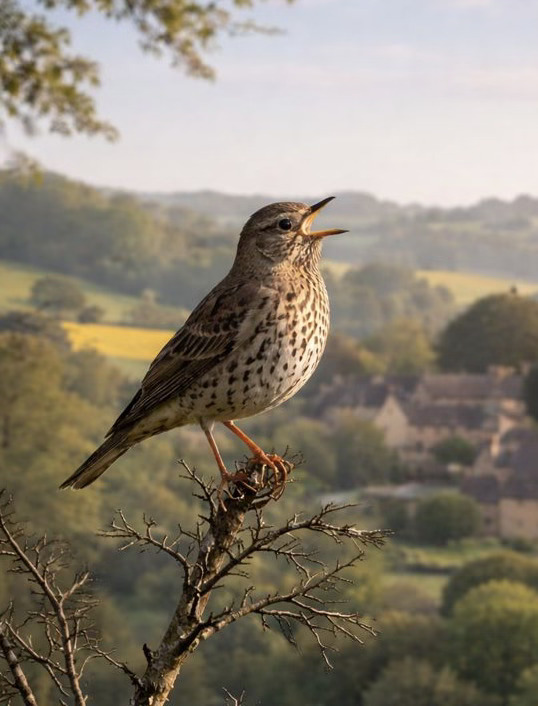
I’m a poor sleeper. Usually awake, or half-awake, as the sun lightens the sky in the east. I can gauge the time by the shade of grey seen through a gap in the curtains. Inevitably, at some point, the sound of the thrush comes through that same gap. Politely, persistently, it asks for my attention.
The sounds within the song are difficult to put into words. It’s another language, one I don’t speak. There are sounds unlike music: creaks, chattering, chirps, then wandering whistles. It demands attention. I have obeyed this command. I listen to the lyrics hard, trying to understand the measure of the tune.
What phrase forms the next verse? Is there a predictive pattern? Is that phrase an imitation? Are the lyrics of a language? Are the words implicit in the music, or is it purely instrumental? Who taught this bird to sing? Who defined the pattern, the metre, the sounds, the rhythms, the beginning and the end?
Does the message have purpose, or is it pleasure? My elderly mother has a carer whom I have heard sing to herself. A quiet hymn as she walks the garden path. She sings for her own pleasure, not for me, the unseen listener. But the joy that springs bursting from my heart to hear such private passionate music is the same. I’m encouraged to think this thrush sings hard all day for its own pleasure rather than some mechanistic imperative to define territory or find a mate.
Perhaps that’s the key. The song holds joy for the singer as well as the listener. My days start with joyful shouts from this bird. A sharing.
I usually avoid ascribing human emotions to creatures. But it’s a human trait to do so, to make sense of the world. The cocked head of a robin perched near where I dig seems friendly. The panicked alarm call of a blackbird disturbed from its bush feels fearful. I’m struggling to define the emotion in the thrush’s song. Is it simply the thrill of singing? It sings because it can. I listen because I must.
The thrush’s sonnet ends with joy too, at the other end of the day, as the sky darkens and this bird is the last to rest. What passion to sing so loud and so long. It must be love.
Like a febrile new lover I’m anxious for our next meeting. But I know it will begin in the early hours, just a few away, if I lie still and stay patient. Sleep evades me, but the song thrush will start my day soon, inevitably. As day breaks the desire is proven and the lover’s promise kept. Delight that the passion is not unrequited. A hope for joy comes true.
It has caught me. I am committed to this bird and its chorus.
