Charles Bridgeman at Sherborne and Lodge Park
Evidence for an Unrecognised Dual Landscape Design?
Introduction
New archival research suggests Charles Bridgeman's influence at Sherborne and Lodge Park, Gloucestershire, may be more extensive than previously recognised. While Bridgeman's involvement at Lodge Park has been documented through his surviving 1729 plan that included a large serpentine lake, contemporary archival records point to simultaneous and coordinated landscape works at both sites during the 1730s. This paper argues that when Bridgeman's ambitious serpentine lake proved geologically impractical, he devised an alternative scheme employing his signature technique of successive water features along the valley bottom at Lodge Park, at exactly the same time as a similar effort in Sherborne Park —creating what may be a previously unrecognised masterpiece of early English landscape design at the heart of Sherborne.
Bridgeman's Known Involvement
Archive documents confirm Charles Bridgeman's presence at Sherborne during the period c.1725-c.1730, when he produced at least one plan for Lodge Park that was rediscovered in 1998. This plan proposed a large serpentine lake within the valley bottom of the River Leach. Geological surveys undertaken c.1730-1731 to assess the feasibility of this scheme proved it impractical, yet Bridgeman's other designs for the site were partially implemented, presumably following a revised plan that has not yet been located.
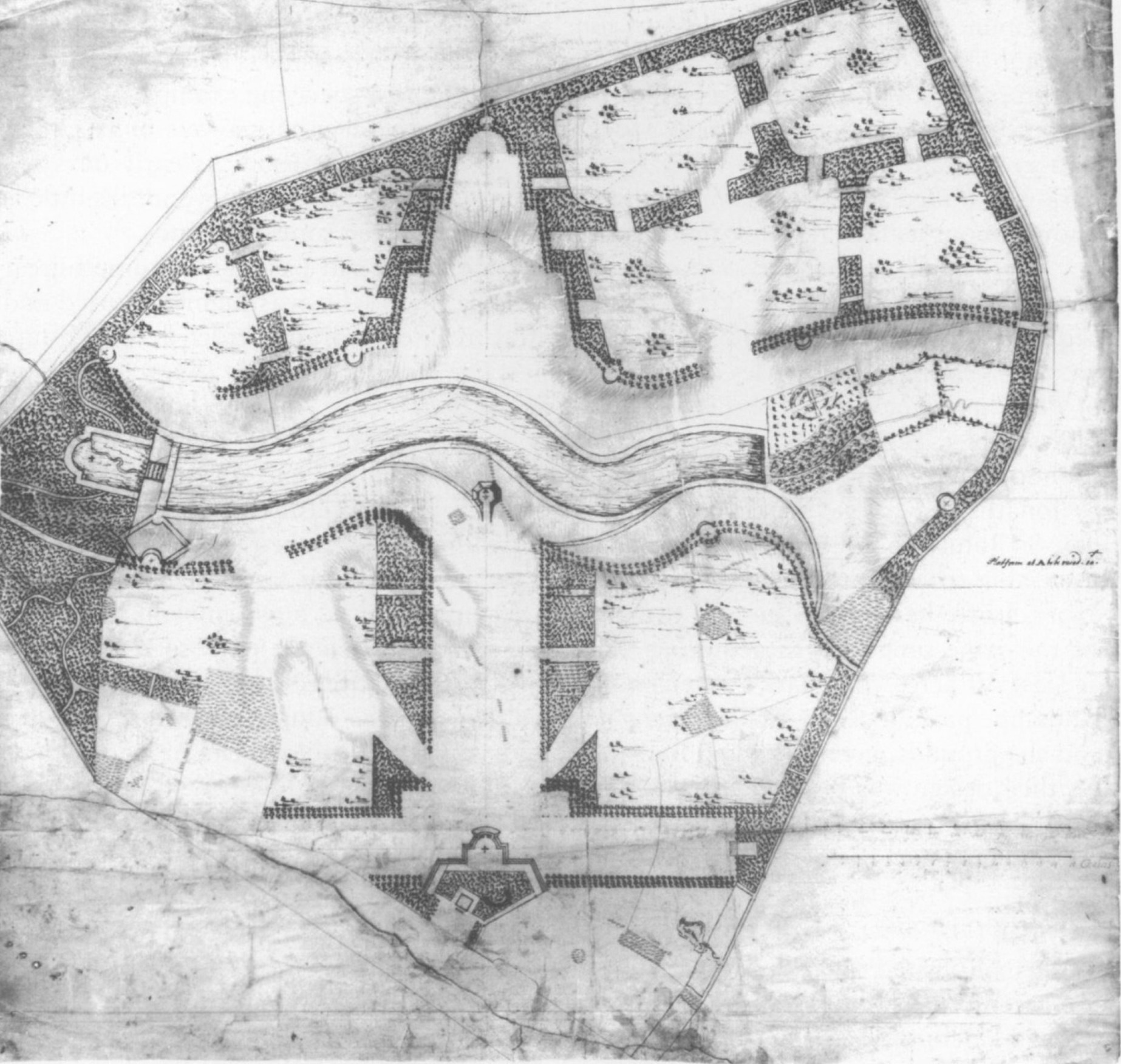
Bridgemans c1729 plan showing the aspired for massive serpentine lake - discovered in the Bodleian Library in 1998.
Evidence suggests a rectangular lake already existed at Lodge Park by 1727—shown in very faint outline on Bridgeman's 1729 plan and supported by records of Sir John Dutton commissioning a boat for Lodge Park that year. While this earlier water feature may predate Bridgeman's involvement, it aligns with his established practice of incorporating existing landscape elements into his designs.
Bridgeman's Design Philosophy and Precedents
Bridgeman demonstrated a particular talent for incorporating natural topography, often enhancing existing valleys by creating chains of lakes or ponds. This approach exploited natural drainage patterns while creating dramatic water features that appeared more naturalistic than the rigid geometries of earlier French-influenced garden styles. His documented works employing multiple water features in valley settings include:
- Stowe, Buckinghamshire (1713-1738): Multiple lakes including the Octagon Lake and Eleven Acre Lake
- Rousham, Oxfordshire (1721-1738): Series of ponds feeding cascades and formal pools
- Claremont, Surrey (1715-1730s): Formal basin later developed into serpentine lake
- Wimpole Hall, Cambridgeshire (1720s): Chain of fishponds later transformed into serpentine lakes
Significantly, Sir John Dutton is known to have visited Claremont, suggesting direct familiarity with Bridgeman's innovative water management techniques.
The Archival Evidence
I have previously analysed the Kip drawing of 1709, which appears to show a weir and sluice gate forming the upper lake in Sherborne Park, and so will not repeat it here other than point out that the upper lake appears to predate Bridgeman’s presence.
A systematic chronological analysis of the Dutton family archives reveals intensive activity around water features during the period 1725-1740, coinciding with and following Bridgeman's documented presence. The terminology requires careful interpretation: contemporary records use "ponds" to describe what would now be termed lakes, as Wendy Bishop's research has clarified.
Over 35 archival references document works on ponds, lakes, and rivers across both Sherborne Park (then Home Park) and Lodge Park (then New Park) during this period. Key entries include:
Lodge Park (New Park) Works:
- 1731: Geological survey of clay to explore possibility of Bridgeman's large lake
- 1732: Hewing stone for the lower pond
- 1735-1738: Major construction phase with masons at ponds
- 1739: Ashlar work at fish ponds
- 1740: Spikes for head of lower pond; piling the lower pond
- 1742: Carpentry at lower lake head
Sherborne Park (Home Park) Works:
- 1727: Making grates for river
- 1739: Masons for fish pond; making sluice for pond. (There is an ashlar stone built sluice beside the lower lake weir.)
- 1740: Making grates for “new pond”; making sluice and grate at pond
Analysis and Interpretation
The archival evidence points to the contemporaneous completion of lower lakes at both sites around 1740. This synchronicity is particularly significant given the documented failure of Bridgeman's original serpentine lake scheme at Lodge Park. The pattern suggests implementation of an alternative design—a "Plan B" that may have been developed but has not survived in the archives.
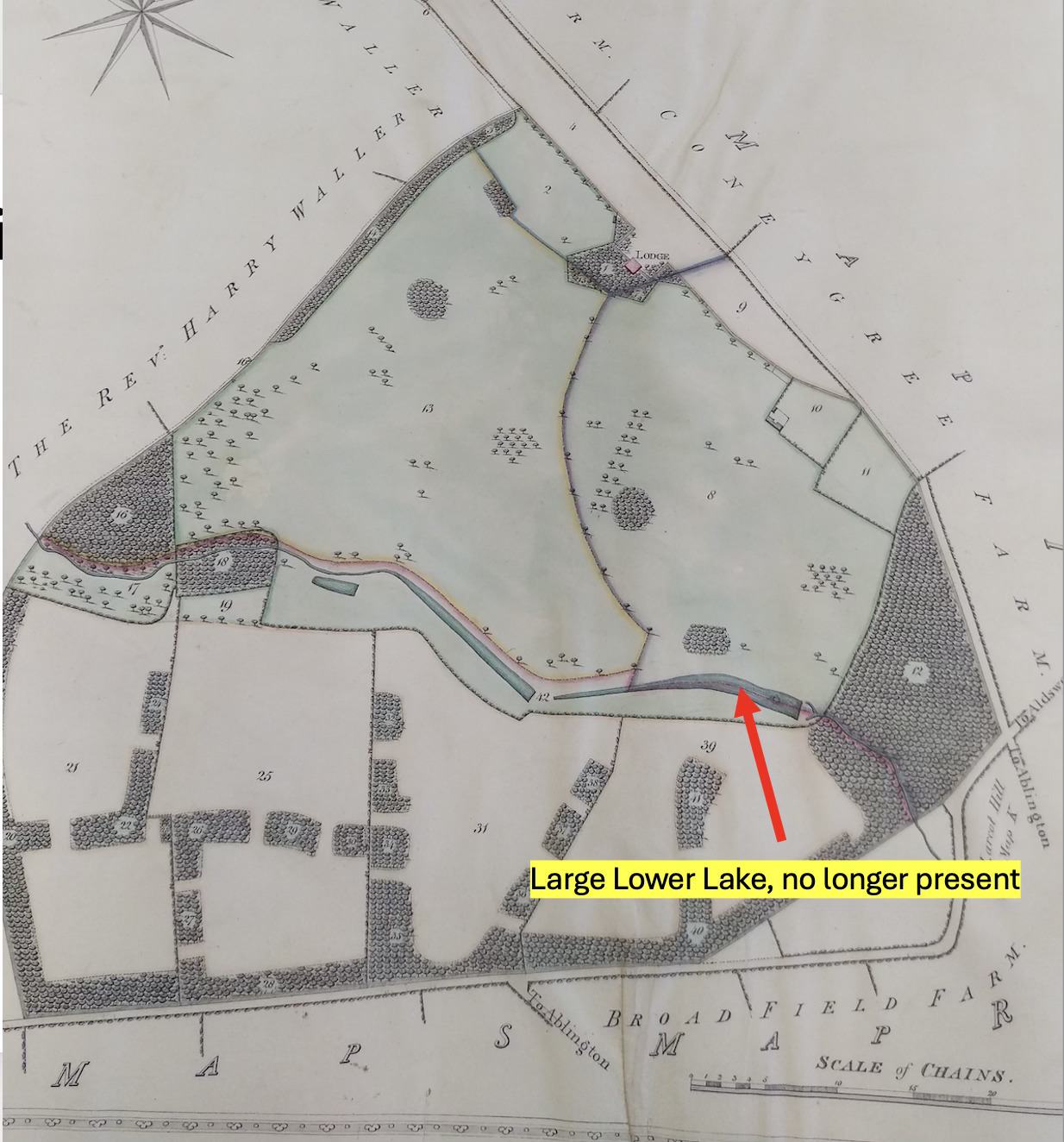
The lower lake at Lodge Park is clearly documented in the 1820s estate plan, yet neither the Historic England Grade I listing nor subsequent scholarly analyses by K.T. Fretwell and Nicky Smith acknowledge this feature other than oblique and minor references to fishponds. This oversight likely stems from modern misinterpretation of historical terminology, where "pond" has been dismissed as indicating minor garden features rather than substantial water bodies. This lower lake feature deserves more attention.
The estate plan below from c1820 clearly shows a large lower lake in Lodge Park, presumably the one created in c1740 . This seems to have been ignored until now in assessments - perhaps it will appear in the history section of the long awaited NT Conservation Management Plan. It no longer exists.
The Case for Coordinated Design
Several factors support the hypothesis that both lower lakes were conceived as elements of a coordinated Bridgeman design:
Design Philosophy Alignment: The creation of successive water features exploiting valley bottoms matches Bridgeman's established design methodology, as evidenced at his other major commissions.
Temporal Correspondence: The intensive period of lake construction (1735-1740) follows directly from the abandonment of the serpentine lake scheme and aligns with the peak period of Bridgeman-style landscape creation.
Existing Infrastructure Integration: Both schemes appear to have incorporated pre-existing water features—the Broadwater at Sherborne Park and the canal pool at Lodge Park—consistent with Bridgeman's practice of building upon established landscape elements.
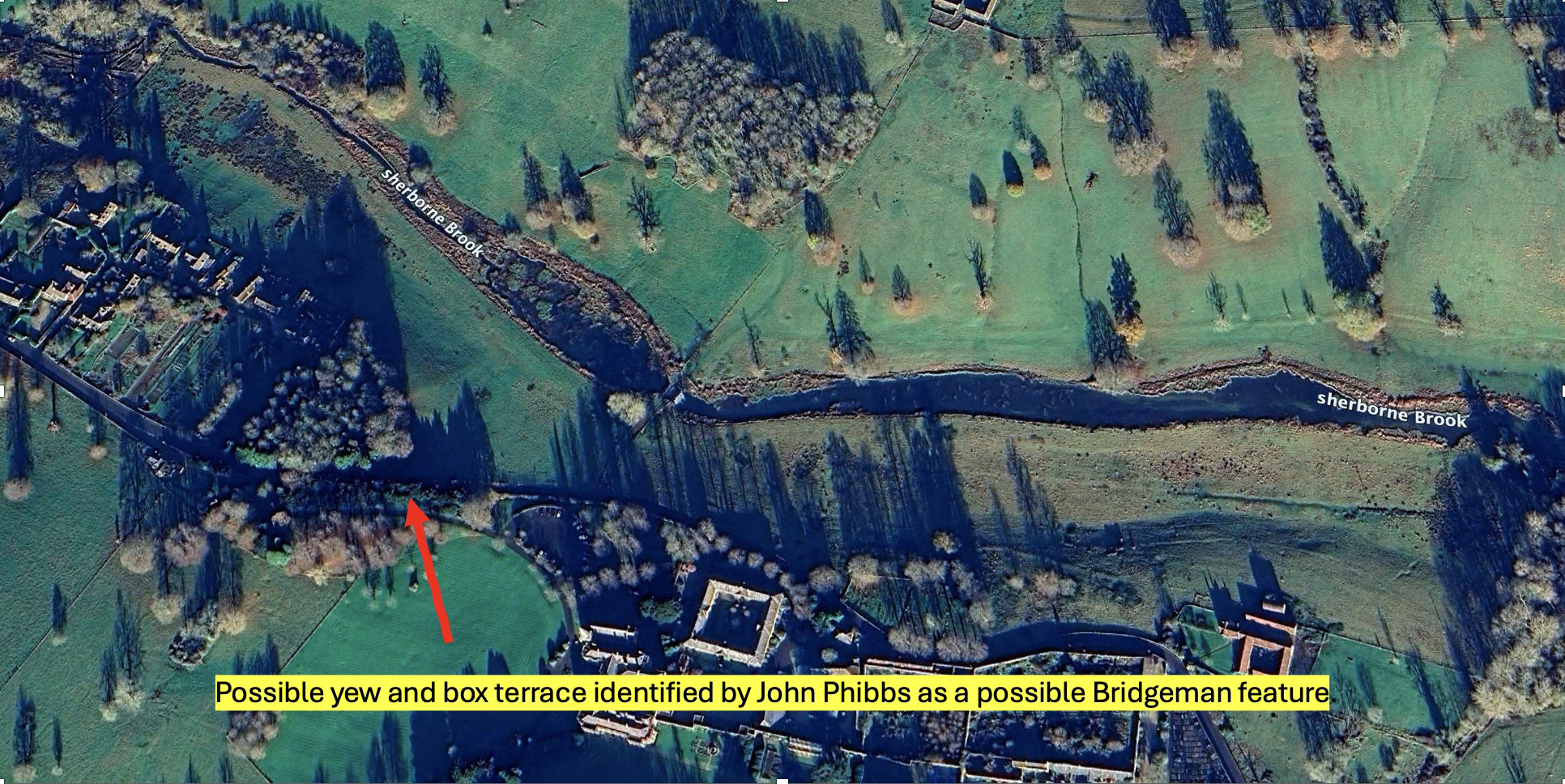
Physical Evidence: The survival of what John Phibbs identified as a potential Bridgeman terrace design overlooking both lakes provides crucial supporting evidence. This elevated viewing platform, positioned to command prospects of both water features with the village road contained within a ha-ha below, exemplifies Bridgeman's innovative use of terraced viewing points.
Logistical Practicality: Given Dutton's documented relationship with Bridgeman and the simultaneous timing of works, coordinated planning across both sites represents the most economical and logical approach.
Conclusions and Implications
The evidence suggests that perhaps Charles Bridgeman's influence at Sherborne extended beyond his documented involvement at Lodge Park. When geological constraints rendered his ambitious serpentine lake impracticable, he appears to have devised an alternative strategy employing his characteristic technique of multiple water features along natural valley bottoms—implemented across both Sherborne and Lodge Parks as complementary elements, perhaps, of a unified design vision. If so, as John Phibbs has suggested, both sites should perhaps be considered together when considering their heritage importance.
If this interpretation is correct, Sherborne may harbor a previously unrecognized Bridgeman landscape of considerable significance. The surviving terrace, positioned to command views of both lakes, would represent a crucial element of this composition—a viewing platform designed to reveal the full scope of Bridgeman's innovative approach to landscape integration.
If this interpretation is incorrect, then it is merely a coincidence that the lower lakes seem to have been constructed at exactly the same point in history, and another coincidence that they matched the design themes of Bridgeman, who we know had dealings in Sherborne a few years earlier and had designed an earlier plan. Is that too many coincidences?
This reassessment has important implications for the conservation and interpretation of both sites. The lower lakes, (Lodge Park’s lake having disappeared) ,currently absent from specific heritage designations and scholarly analyses, merit recognition, perhaps, as integral elements of an early masterpiece of English landscape design. Furthermore, the potential existence of additional archival material, perhaps a surviving "Plan B” for Lodge Park, warrants systematic investigation of relevant collections beyond those already examined that turned one up as recently as 1998.
The case for Bridgeman's dual landscape design at Sherborne and Lodge Park might be important. It is understood that the National Trust are seeking funds to address the Sherborne Park lakes and it is hoped this new analysis might contribute and help position them as worthy of restoration.
Finally I would also point out that while both Sherborne Park and Lodge Park may have seen the hand of Bridgeman in the 1730s, it appears that other designed landscape features in these landscapes date from a century earlier, from the time of Crump Dutton. I have explored some of these in other posts.
Sources:
Fretwell, Katie T. "Lodge Park, Gloucestershire: A Rare Surviving Deer Course and Bridgeman Layout." Garden History23, no. 2 (Winter 1995): 133-144.
Smith, Nicky. "Lodge Park and Charles Bridgeman, Master of 'Incomprehensible Vastness'." Garden History 34, no. 2 (Winter 2006): 236-248.
Dutton Family Archives Estate archives D678 series, Gloucestershire Archives.
Bishop, Wendy. Ornamental Lakes, Their Origin and Evolution in the English Landscape. Routledge, 2021.
Phibbs, John. Paper assessing Sherborne’s landscape for the Sherborne Brook Support Group, 2022.
