Human Aspects of Sherborne’s Heritage
I came to loving history a little late in life. As a schoolboy, history was the driest of subjects, and I felt disconnected from it. There was a separation between me and the subject that I had little interest in bridging, it seemed to have little relevance. Sherborne has changed that for me, with its history, heritage and its natural history too. When one lives in such a place one cannot help but wonder how our predecessors lived here, and how they interacted with what was around them, as we in a daily sense engage with the same place. We are wired into Sherborne, and its landscape. Our heritage here is not dry history. It’s the landscape, the Brook, the nature (from the mighty oak to the flash of the kingfisher), our neighbours, our community.
Our predecessors engaged with the same place, a hundred years ago or five thousand years ago. Our modern layer sits on top of that, of course in different ways, but it is the similarities that bind us.
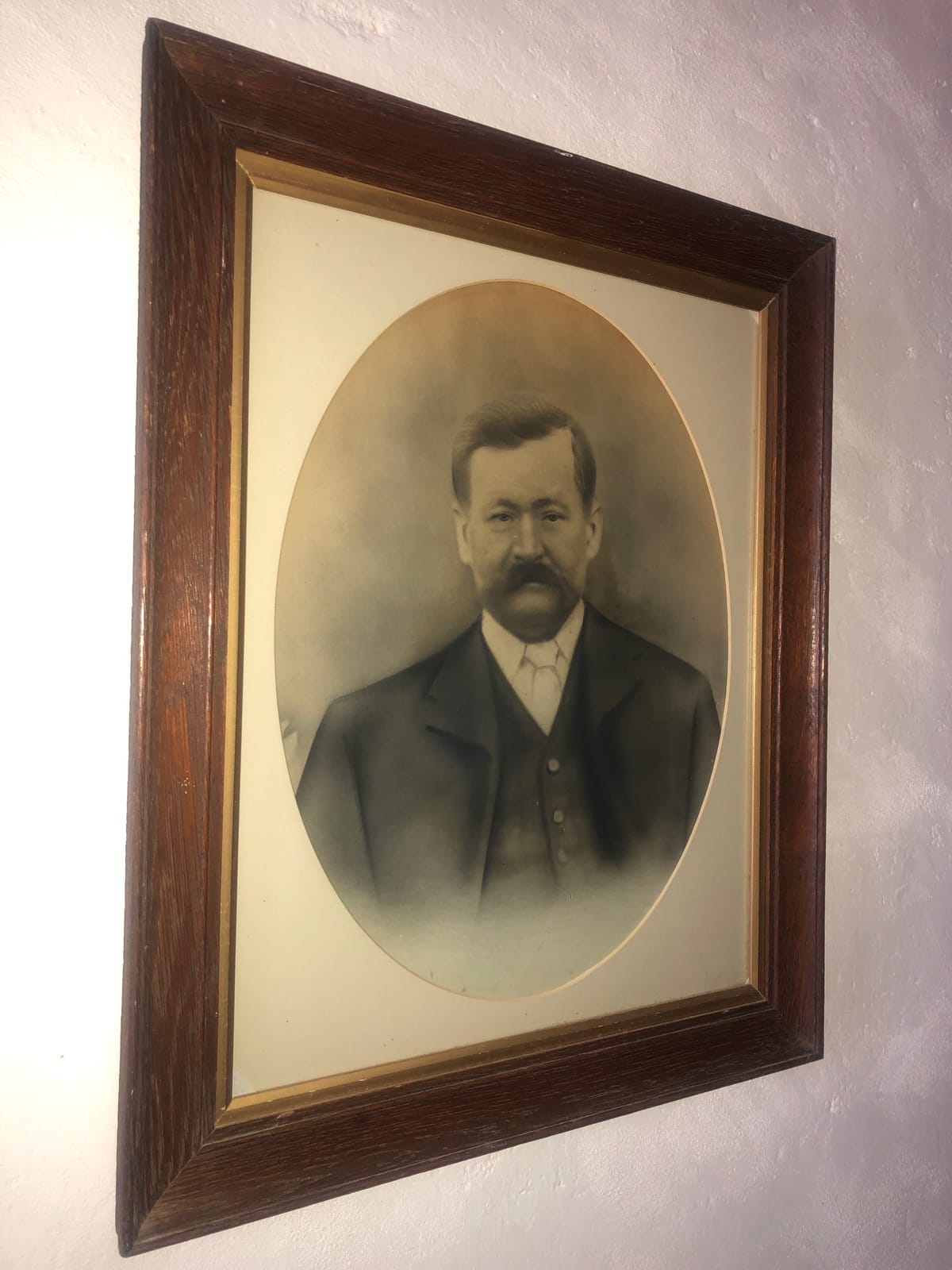
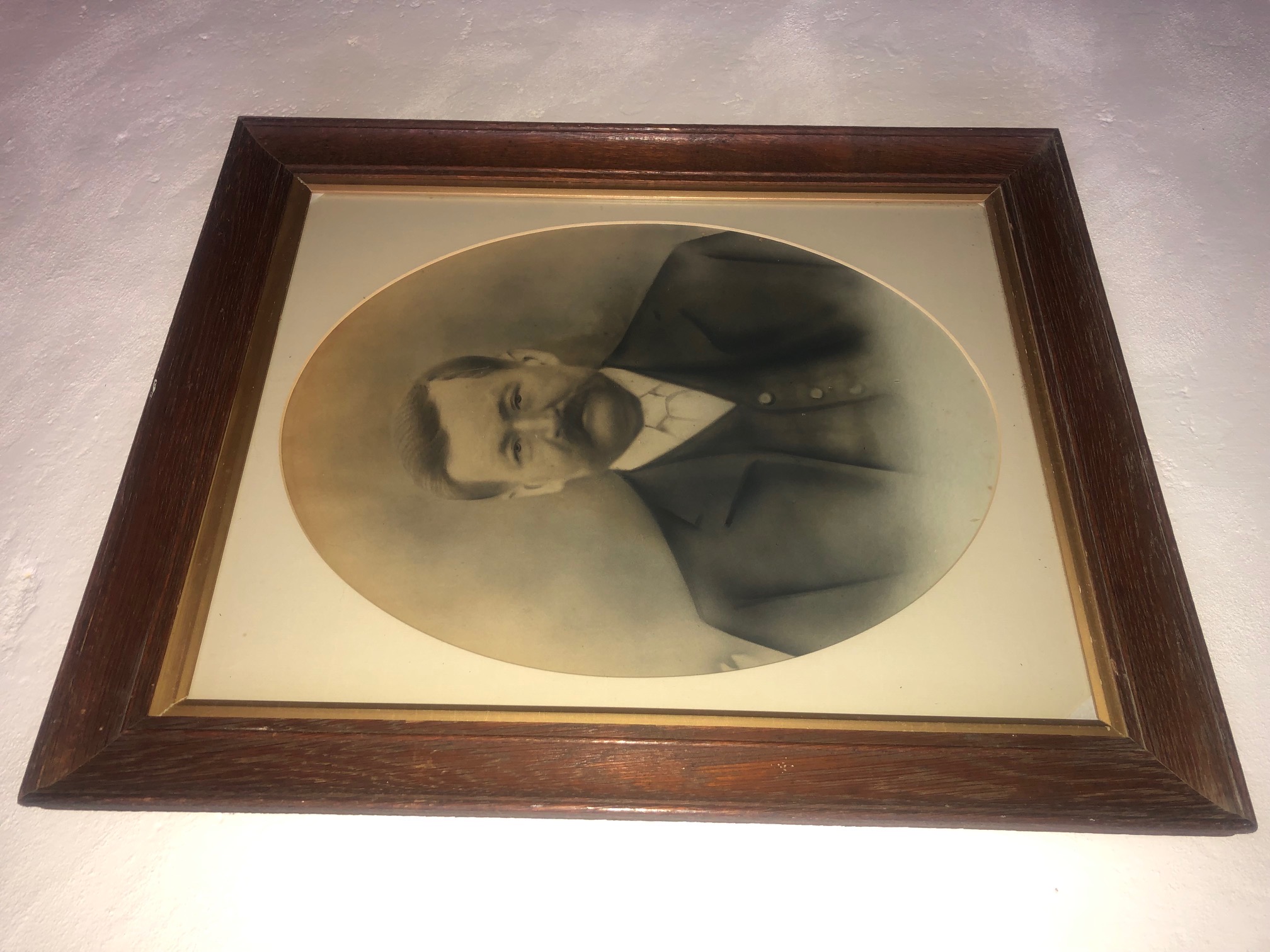
Here’s one example, and with a nod of thanks to Martyn Hayward, one of Sherborne’s diaspora. Martyn is rightly and admirably proud of his ancestors here in Sherborne and their role in this place. On his wall hangs this picture of Martyn’s great grandfather, Harry Taylor, a resident of Sherborne
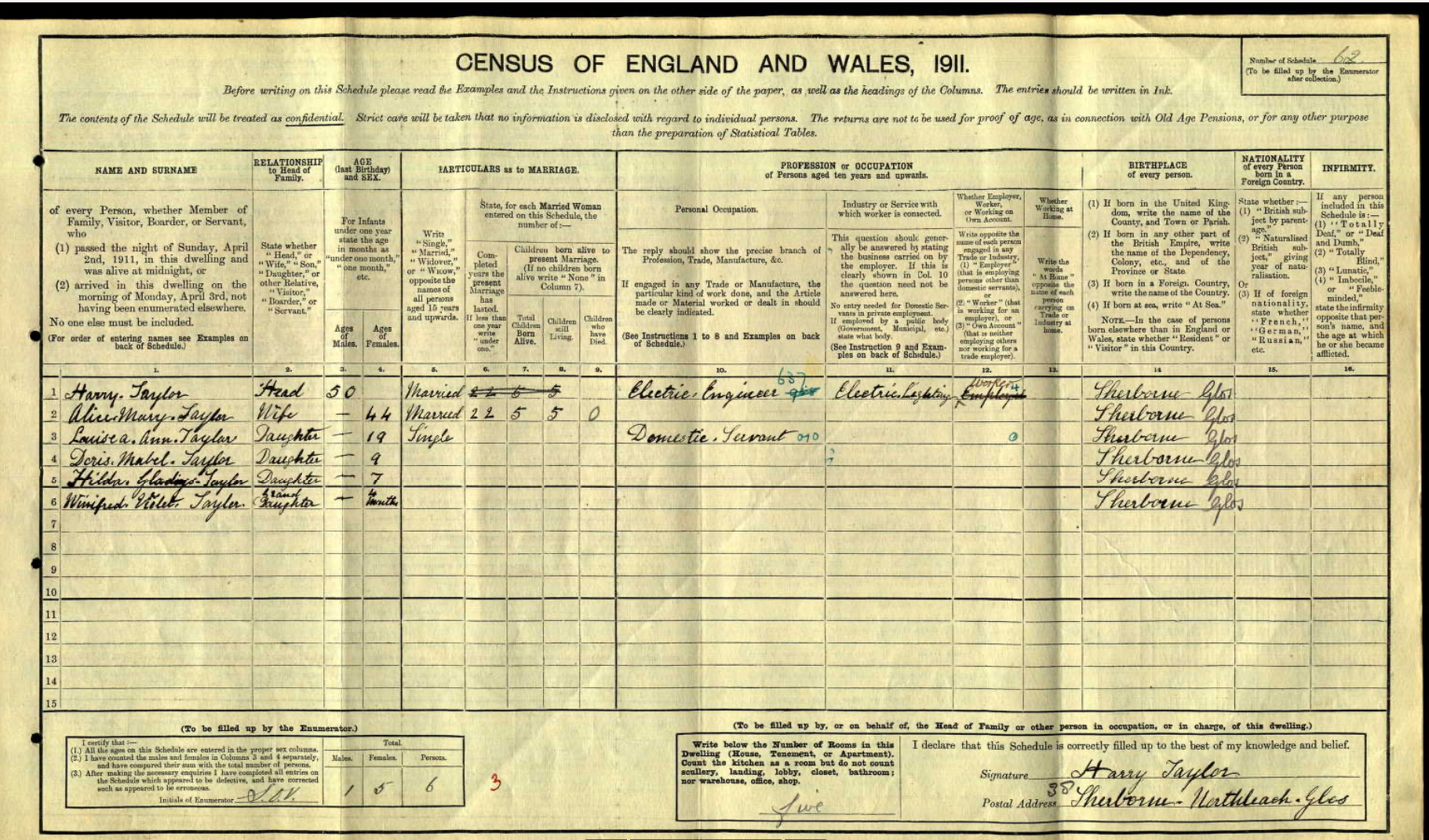
Now, Harry Taylor had a key role in Sherborne. One can see this from the census entry for him in 1911. Note his occupation as “Electrical Engineer”.
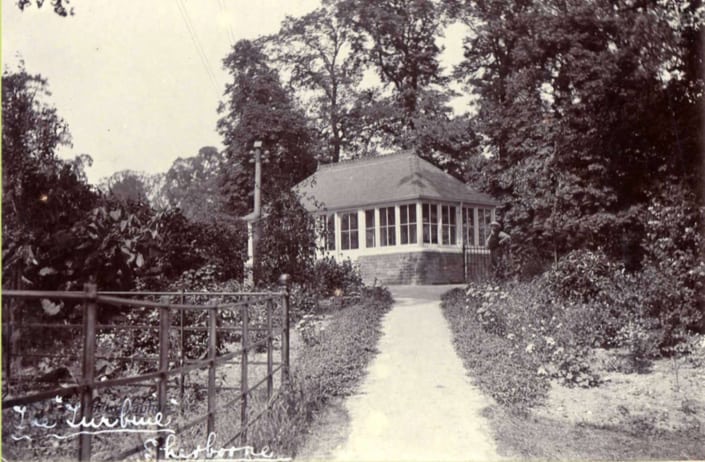
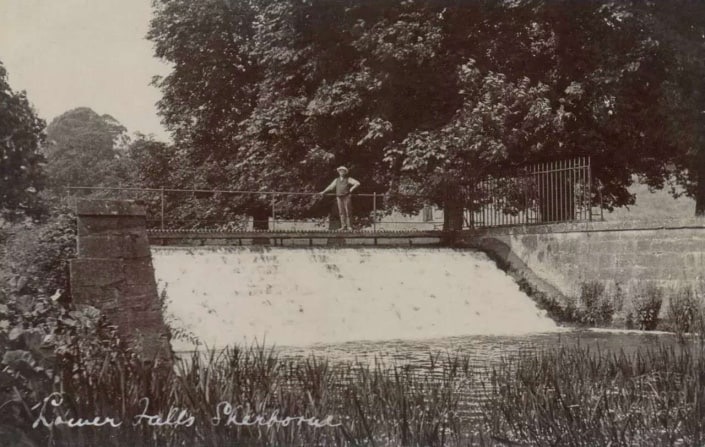
It was Harry who ran the turbine house, by the lower weir, and these two pictures below show him at work, if one looks carefully. One can sense, without too much imagination, the pride and self respect that Mr Taylor had in this important job. We all hope that this turbine house can be restored, it’s a fabulous spot.
But there are intensely personal and emotional sides to this real history, that Martyn has so kindly shared with me. If one looks at the census return, you will see Martyn’s grandmother, Louisa Ann, living with her father Harry, and mother Alice at No 38 Sherborne. Louisa Ann was born at Waterloo, opposite me. Also listed is Louisa Ann’s daughter, Winnie, aged 4 months. Tragically within a year, poor Winnie had died of measles.
Now there are similar stories, similar history and similar heritage at every house in the village. Stories of sadness, stories of happiness, pride and sorrow, routine and exceptions, woven, all connected with this place we live in and the people here before us. We should cherish this, I’m sure you agree. If you’d like help to find the historical census returns for your home in Sherborne let me know and I’d be pleased to help. There is remarkable detail to be derived from these bits of official history, now available on the web. Some of you will recall the deep dive on Mrs Cross, the last miller of Sherborne at Ducklestone Mill that we did last year, again driven by census returns. I’m so pleased that people like Martyn and also the Sherborne Archives are working hard to make sure these sorts of history are not lost. We can all help too, by encouraging the NT to preserve the Turbine House as part of our community’s heritage.
This is what makes Sherborne, and so this is what makes us a strong community. The ties that bind us together, forever, with more in common than our differences.
