Not Inigo Jones after all...
More understanding of Lodge Park
I’m very indebted to a subscriber to this substack who put me in touch with Dr Gordon Higgott, a leading architectural historian and expert on the designs of Inigo Jones. Dr Higgott was kind enough to consider my recent paper where I made a conjecture that Lodge Park Grandstand was not likely to have been designed by John Webb or Valentine Strong given its 400 year old age. I also highlighted weaknesses in any attribution to Balthazar Gerber and Nicholas Stone. My conjecture was that given the dates and what I understood of the design, it may have been designed by Inigo Jones and implemented by Isaac de Caus.
Dr Higgott has made an excellent refutation of my conjecture, which leads us to a much better understanding of some of the features in the building. I have his permission to relay his comments to you:
I was very interested to read the paper on the Lodge Park Grandstand, in which all the arguments are very clearly set out, and much new information is brought to bear on the problem of attributing this unusual building to a particular architect.
However, I am afraid I don’t agree with the arguments set out in the paper support of an attribution to Inigo Jones. My reasons are chiefly that the architectural details of the building are unlike Jones’s, and in many respects are far removed from what we would expect from Jones’s hand as a designer.
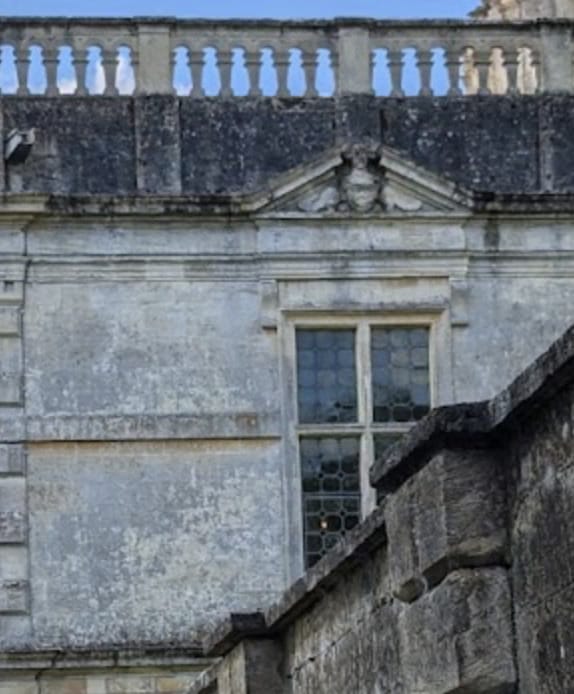
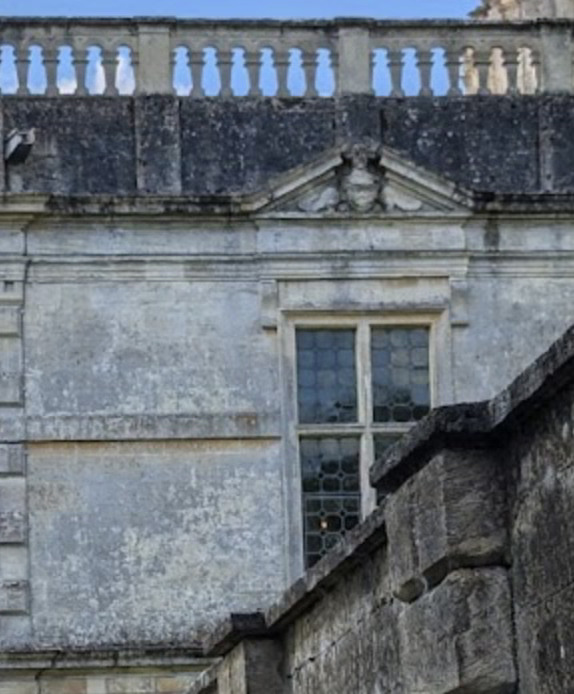
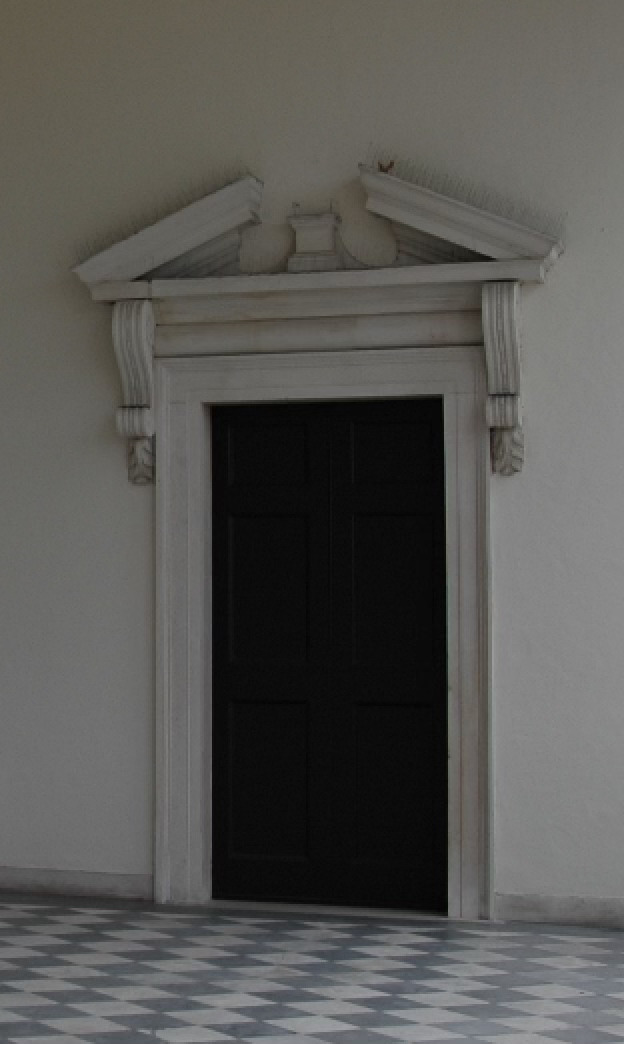
In particular: Jones would never have used broken pediments (or open-topped) on the exterior of a building, as this was a feature that Palladio specifically condemned in his chapter xx on ‘abuses’ in Book I of I quattro libri, and which Jones noted amongst comments he wrote on this chapter on 26 January 1615 (‘broken frontispices blamed’). Jones only used such open-topped pediments on the insides of buildings, as in the loggia and first-floor gallery at the Queen’s House, Greenwich. I attach a photo of the example in the loggia. Here you see another characteristic detail in a Jones building: the design of the console bracket. This was a feature Jones studied closely, from examples in Roman temples in Book IV of the Quattro libri, and others in his copy of Vignola’s Regole (Rome 1652, 1607), and Scamozzi’s L’Idea della architettura universale (Venice, 1615). He always set the scroll directly beneath the corona of the cornice, and the scroll embraced the whole height of the entablature and the architrave of the opening below. Compare his example at the Queen’s House with the small-scale, poorly detailed and misplaced scrolls on the exterior of the Lodge.
Likewise, Jones generally followed Palladio in proportioning his entablatures 4 : 3 : 5 for the architrave, frieze cornice. The Lodge has entablatures that are far removed from this classical precedent in proportion and detail. Also we find architraves elided and friezes made far too large.
On the exterior of the lodge the architect has run plat bands across in line with the transoms of the main windows. Again, this is far removed from Jones’s architectural language. Compare his design of 1616 for the entrance bay of a country house (RIBA Jones&Webb 1972. Fig. 72), where there are no plat bands in line with the transoms. Introducing plat bands at this point on a facade creates a false frieze at inappropriate points on the elevation — something we never find in the work of Jones.
Jones never designed arcades carried on round columns with channelled stonework. His preference was for piers with attached columns, whether rusticated or not. Again the precedents were in the work of Palladio (in Book I of the Quattro libri, illustrating examples of orders in arches). The Ionic capitals of the Lodge columns are shallow and poorly detailed. They could not have come from the hand of Inigo Jones.
As regards the gate piers at Sherborne Park which are attributed to Jones in the paper, these find no comparisons in attributed work by Inigo Jones. They are typical of gate piers of the 1660s designed by the likes of Edward Pearce junior (c.1630-1695). There is nothing like them in the 1620s-30s. It is not reasonable to describe the opinions of Lord Burlington and Henry Flitcroft on the work of Inigo Jones as ‘professional’. Burlington was an amateur architect whose knowledge of Jones’s work was affected by him not being aware of the difference between Jones’s drawings and those of his assistant John Webb. Flitcroft served as his draughtsman, copying drawings by Jones and Webb and measuring features at some of Jones’s buildings. They were not qualified to say what was, and what was not, a building by Jones.
The use of proportion in the building is interesting. However, I must point out that there is no evidence of Jones having knowledge of the Golden Section ratio or using it in any of his buildings, or in any of his drawings. The double-cube interior is certainly characteristic of his work, and a proportion he admired. But this proportion was one recommended by Vitruvius and Palladio. It is also found in the work of Serlio. So it was not unique to Jones at the period. Moreover, the first room proportion Palladio’s recommends in chapter xxiii of Book I of the Quattro libri is that the height of a room, from the floor to ceiling, should be equal to its width. Thus any room two squares long could become a double cube if this simple rule is followed.
So I am sorry to be negative. I do think the authorship of the building is worth exploring. Given that there is no documentary evidence of any kind to link Jones with the building, I think one needs to look elsewhere for a possible architect, and perhaps consider subordinate figures in the 1620s-30s period, like Isaac de Caus. The evidence of dendrochronology is clearly important for establishing the date range, and generally speaking the building does look to be from the 1620s-30s rather than the 1650s-60s.
For context here’s an image of an open topped pediment on the exterior of Lodge Park, which Dr Higgott believes would only be an interior feature in a Jones designed building. here the pediment is broken, somewhat crudely by a bust:
and here’s an interior broken pediment at Queen’s House, Greenwich, designed by Jones - much more sophisticated too:
So all this gives us a significantly better understanding of the architecture of Lodge Park Grandstand. Dr Higgott has also encouraged me to look closer at Isaac de Caus, whom I had suggested played a subsidiary role to Jones. Isaac de Caus worked with Inigo Jones on the Banqueting House in the early 1620s, and on Wilton House and Covent Garden in the 1630s. He was therefore familiar with Jones’s ideas, but perhaps not “expert” at replicating them. De Caus was also familiar with Serlio’s work from Fontainebleau in France, and Serlio, as Dr Higgott points out, also used double cube rooms. Perhaps Lodge Park grandstand was designed by Isaac de Caus, using a poor pastiche of what he imagined might be a Jones design.
There is something more too - Isaac de Caus laid our geometric garden features at Wilton, utilising his surveying skills and was an expert hydraulic engineer. I have detected what I believe to be a geometric layout in Lodge Park that lies hidden under Bridgeman’s later design. There is too, the rectangular “Canal” structure in Lodge park, which is not geometrically linked to Bridgeman’s design but is exactly perpendicular to 1620s features in the landscape. I think the association of this canal with Bridgeman is weak, for a variety of reasons. The valley bottom in Lodge Park also contains curious hydraulic engineering pumps and apparent conduits which, just maybe, have a connection with Isaac de Caus’s hydraulic engineering projects. I have a book he wrote a little later on hydraulic engineering which needs another look at. So my plan over the next few months is to survey the geometric framework at Lodge Park when it opens again to the public in the summer, then recast my paper to include that and see if Isaac de Caus comes out as a strong possibility. There is another interesting angle to pursue too. In 1622 Crump Dutton commissioned a “surveyor” to survey Sherborne Park around the village. Alas all but one annex is lost. But the annex in manuscript is in Gloucestershire archives. I wonder if it might be in the hand of De Caus? I can get a copy of his handwriting from elsewhere and compare. It’s a long shot but it also helps explain the curious geometry of Sherborne Park which I am currently surveying, and the dates sort of fit.
Either way, the 400th anniversary of this (pre-1634) building is fast approaching and it would be good to get to the bottom of it. A good part of my previous paper, specifically the criticism of the Webb, Strong, Stone and Gerbier attributions, I think still stands. And in any event, and most importantly, thanks to Dr Higgott we have a much more detailed critical understanding of some of its features. I can see, now, some of the crudeness of these features which seems implicit in rejecting Jones as the architect. Amateur observations such as mine are always better when leavened with expert opinion, and I welcome such engagement.
Your comments and encouragement are welcome, as usual.
