Reconsidering the Attribution of Lodge Park Grandstand: A Case for Inigo Jones
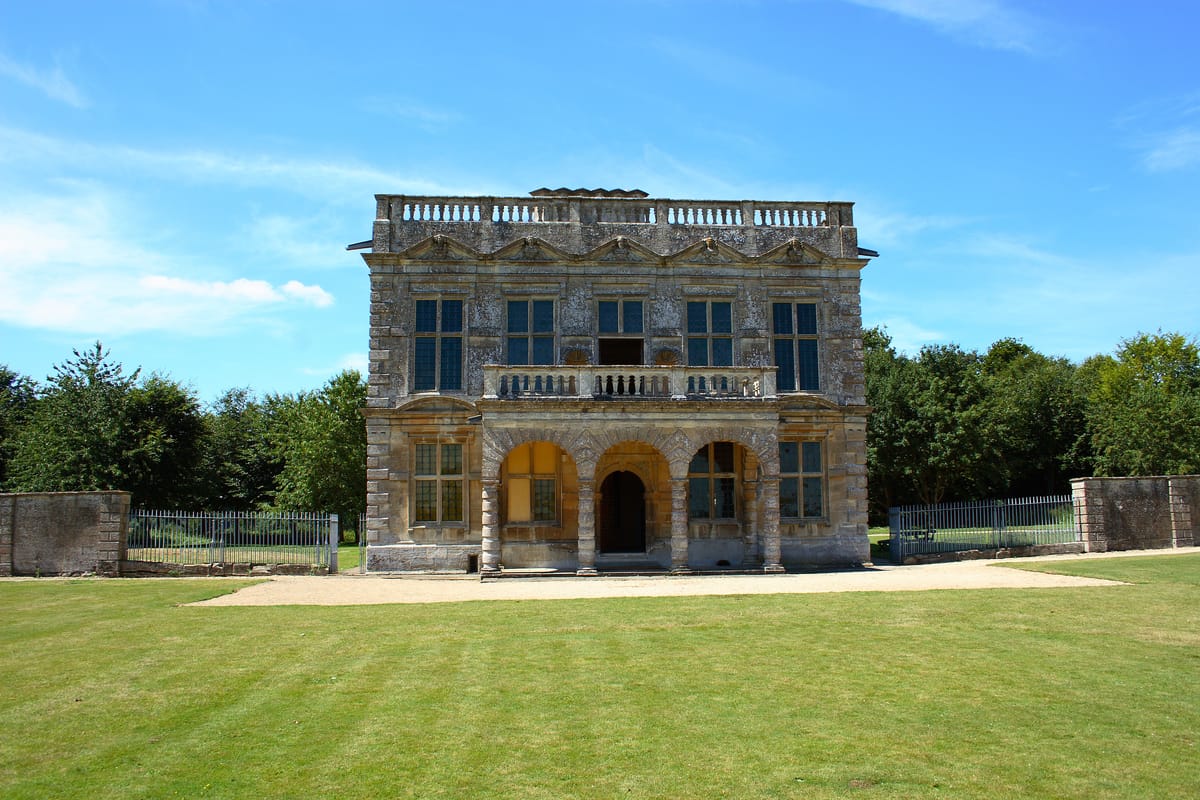
Abstract
The attribution of Lodge Park's grandstand in Sherborne has been increasingly questioned in recent decades, with scholars proposing alternative architects including John Webb, Balthazar Gerbier, Valentine Strong, Nicholas Stone, and Salomon de Caus. This article re-examines the evidence and argues that the traditional attribution to Inigo Jones remains compelling, particularly when considered within the Vitruvian principles that guided Jones's architectural philosophy, and in the context of the recent uncovering of Vitruvian proportions to the Lodge Park parkland,. Notable architectural historian Clive Aslet is unsure - at one point dismissing it but elsewhere suggesting a Jones attribution is still worthy of consideration. In particular, careful analysis of chronology highlights some curious anomalies in alternative suggestions.
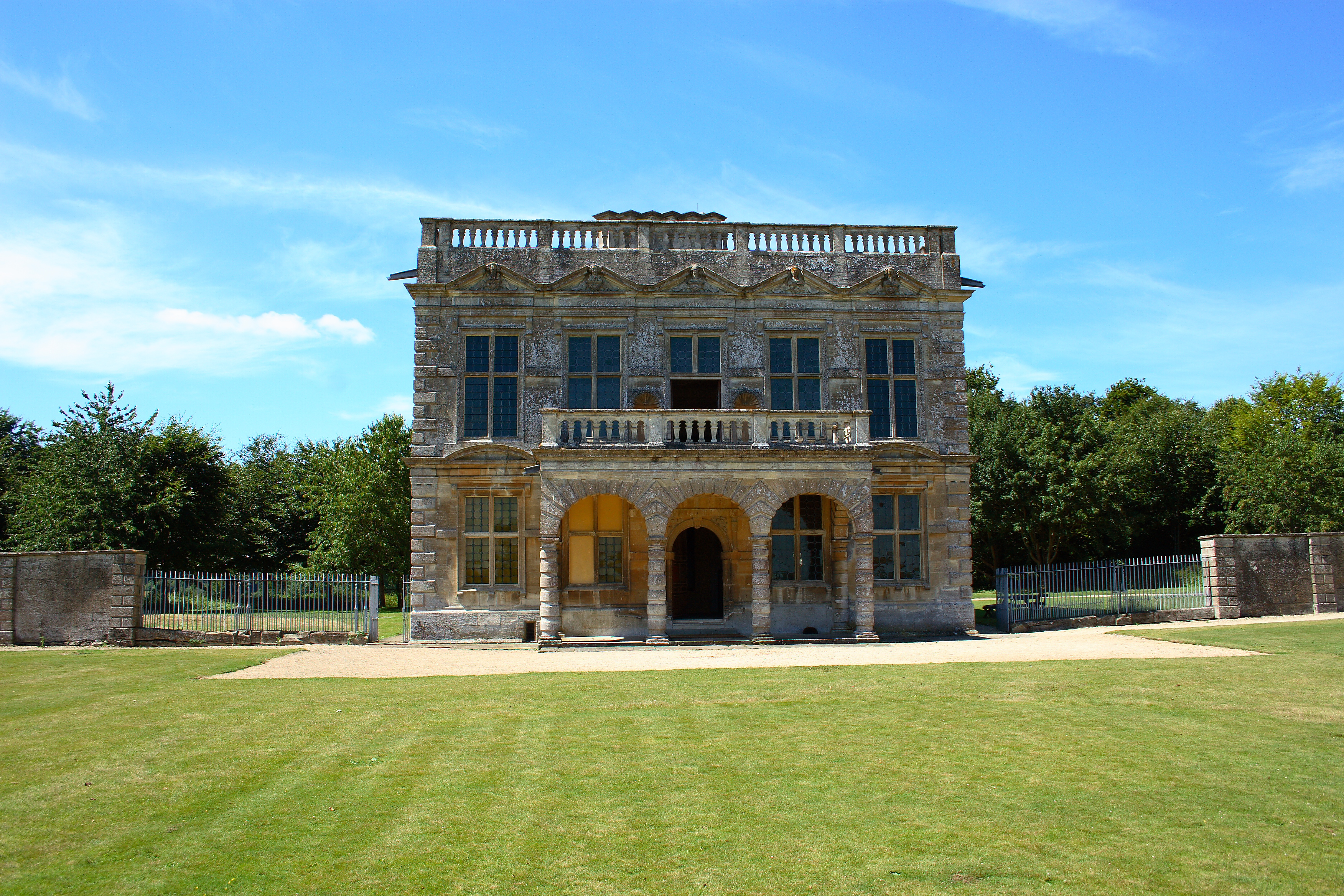
Image: Creative Commons: commons/wikimedia.org/wiki/File:Lodge_Park.jpg
Introduction
For centuries, the distinctive grandstand at Lodge Park was confidently attributed to Inigo Jones, England's pioneering classical architect. However, this attribution has come under sustained challenge since the mid-twentieth century, with various alternative candidates proposed by architectural historians. Recent archival research, including examination of the Dutton memoirs held in the Sherborne Archives, provides an opportunity to reassess this debate with fresh evidence and perspective.
Historical Context and Dating
Lodge Park's grandstand was constructed probably between about 1625 and 1633, predating the main Sherborne House by two decades. The construction date of 1634 as given by many sources, appears to have been casually derived from a manuscript by a Lt Hammond, describing a visit to the grandstand and deer course at that date. But the document only shows that the grandstand existed in 1634. It could have been constructed a decade earlier. The building was commissioned by "Crump" Dutton, who inherited the estate in 1618 and was among England's wealthiest commoners, though not ennobled. The structure served as a gambling lodge and viewing pavilion for deer coursing, representing a specialized building type that combined entertainment and sporting functions.
The grandstand exhibits several distinctive architectural features: Palladian styling, a rare double cube room, and proportions that suggest sophisticated understanding of classical architectural theory. Despite subsequent modifications, enough of the original fabric survives to analyse the architect's intentions.
Alternative Attributions Examined
John Webb (1611-1693)
The Images of England series attributes the design to Webb, Jones's assistant and eventual successor. However, chronological analysis reveals significant problems with this attribution. Webb was born in 1611 and apprenticed to Jones in 1628 at the age of seventeen. During Lodge Park's construction period (1625-1633), Webb would have been fourteen to twenty-two years old—far too young and inexperienced to undertake such a sophisticated commission for England's wealthiest commoner. Webb's documented independent work began only in the 1650s after two decades of apprenticeship to Jones, well after Lodge Park's completion.
Balthazar Gerbier (1592-1663)
Historic England has suggested Gerbier as a possible architect and Aslet too makes him a possibility. While Gerbier was active in the relevant period, several factors argue against his involvement. First, his architectural style did not embrace Vitruvian and Palladian principles—indeed, he later published works diminishing their importance. Second, he had not completed any independent buildings by the early 1630s. Third, his diplomatic mission to Spain (1631-1641) would have precluded involvement during some of the relevant construction period.
Valentine Strong (1609-1662) and Timothy Strong
Historic England also proposes the Strong family, local masons and builders. Valentine Strong, born in 1609, would have been barely twenty during construction—again, implausibly young for such a commission. His father Timothy's earliest documented work dates to 1632-1633 at Cornbury House, where he executed specific elements (fireplace surrounds and porticos) to Nicholas Stone's designs rather than functioning as an architect. The Strongs were skilled craftsmen, and did design and build houses later, but the evidence suggests they worked as builders rather than designers during this period, and none of their known buildings displays the characteristics seen here.
Nicholas Stone (1587-1647)
Perhaps the most credible alternative attribution comes from distinguished scholars including Sir Howard Colvin, Mark Girouard, and John Harris, who have proposed Nicholas Stone as a possibility for Lodge Park's architect, as has RIBA. Stone was Master Mason to the Crown from 1632, collaborated closely with Jones on major projects including the Banqueting House, and was active during Lodge Park's construction period.
However, Stone's meticulous account books and notebooks, which survive intact, contain no reference to Lodge Park, Sherborne, or Dutton—a surprising omission for such a significant commission. Moreover, during the relevant period (mid-1620s to 1634), Stone's documented work focused on interior features, facades, fireplaces, and porticos rather than complete buildings.
Salomon de Caus (1576-1626)
Several scholars, including Roy Strong, David Jacques, and Timothy Mowl, have suggested Salomon de Caus based on stylistic similarities and his expertise in hydraulics, geometry, and Vitruvian principles. De Caus's mathematical approach to design and experience with water features might explain Lodge Park's sophisticated geometry and the presence of its distinctive canal system.
However, de Caus returned to France in 1620 and died in 1626, creating chronological difficulties with a structure built between 1625 and 1634. While his brother Isaac continued working in England, there is no evidence linking either brother to Lodge Park.
The Case for Inigo Jones Reconsidered
Documentary Evidence and Contemporary Recognition
Critics of the Jones attribution often cite the lack of documentary evidence. However, this argument cuts both ways: no documentary evidence supports any alternative attribution either. The survival of architectural records from this period is notoriously patchy, and the absence of documentation cannot be taken as proof of non-involvement.
Significantly, William Kent, who undertook work for the Duttons in the 1720s, evidently considered Lodge Park to be the work of Inigo Jones at that time. Working for Lord Burlington, Kent produced a book featuring drawings by Burlington's in-house architect Henry Flitcroft of various works by Inigo Jones. It includes a drawing of Lodge Park. This early eighteenth-century recognition, predating later scholarly doubts, carries some weight as it reflects contemporary professional opinion in the 1720s.
Architectural Analysis
The grandstand exhibits several features strongly associated with Jones:
Double Cube Proportions: The building contains a double cube room, a sophisticated spatial arrangement that Jones favoured and employed in other works. This proportional system, derived from Palladian theory, was virtually unknown among other English architects of the period, with Jones being the very man who introduced it. I can find only two other buildings in England with double cube rooms built before the mid 17th C - Wilton House and the Whitehall Banqueting House, both of them Jones designs. The third is the lodge at Sherborne.
Palladian Influence: The building's classical vocabulary closely follows Palladian principles, which Jones pioneered in England following his Italian travels and study of Palladio's treatise.
Golden Ratio Proportions: Analysis of the interior walls reveals the use of golden ratio proportions, consistent with Jones's documented interest in mathematical harmony in architecture.
Aslet’s criticism is that the design is too “fussy” in places with proportions of some detailing not quite right. Perhaps this just demonstrates a lack of attention to detail for reasons lost in time, with local builders ‘“filling the gaps” in a design without detail, or a client, Crump Dutton, adding some amateur flourishes to a design by Jones.
Jones's Architectural Philosophy and Vitruvian Fitness
A crucial piece of evidence emerges from Jones's personal copy of Palladio's I Quattro Libri Dell'Architettura, held in Worcester College, Oxford. In Book II, Chapter 1, Palladio discusses the appropriate design of buildings relative to their owners' social status. Jones annotated this passage in his own hand: "Loges and large halls in great me(n)s houses, for meaner Gentlemen lesser houses."
This annotation illuminates Jones's thinking about architectural decorum. While Crump Dutton was exceptionally wealthy, he was not nobility. Lodge Park's relatively modest scale and ornament may reflect Jones's deliberate application of Vitruvian principles of fitness (utilitas)—the building was designed appropriate to its owner's social status and its specific function as a sporting lodge rather than a palatial residence.
Critics who dismiss the Jones attribution often argue that Lodge Park lacks the grandeur of the Banqueting House or Queen's House. However, this comparison misunderstands Vitruvian architectural theory, which Jones explicitly embraced. The building's apparent modesty may be evidence of Jones's sophisticated understanding of architectural decorum rather than grounds for rejecting his involvement.
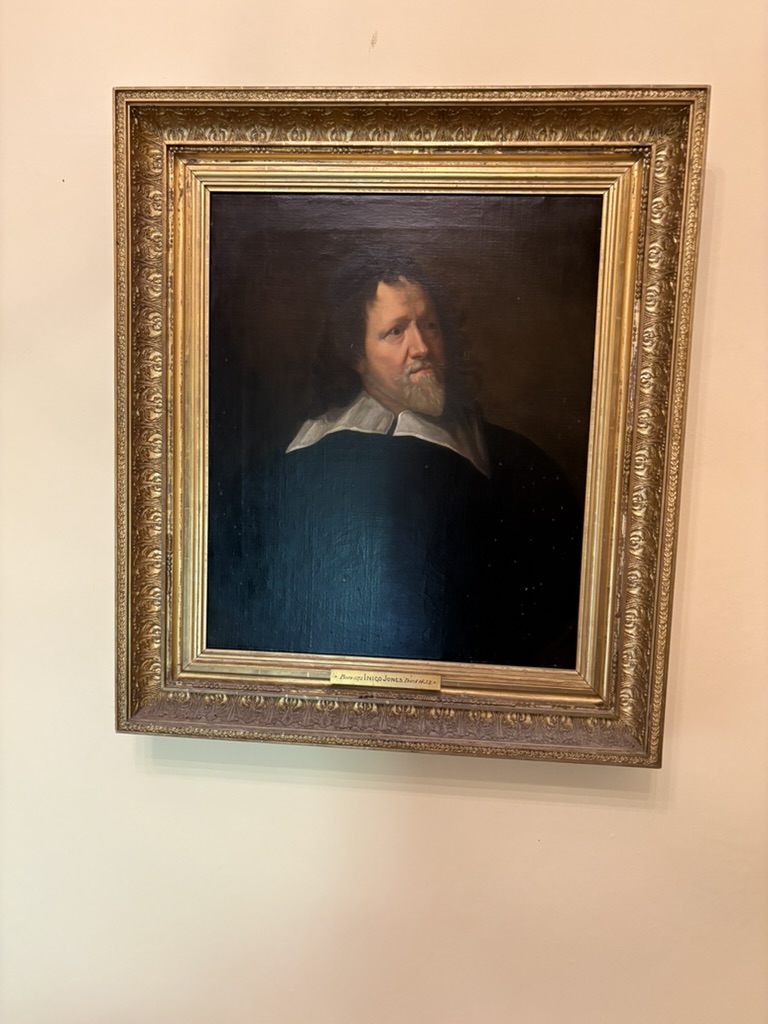
Inigo Jones’s portrait in Lodge Park - estate accounts from the 18th C record the brass plaque beneath it being purchased.
Broader Estate Context
The case for Jones's involvement extends beyond the grandstand itself. Recent analysis, not available at the time of all other assessments, has identified clear Vitruvian proportions throughout the Sherborne estate, apparently laid out contemporaneously to the building of the Lodge Park grandstand. No other English architect of this period employed Vitruvian proportional systems with comparable sophistication or consistency, if at all, at this time in history. The Dutton memoirs on loan to me from the Sherborne Archives also suggest Jones’s hand in the layout of the plantations in Lodge Park was considered in the 19th C, which intriguingly matches my own recent work establishing the Vitruvian proportions of Lodge Park. What other architect was laying out parkland in Vitruvian proportions in the 1620s -1630s? I cannot find one.
Furthermore, gates visible in Johannes Kip's 1709-1710 drawing of Sherborne House display unmistakably Jonesian design characteristics. This too was not noticed by architectural experts making alternative attributions. This drawing suggests the Jones gates predate the Palladian revival of the 1720s and 1730s by decades, suggesting the presence of authentic Jones designs on the estate from the seventeenth century.
Historical Parallels and Context
An intriguing parallel emerges with Jones's work at Greenwich. In 1616, Jones was commissioned to design a grandstand for Queen Anne of Denmark to overlook the deer park at Greenwich. Construction began but ceased in 1619 upon the Queen's death, with the building only half-completed. When work resumed in 1632, for a very different Queen, the design evolved into the Queen's House as we know it—a very different, more palatial structure.
The Lodge Park grandstand, built perhaps in the 1620s as a viewing pavilion for deer coursing, represents precisely the same building type and chronological context as Jones's original Greenwich commission. Given Dutton's status as England's wealthiest commoner, it would be entirely logical for him to have engaged the same architect who had recently designed a similar structure for royalty.
The position of Queens House in the Greenwich landscape - with apparent Vitruvian proportions there too, also parallels Lodge Park, not only proportionally but at exactly the same scale - 880 yards across. That’s got to be a remarkable coincidence if it was not Jones himself in both places.
Stylistic Precedents
Jones designed various building types throughout his career, including churches with minimal ornament and utilitarian estate buildings. The expectation that all his works should match the grandeur and perfection of his royal commissions perhaps reflects a misunderstanding or mis-assessment of his varied practice and theoretical commitments to Vitruvian appropriateness.
Conclusion
While absolute certainty remains elusive given the documentary limitations, the balance of evidence, including recent discoveries, in my admittedly amateur opinion, favours Inigo Jones as Lodge Park's architect. The alternative attributions, when subjected to careful chronological and stylistic analysis, present significant difficulties. The building's sophisticated proportional systems, albeit a little lost in some details, the Palladian vocabulary, its chronology and apparent application of Vitruvian principles in context, all point toward Jones's involvement. He was nicknamed “Vitruvius Britannicus” after all.
The convergence of multiple factors—the building's overall architectural sophistication, its contextual relationship to other probable Jones work on the estate, professional recognition by William Kent within a century, and the compelling parallel with the Greenwich commission—creates a cumulative case that transcends any single piece of evidence and perhaps overcomes Aslet’s concern about certain stylistic detail.
Perhaps most significantly, Jones's own marginal annotation in his Palladio reveals his thinking about architectural appropriateness in ways that directly illuminate Lodge Park's design choices. Rather than seeing the building's relative modesty and provincialism as evidence against Jones's involvement, we might understand it as evidence of his sophisticated application of classical architectural theory.
The traditional attribution to Inigo Jones, while requiring further documentary support, remains the most compelling explanation for Lodge Park's distinctive architectural character perhaps even because the other candidates seem so weak. Future research might profitably focus on uncovering additional archival evidence, or comparisons between the parkland layout at Greenwich and Lodge Park.
I gratefully acknowledge the assistance of the Sherborne Archives in providing access to the Dutton memoirs and related materials.
