Sewage release - an ongoing concern
Bourton-on-the-Water: 42 Days of Sewage Discharge into the Windrush
Some of you will have seen the recent Channel 4 dramatisation "Dirty Business" of the campaign against sewage pollution in the River Windrush. If you haven't, I'll put a link below. Ashley Smith and Peter Hammond have done remarkable work over the past few years in bringing this problem to national attention. The Channel 4 dramatisation explains it beautifully. I strongly recommend watching it.
That campaign, roughly five or six years ago, prompted Thames Water to produce a plan for addressing sewage overflow from Bourton-on-the-Water sewage treatment works. This matters directly to Sherborne, because our village sewage is pumped to Bourton for treatment before any discharge reaches the Windrush. It's all about our shit.
The Thames Water plan is publicly available — I'll link to it below. In my view, it is a poor document. Recent events have sharpened that concern considerably.
What has been happening since 20 January?
Yes, January and February were wet. But what has happened at Bourton goes well beyond a seasonal weather story.
The Bourton sewage treatment works began discharging storm overflow into the River Windrush at 7am on 20 January. It has not stopped since. It's still going today. As of this morning, that is 42 consecutive days — over 1,014 hours of continuous discharge into an important and beautiful river that runs through the heart of the Cotswolds, and runs alongside our parish. This is happening despite several million pounds of investment in the site over the past five years. This is personal - talk to Peter Summers about the his trout fishing a couple of decades ago - talk to Brian Agg who as a boy knew where the freshwater mussels could be found in the once idyllic stretch between Sherborne and Great Rissington.
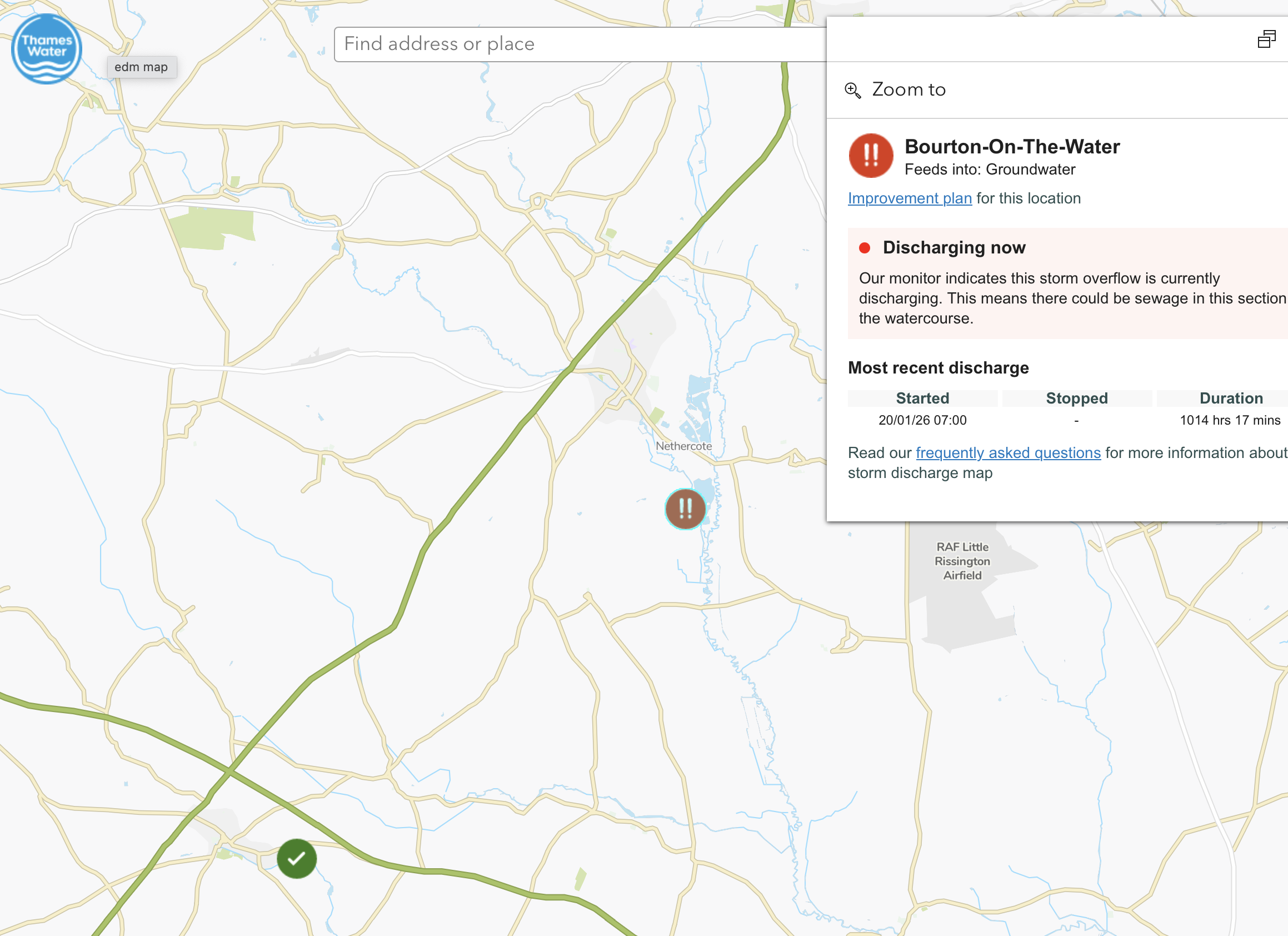
You can view Thames Water's live storm overflow map at the link below. It tells you that a discharge is occurring. But it tells you nothing else.
Why the data Thames Water provides is almost useless
Storm discharge from a sewage works is not pure sewage. What is happening at Bourton is that groundwater is leaking into the sewage network through cracked pipes and manhole covers, swamping the system. The overflow into the Windrush is a mixture of sewage and groundwater. For the past five years Thames Water have been lining pipes and sealing manholes to reduce that leakage. Yet here we are: 1,007 hours and counting. Several km of pipes have been lined. Dozens of manholes sealed - yet probably (my estimate) 100 litres a second of discharge pours into the Windrush. Think of the number that 100 litres a second becomes over 42 days and counting.
Here is something counterintuitive but important. When large volumes of groundwater flood into the sewage system, the sewage itself becomes heavily diluted. A highly diluted discharge may cause less ecological harm than a smaller but more concentrated one. At this time of year, with the river running high and cold, even a diluted discharge may be less damaging than it would be in spring or summer.
But we simply do not know. Thames Water will tell us a discharge is occurring. They will not tell us the volume. They will not tell us the concentration. They will not tell us the ratio of sewage to groundwater. They must hold this data — their own management plan describes a network of flow monitors and sewer depth sensors across Bourton. Yet none of that translates into anything the public can use to assess the actual harm being done to the Windrush.
I find that very hard to justify. Surely if you are going to tell people that untreated sewage is entering a river, you have an obligation to tell them how much.
Why the plan itself is the problem
Thames Water's management plan for Bourton was written in January 2021. It has been added to annually since, but each update adds tables of activities and graphs that are, frankly, difficult to interpret and tell us little about whether anything has actually improved. It is virtually impossible to compare one year with another. Last year's update on the Bourton Sewage Treatment Works, rather bizarrely included plans for numerous other sewage treatment plans - that's just sloppy management and suggests the TW team are amateur and "out of their depth" or couldn't be bothered to extract the detail for Bourton and our pooh.
The original plan promised the major upgrade to the treatment works would be complete by March 2023. It was not. The target date has quietly moved to summer 2026 — three years late — without the plan being rewritten to reflect this. Clear, consistent completion dates? I cannot find them. If you can, you are sharper-eyed than I am.
Most tellingly, the plan contains no outcome targets. It records what Thames Water have done — metres of pipe lined, surveys completed — but never what improvement those activities were supposed to achieve or whether they have achieved it. Any vague targets are ill-defined and subject to funding being found. A plan with no measurable outcomes cannot fail on its own terms. It simply continues.
Forty-two days of continuous discharge, five years into a remediation programme, is not a plan working as intended.
What the Sherborne Brook Support Group will do
The Brook Group is a member of the Windrush Catchment Partnership — a formal body that includes Thames Water, the Environment Agency, and other significant organisations with a stake in the health of the Windrush catchment. The Partnership meets in March.
Bourton's sewage discharge is almost certainly the Partnership's most pressing concern. I intend to bring this directly to that meeting, and to propose two specific actions.
First, that the Partnership formally asks Thames Water to provide monthly discharge data — volume, duration, and concentration — so we are not waiting a year or more for annual returns that tell us very little. Waiting for the next EDM annual return is not good enough when 1,007 hours of discharge has just happened in real time. It's happening today. If we sit on our hands Thames Water will tell us not very much about it in 18 months time. That's unacceptable.
Second, that the Partnership asks Thames Water to acknowledge that their current plan is not delivering and to commit to a revised programme with clear, measurable targets. If we do not push for this collectively, Thames Water will reasonably conclude the current approach is acceptable. It is not.
I will also be meeting Peter Hammond from WASP in the coming weeks to discuss the technical picture in more detail, and I hope to coordinate with the Partnership coordinator ahead of the 28 March Catchment Partnership meeting. This March meeting actually is scheduled to take place in Sherborne and I'd welcome a group member to attend in support with me. One of the other matters on the agenda is wetland creation down beside the Windrush - one wonders what the impact of 1000 hours of sewage storm discharge into this wetland would cause.
I will keep you informed as this develops. In the meantime, watch the BBC film. And take a look at the Thames Water plan. You tell me whether you think it is good enough. Remember this is our sewage we are talking about. We can't just flush it away.
Links: Channel 4 dramatisation
Thames Water storm overflow map.(Click on the map at the symbol at Bourton)
Thames Water Bourton management plan
This post is on "Ghost" which we are migrating to from Substack. Let me know if it works for you.
