Sherborne's Son, murdered in 1943.
The tragic story of John Houlton.
I seem to increasingly be writing about the heritage of Sherborne. Heritage is not just about the structures and landscape. It’s also about the people of Sherborne. This post is about a single person from Sherborne’s history. It’s the sad and dreadful story, over 80 years old but perhaps a cornerstone of why we should cherish our heritage.
Born in 1919, John Houlton was brought up in Mill Hill Farm, right by the crossroads. His father was a tenant farmer on the Sherborne Estate. John attended the village school and then schooled in Northleach. I imagine this young boy cycling through the village without a care in the world.
A bright young man, he went to Bristol University as war clouds gathered, and on graduation, with war underway, joined the Army, as a young officer in the artillery.
His first posting was to Rangoon in Burma, to an anti-aircraft regiment. Almost immediately after arriving in Rangoon, he was sent to Singapore to undergo specialist training, attached to an anti-aircraft unit based there.
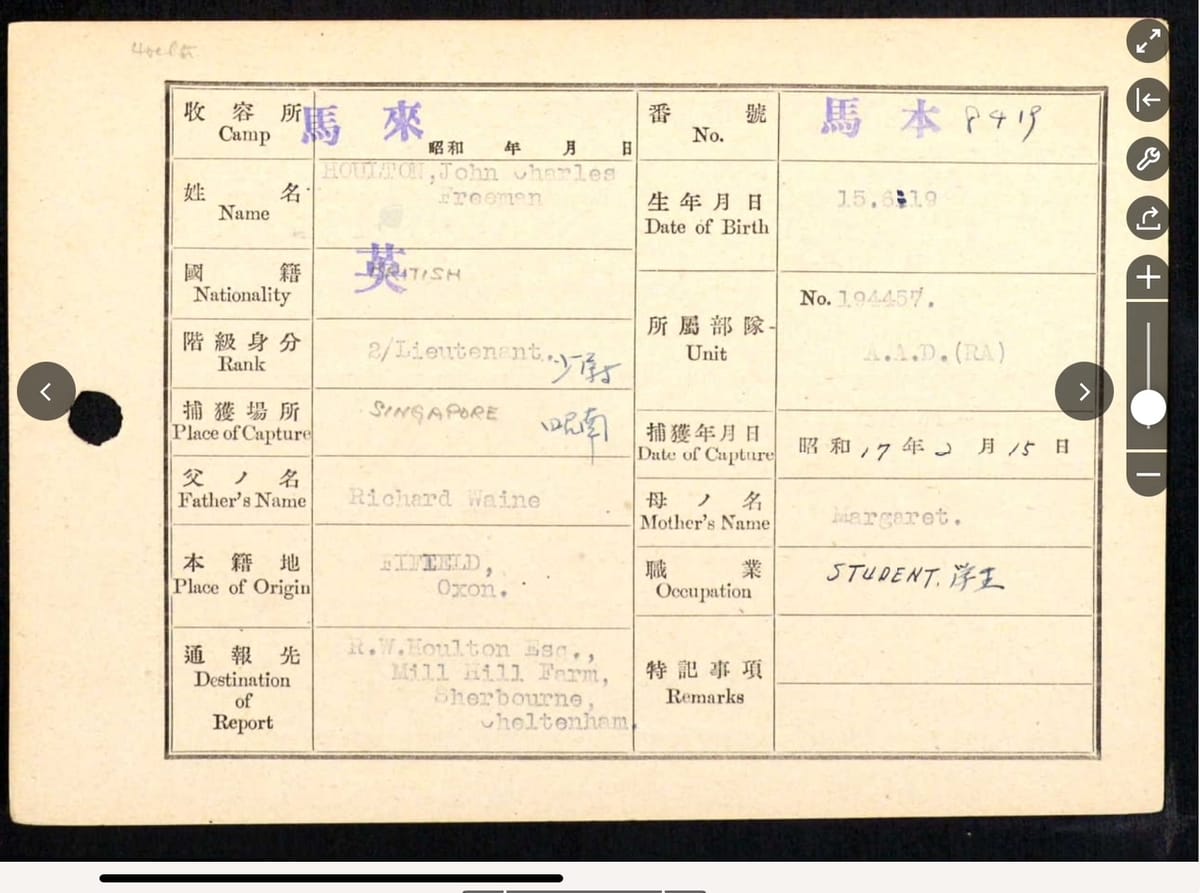
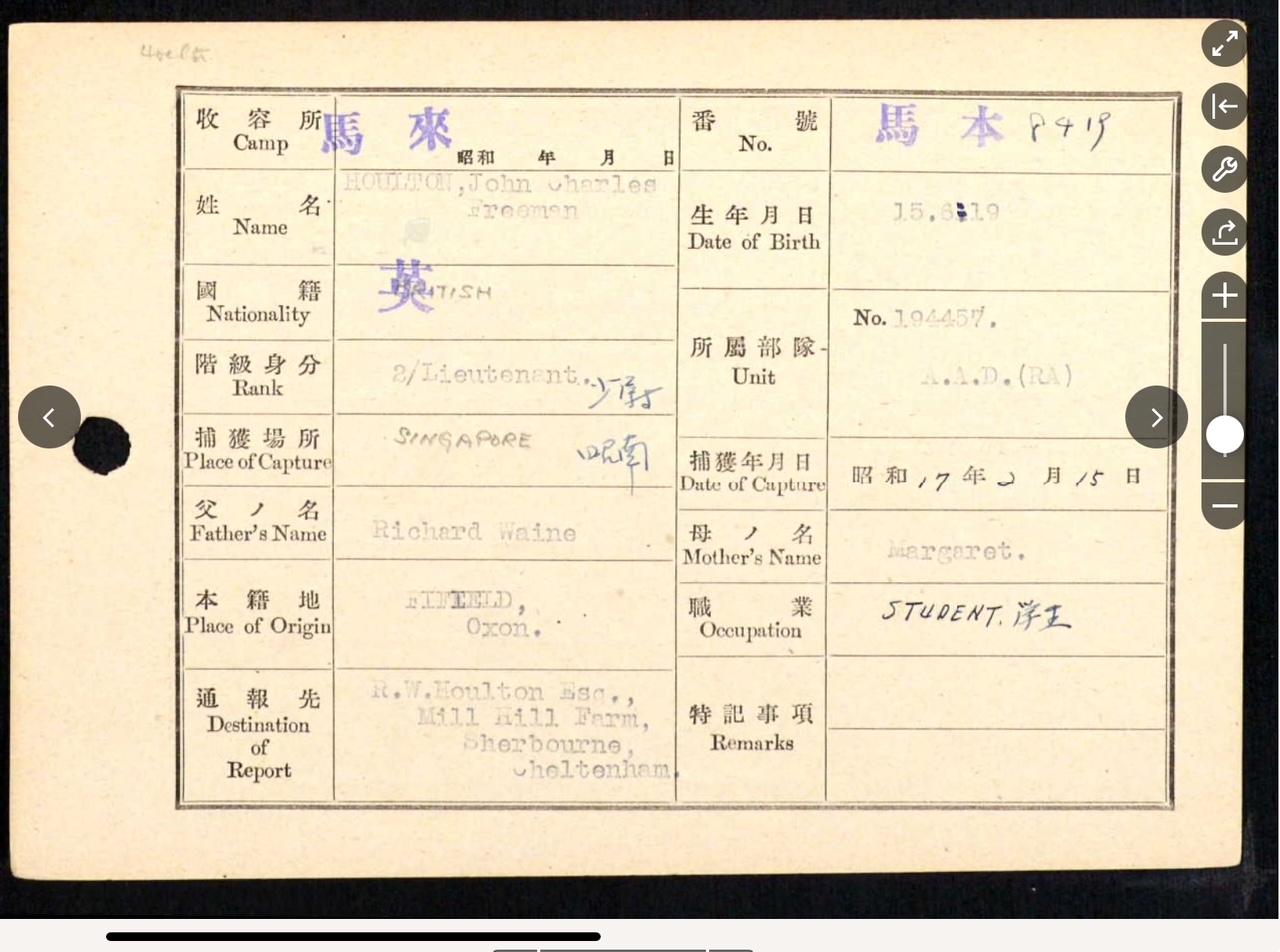
Just as he arrived the Japanese invaded the Malay Peninsula and days later Singapore surrendered, our young Lt John Houlton among them. Imagine the thoughts of his parents here in Sherborne. Here’s the report his parents received from the Japanese authorities (found in an online search) :
John Houlton was incarcerated for many months in Changi, in appalling conditions. Then one day in October 1942, 600 artillerymen, including John were loaded into the hold of what became known as a hell ship, a former coal ship. 400 men went in one hold, 200 in the smaller aft hold. Many collapsed after the 15 mile march, given their ill health. They laid there, side by side in the bottom of the hold. They probably thought they were being shipped to a POW prison in Japan. After a few days the ship docked in Rabaul, a remote part of New Britain, an obscure corner of the Pacific. After some time 519, including John Houlton, were reboarded onto another hell ship and they set out to sea again. The 81 left behind were too ill to be useful to the Japanese. A small handful of the 81 survived the war.
Some days later the ship came to the remote island of Balalae in the Solomon Islands. 519 artillerymen got off the ship and were lined up on the beach. None of them were to survive. An officer (possibly John Houlton) was brought to the front, forced to kneel and beheaded, as an example to the others, who were put to work building an airfield. Reports are sketchy and gathered from one or two Chinese slaves who survived. The artillerymen were kept separate and worked until they dropped. After the war, one of the Chinese slaves reported an appalling act of torture on another artillery officer, too gruesome for me to repeat here. Sickening. When the airfield was bombed (repeatedly) by US bombers, the POWs were forbidden to take cover, but lay in the open.
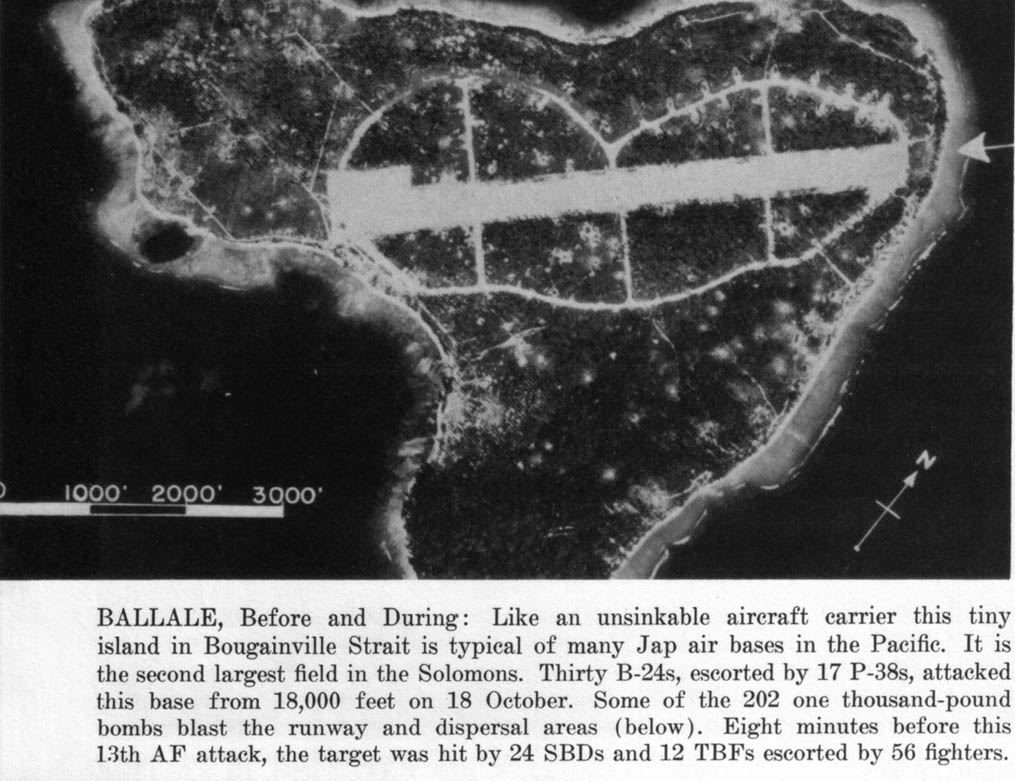
The conditions were horrific, and many men died from disease, malnutrition, and exhaustion, as well as Allied bombing.
In the summer of 1943, the airfield was completed. The surviving soldiers, possibly still including John Houlton, were lined up, bayoneted and buried in a mass grave. It makes me weep to write that.
After the war ended the Japanese obfuscated and claimed the artillerymen were passengers on a ship sunk by allied bombing on a ship. But the grave was uncovered by Australian Forces in 1946, with the dog tags still with the remains. The bodies were exhumed and reburied in a mass grave in Bomana Commonwealth War Cemetery, Port Moresby, Papua New Guinea. John Houlton’s body never returned. Sherborne never got back its son, and Mr and Mrs Houlton lost their most precious love. Think of them.
No Japanese personnel were brought to justice. But be in no doubt this was murder. I have no picture to share of John Houlton and that saddens us further.
John Houlton’s name is recorded on the side of the Sherborne war memorial as “John Charles Freeman Houlton”. It is a further tragedy that John was named after Charles Freeman, his uncle, also recorded on the village war memorial after dying of his wounds in Gallipoli in 1915, some four years before John was born. Charles Stow Freeman was I think John’s mother’s brother. What a price that family paid in successive world wars!
On Sunday, 9 November at 3pm, Sherborne villagers will gather at our village War Memorial to remember the sacrifice of the war dead. All the others were killed in action or died of their wounds. John Houlton is the exception, being murdered, but every one deserves our remembrance. We owe it, as Sherborne villagers, to turn up and bow our heads to recall these young men, and their loss, to their family, the local community and the world. Sherborne’s heritage has pain and tears and well as joy. We must endure the former to appreciate better the latter. I’ll see you there.
