Sherborne's Time Machine
The clock ticks backwards..
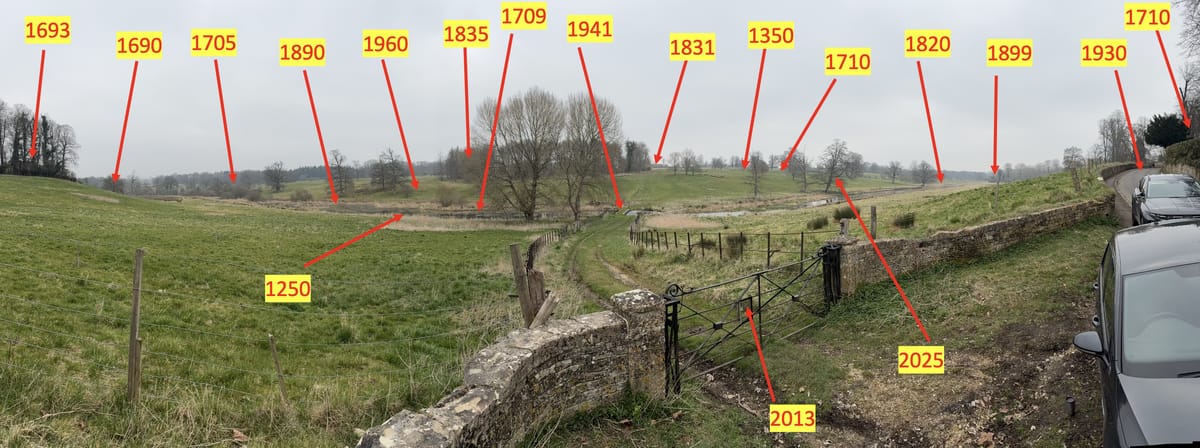
You may not be aware of it, but we, the community of Sherborne, have in our possession a genuine time machine. This Sherborne Time Machine sits in the centre of the village and is free to use. I'm going to show you how to use this time machine and, at the end, explain the reason for this journey.
In the middle of the village, as the road dips below the bank beneath Sherborne House, stands a gate that leads from the road down to the weir and footbridge over the Brook. Originally the gates were a little grander and consisted of a complex cast iron design... and were called the "cast gates." Over the decades, this name evolved, with many people calling them the "cascade gates," perhaps incorrectly.
Our time machine is here, invisible. This is the view from the time machine, and I have annotated what we can see from this vantage point as we go backwards in time. Are you ready? Strap in, hold on to your hat, it's going to be a bumpy ride...
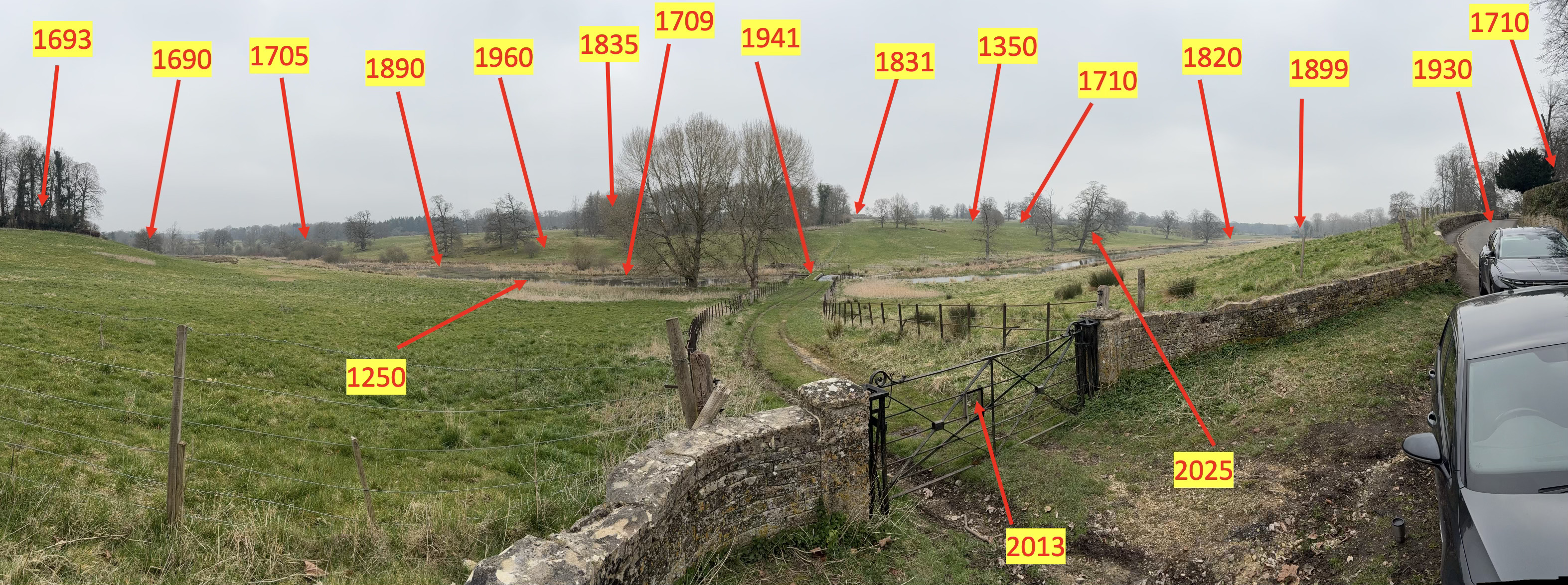
The Present Day
Before we press "GO", just notice the scene before you. Not a person in sight. The parkland is empty. On some days you might see Matt tending his fabulous herd of Herefords on the hill to the half left. On others, you might spot Luke, the NT ranger, checking on trees. But most of the time, this view is empty of people. It wasn't always this way. Let's press "GO" and travel back in time:
2025 – Yesterday!
An osprey sits patiently in the tree here, deciding which of the trout to go for. Ospreys will have visited Sherborne for centuries, the open water providing the promise of a fish for supper. As we pass back in time, we will see humans too, fishing—maybe Bob Dadge dipping a fly into the Brook, having more success than the average osprey. The two lakes (once called ponds) will have been used for fish production to feed people in the House and the village for hundreds of years.
2013 – A Few Years Ago
Just a few years ago, there once sat a useful interpretative sign from the National Trust on the gate, explaining the nature laid out in front of the gate and the species that might be visible—and suggesting that the public not progress further. The sign rotted away and has not been replaced, despite offers from the Brook Group to pay.
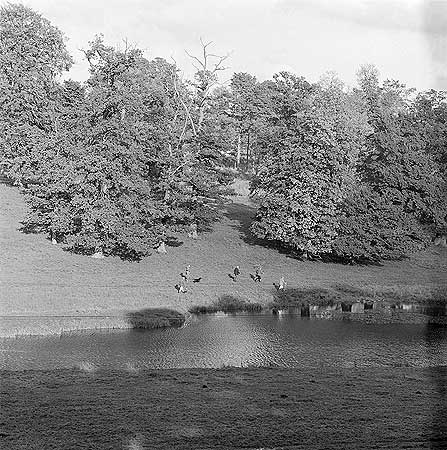
1960 – Hunting Heritage
The parkland provides an environment for Lord Sherborne to shoot game and employment for a number of villagers. generation after generation of gamekeepers were kept in employment. Here's a picture showing some returning from a pheasant shoot, beside the open water of the Broadwater.
1941 – Wartime Training
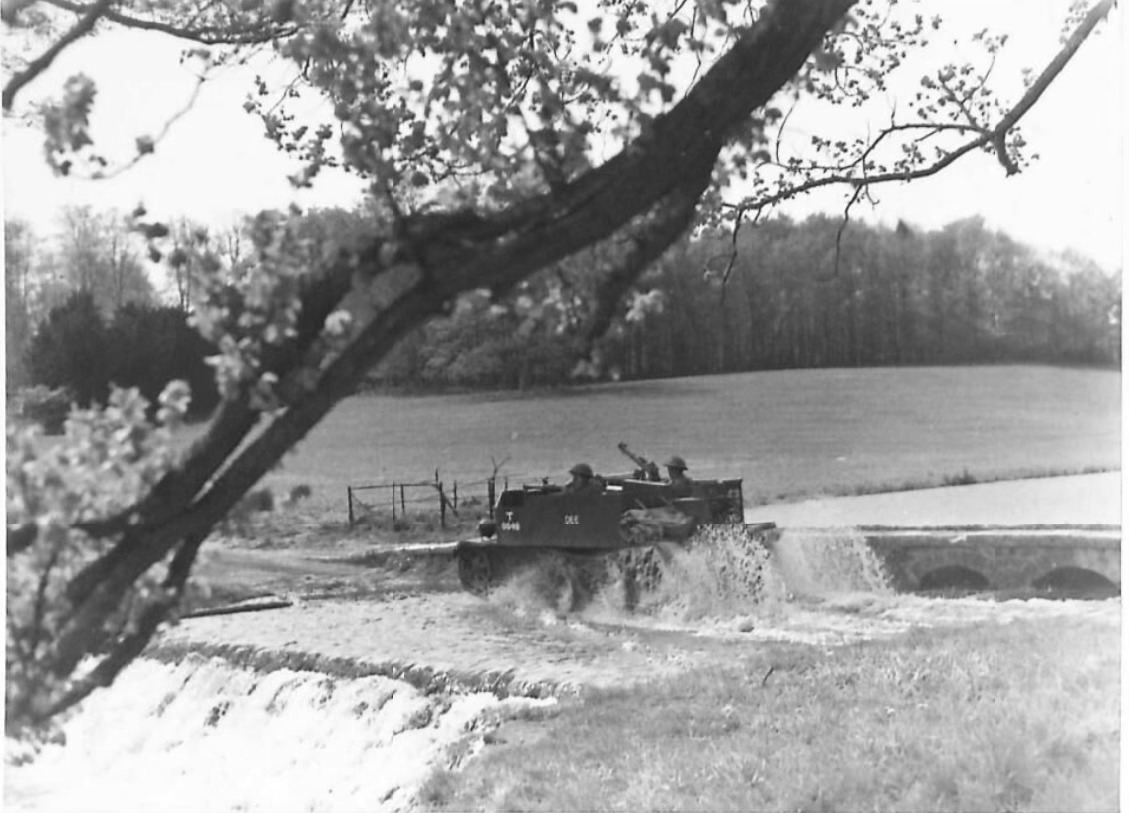
As our time machine stops, we are surprised by the roar of a Bren-gun carrier, a small tracked army vehicle, as it races across the ford in front of us. Other soldiers of the Highland Division assault up the hillside p explosions, shouted orders and rifle fire echo across the valley. They are based here to train, Sherborne being their battle school prior to deployment to North Africa and the battles of WW2.
1931 – Agricultural Innovation
In the distance, we can see a long thin building—a chicken shed, one of two in Old Park built as an agricultural experiment. Just the faint foundations remain today, but here villagers would have been daily involved in the management of the experiment.
1930 – Echoes of Lives Lost
As we stop, a young lad on a bicycle passes by. We are invisible to him. He whistles as he pedals up the hill and on to the village school which he attends—if his mother saw him cycling with his hands in his pockets, she would scold him. It's John Houlton, whose father farms Mill Hill Farm, beside the crossroads. Remember him. Twelve years later, he was killed by the Japanese in dreadful circumstances on a remote Pacific island, far from home. He can't see us, but it's important we see him now. His Uncle, Charles Freeman, would have passed this way too some years earlier—and he died in Gallipoli in 1915. This time machine helps us recall. Remember young John's whistle, without a care in the world, and weep for the young life lost just a few years later.
1899 – Victorian Leisure and Innovation
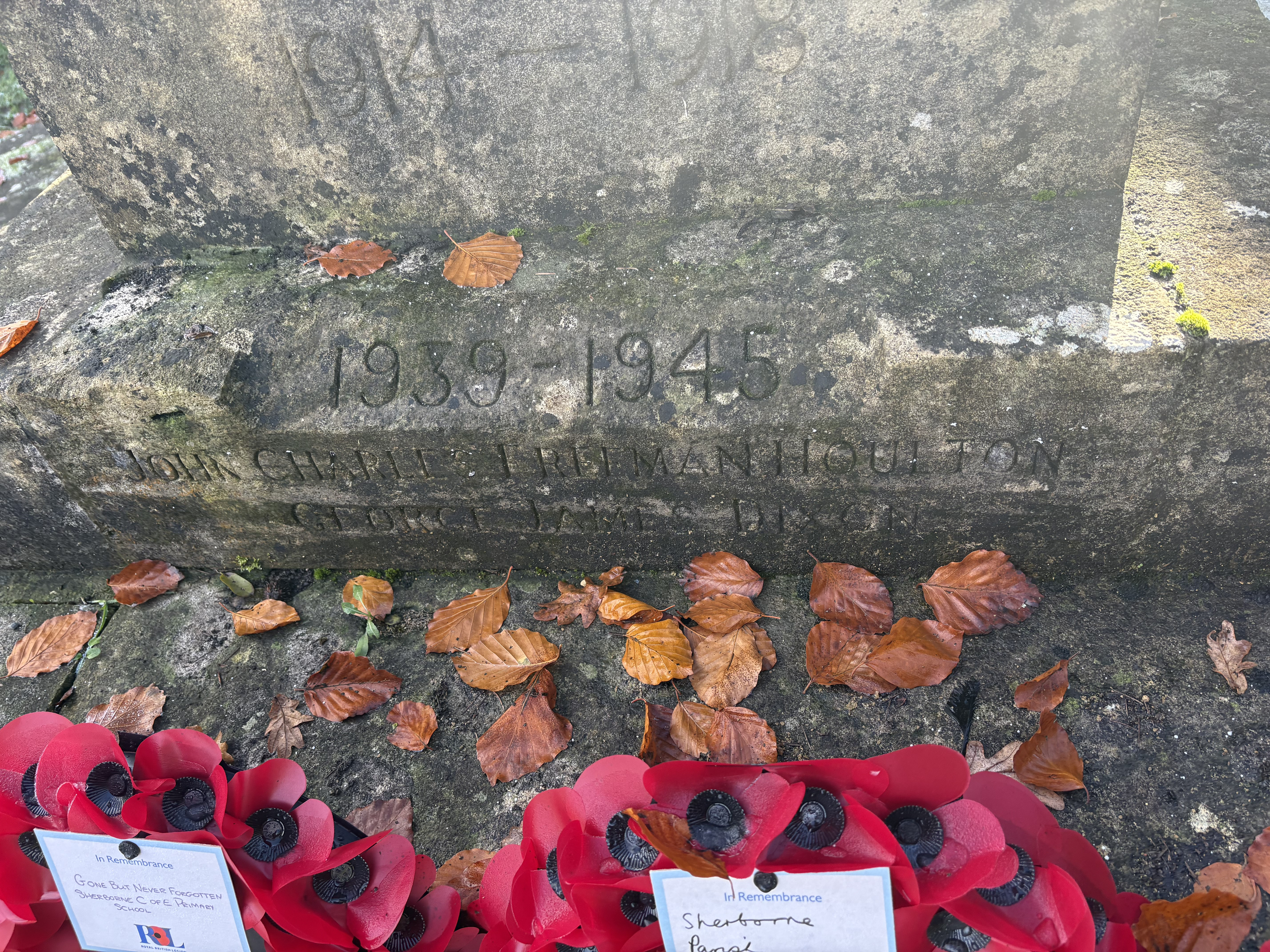
Just visible to our right is the boathouse and beyond it the turbine house, both built around this time. The boats would be used for pleasure and perhaps for fishing—the lake was big enough then. Can you see another patient fisherman at the oars of a rowboat? In the turbine house, just visible through the trees, we can see Harry Taylor, the electrical engineer, tending the flowerbeds beside it, waiting for Lady Sherborne on her daily walk.
1890 – The Majestic Landscape
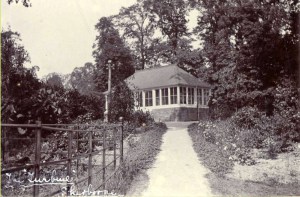
The lakes and parkland are glorious, the oak trees at full height and the serpentine lakes along the valley floor. Here's a photo taken then from the bank behind us.
1832 – Designed Beauty
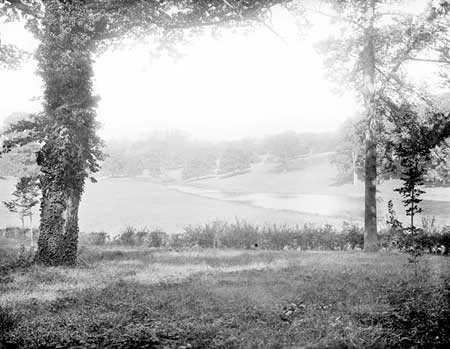
The landscape designer W.S. Gilpin is overseeing the planting of the "Clump" as one of his signature designs. He's working on contract for the second Lord Sherborne. Of course, it is Sherborne villagers working for Lord Sherborne who are doing the actual work.
1831 – Building the Sheafhouses
In a brief stop as we travel backwards, we can see villagers working on constructing the Sheafhouses, now sadly derelict and tumbledown. These were built for the husbandry of animals, but a century later, some of the buildings were used to grow mushrooms in an agricultural experiment. An earlier T shaped structure was demolished just in front of the current buildings.
1820 – The Ornamental Bridge
As the early 1820s flash by, we can see a beautiful arched wooden bridge, a designed feature of the serpentine lake, with two young children idly watching the wild fowl below. By 1860, the bridge had rotted away and not been replaced.
1740 – Creating the lower lake
Workmen on the estate, as recorded in the estate archives, are creating the Narrow Water as a serpentine lake from the stream that existed there before. The word "lake" wasn't used until the late 1700s, and this body of water was described then as a fish pond, fulfilling both a decorative and practical purpose. This lake was being built within a decade of London's Serpentine lake, designed by Bridgeman, so it was very fashionable.
1709 – The Artist's View
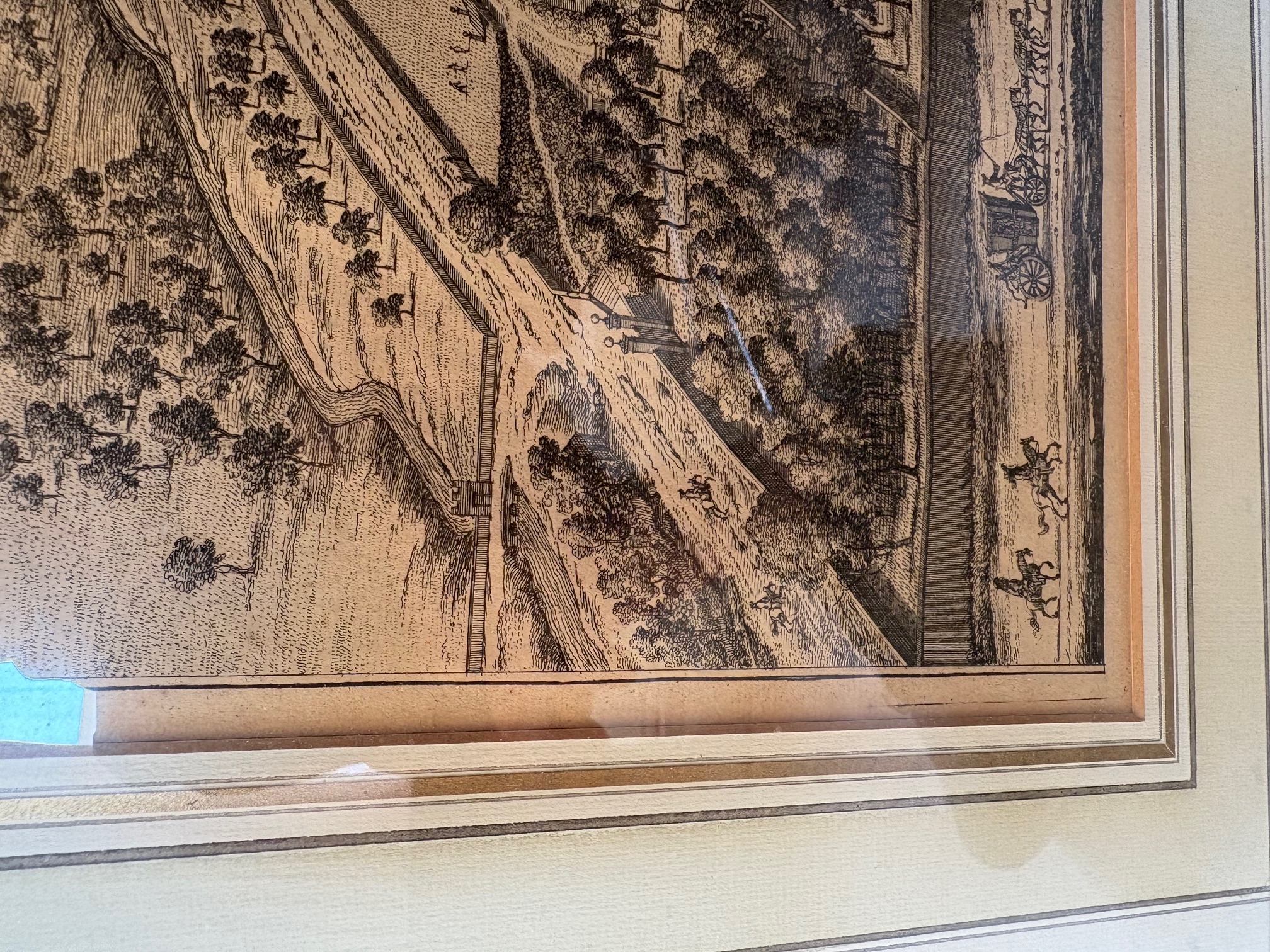
Walking past us is the celebrated artist Johannes Kip, sketchbook in hand, muttering in Dutch! —he's preparing a bird's-eye view of the area for Ralph Dutton. In it, we can see the decorative weir that the current one replaced. Beyond the bridge downstream is the narrow brook, dammed 30 years later.
1705 – Maintaining Boundaries
Two workmen are repairing the wall that surrounds the park, as the archives describe. Today it's tumbledown and derelict here, but the wall in those days had to keep deer within.
1693 – A Notable Birth
We can hear the wail of a newborn baby from this house. This is Monk's House where the infant James Bradley's father lives, working as estate manager. James grows up to be Astronomer Royal, a celebrated scientist.
1685 – The Birth of the Great Oak
This large oak tree next to "fisherman's bridge" has a massive girth, but in about 1685 it was a sapling being planted by a villager on instruction from the estate manager. Today King Charles III is on the throne; then it was King Charles II.
1450 – Medieval Agriculture
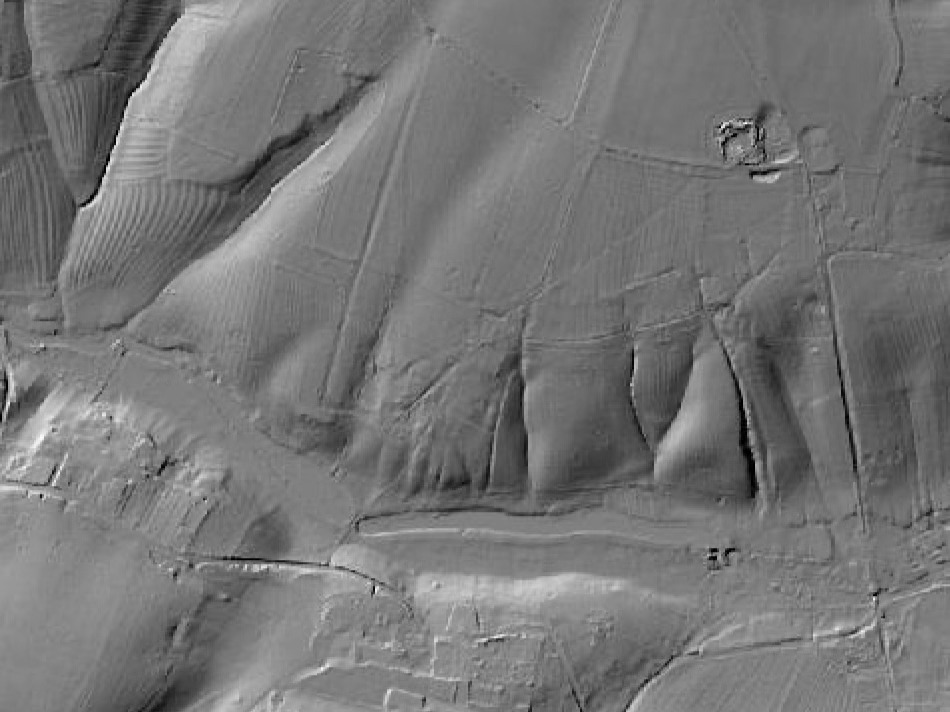
In the distance, on the horizon, a ploughman is tilling the field. His plough is pulled by two oxen, backwards and forwards, each length a furlong. A young lad, his son, another villager, assists with a long willow twitch to encourage the plodding oxen to turn at the headland. The marks this team of villagers and their oxen made over the centuries remain visible in the LIDAR image below. I bet they didn't expect their work to be noted 600 years later.
1250 – The Wool Trade Thrives
As we go back in time, the busiest scene of all erupts in front of us. It is May, and thousands upon thousands of sheep are brought from all over the local areas to be sheared, their wool packed into bales and sold. There are shepherds and their dogs shifting herds; there are villagers up to their waist in water in the brook, manhandling sheep to clean them. The washed sheep, still seemingly surprised, dry in the sunshine on the far bank. Once dried, more villagers are shearing the sheep of their winter coats once dry. Children of the village pick away at the grotty "dags," pulling the dirt out to make the wool as clean as possible.
Monks from Winchcombe, who own Sherborne and its estate, flutter about imagining they are doing something useful in terms of oversight. Local wool merchants haggle with foreigners from Flanders and Lombardy to buy and sell massive bales of wool. Some have thick heads from a night in the inns of Northleach. But this is industry, and Sherborne sits at the heart of a nationally important trade.
Some say the name of Sherborne itself means "clear stream," and indeed the Brook has fabulous clear water. But others suggest it's the "Shear Bourne," the river where shearing takes place. On a busy May day in 1250, us time travellers wouldn't argue with either.
But, quickly now—the batteries on our time machine are getting low, and we must return to the 21st century, to today. We'll leave the Anglo-Saxons, the Romans, the Celts, the Bronze Age, and the Stone Age for another time travel trip with our batteries fully charged—but don't doubt that they too created this landscape in their own way.

Back to the Present: Our Heritage
If you don't live in Sherborne and have no attachment to its heritage, the view presented from this spot may look like "nature" because, of course, nature sits on top of what is underneath. But to a Sherborne villager, whose connection is to heritage as much as to nature, you can use this community time machine to look beyond. Have you ever imagined a view with more history in it?
This isn't a pretty but empty landscape. It's a wonderful tapestry of events and effort going back decades, centuries, and beyond—it's a landscape full of our predecessors, busy working and playing in this complex parkland. They built this landscape, literally, and then they lived in it. Enjoy the fantastic nature, but remember the heritage that sits within it is ours. Imagine our predecessors within the view of our time machine's window. There is a lot of nature in this view, but one shouldn't separate it from the human heritage that caused it to be here.
