The Astounding Secret Plan for Sherborne: Uncovering Another Hidden Landscape Design
Following my exploration of Lodge Park's geometric secrets, I've turned my attention back to Sherborne Park, with simply jaw-dropping results
Revisiting Sherborne's Geometric Patterns
In my recent post about Lodge Park's hidden mathematical design, I mentioned some initial observations about gates at Sherborne Park. Indeed I wrote about this in a newsletter last year before we migrated to Substack. That investigation has continued to intrigue me, so I've returned to analyse the parkland surrounding Sherborne village more deeply using what we learned at Lodge Park. I’ve found some additional observations that astound me. I suspect they might you too. I think it turns upside down what we thought we knew about the parkland around Sherborne.
What I've discovered suggests deliberate geometric planning on a remarkable scale - in an identical geometric strategy to that we have uncovered at Lodge Park. I think we had assumed until now that the parkland around Sherborne was a simple enclosure of pre-existing fields by Crump Dutton, perhaps part of a deer park. What I’m going to show you changes all of that. It is complex so stick with me.
The Original Discoveries
Here’ s a link to my recent post about the discovery of an Vitruvian Man geometry at Lodge Park - with the proportions of a very clear 880 yard geometry at its heart. Is it Bridgeman or earlier? Now, let me first recap what I found several months ago in Sherborne, then share my newest discoveries.
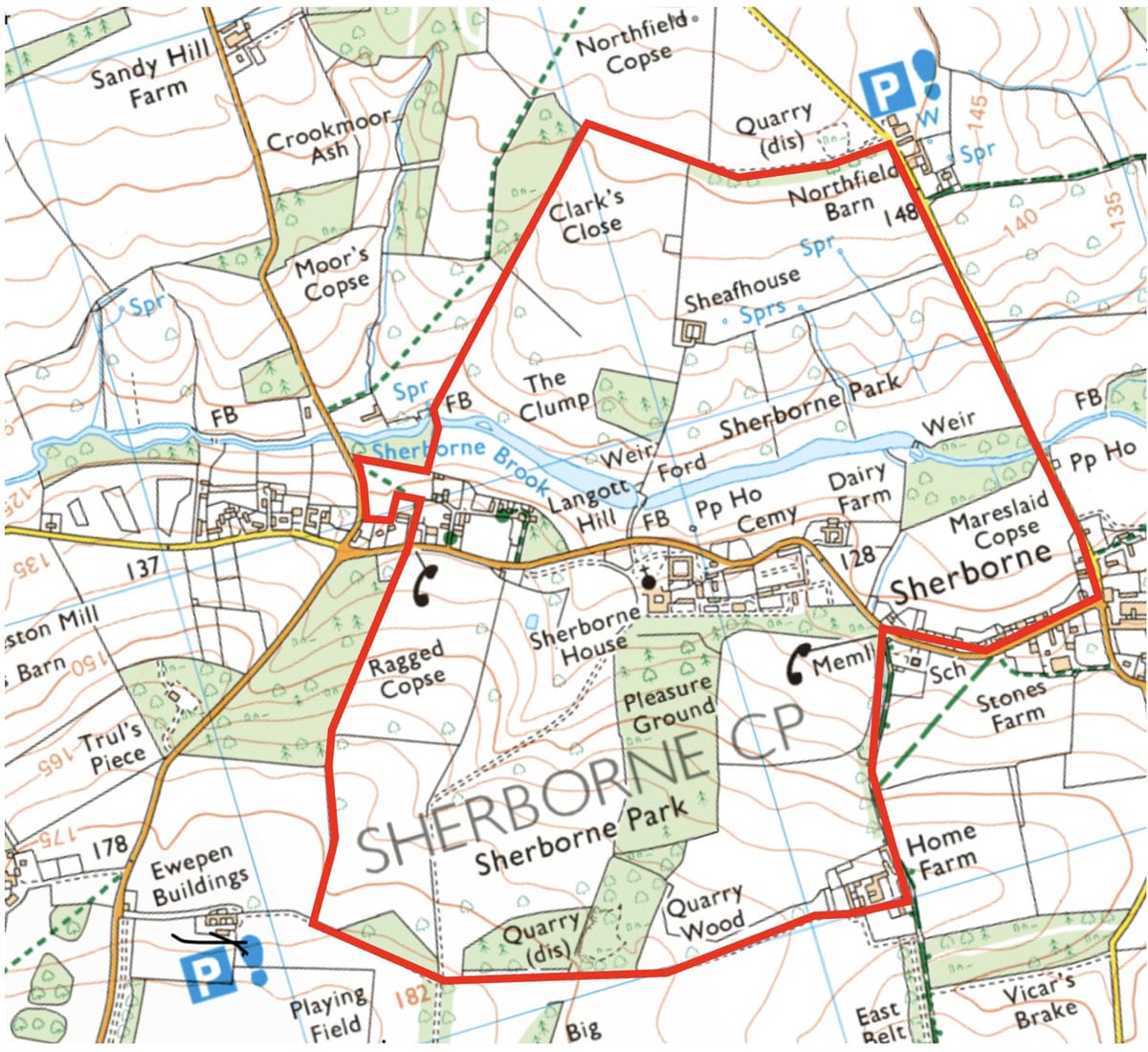
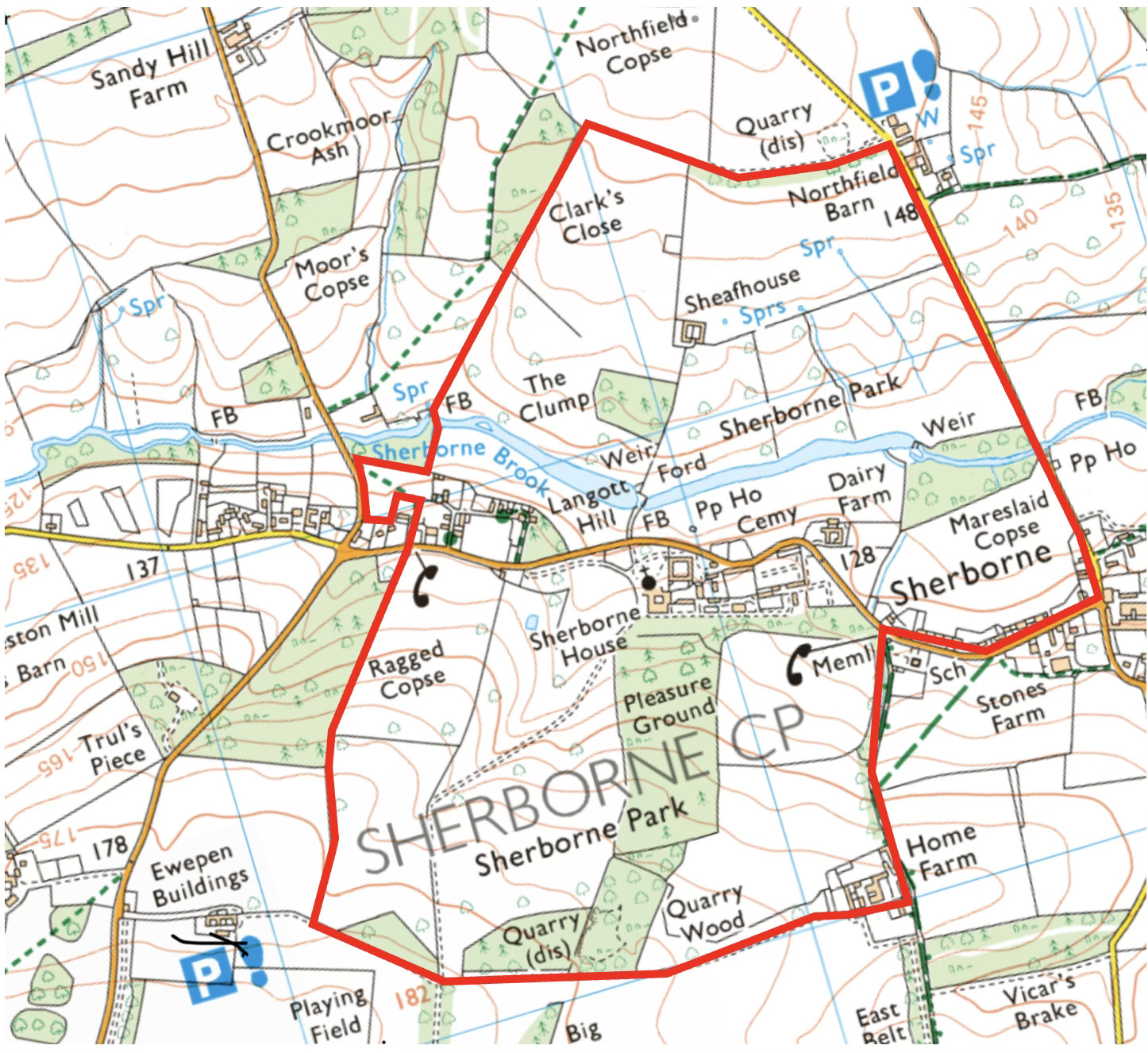
Here's what Sherborne Park likely encompassed originally - maybe- notice it straddles both the village and the Brook, with Sherborne House positioned fairly centrally:
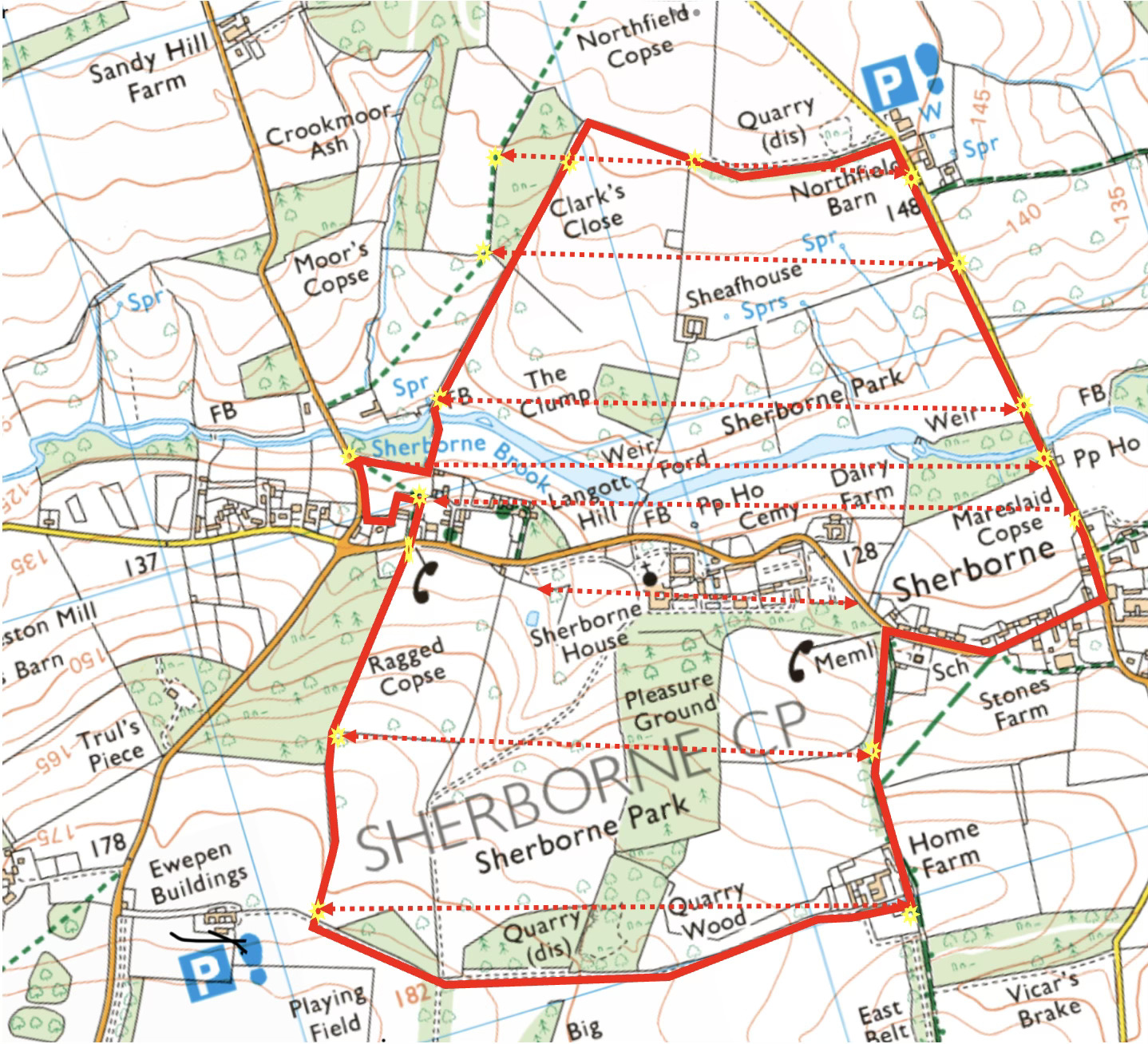
Next, I identified all the "entrances" to the park that still exist today - gates, doors, and stiles. The wall around the Northern part was originally much higher (designed to contain deer), with a couple of doorways on the western side. One was unfortunately destroyed by a fallen tree about ten years ago and hasn't been restored, while another marked as a "door" on c.1820 plans has since been converted to a gate. I have estimated where I suspect a gate must have been prior to the construction of Home Farm in the early 1820s. I’ve added a few other gates and some other features.
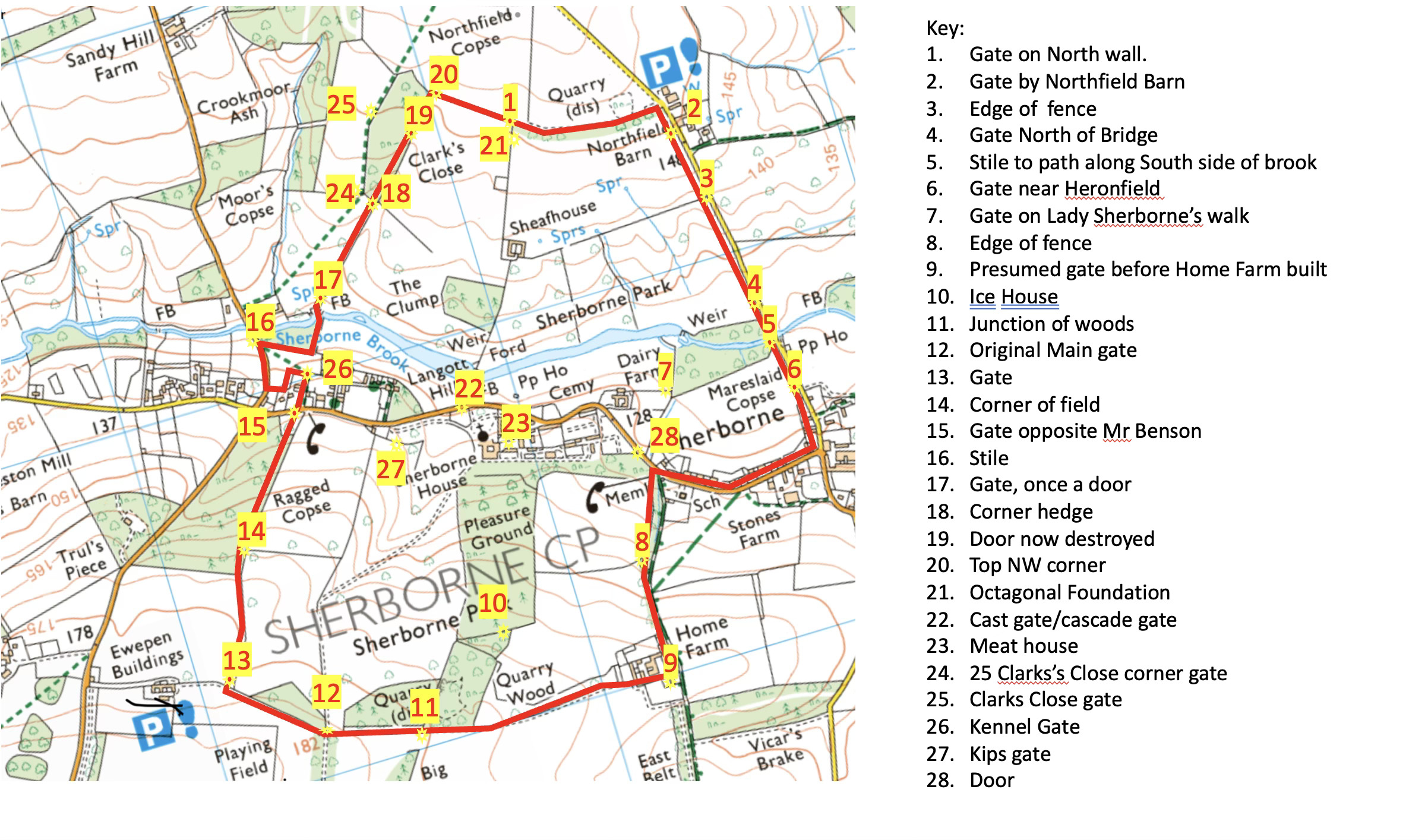
I’m sorry that’s such a busy slide but as you will see every single one of those gates or objects has a role in the remarkable secret design.
The Key Alignment: 285 Degrees
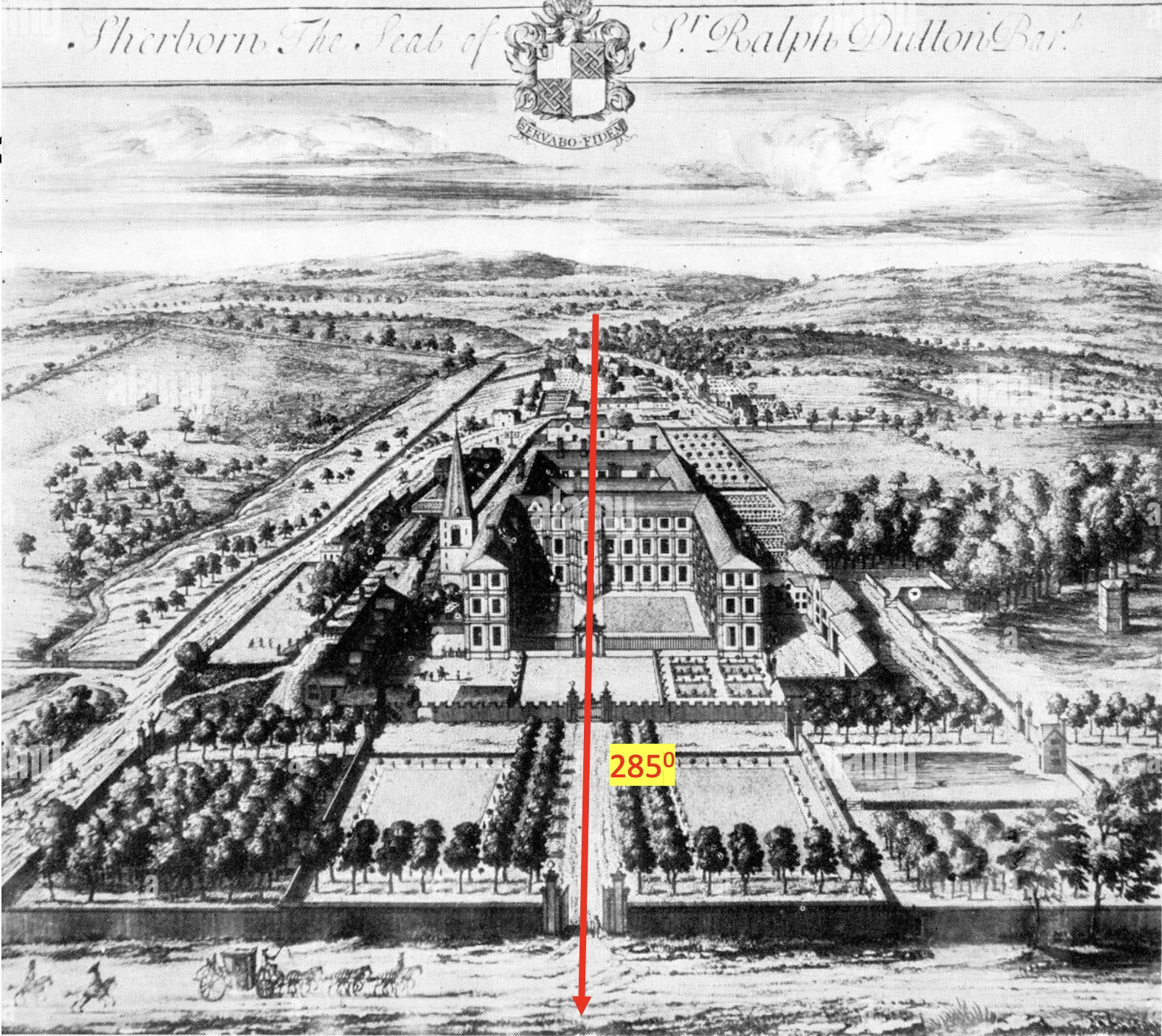
The geometric key to Sherborne Park begins with Sherborne House itself. Standing at the front door and looking outward, you face a bearing of precisely 285 degrees. This alignment was emphasized by an avenue leading from the door to grand entrance gates (visible in Kip's c.1709 drawing). Look at the dotted red line in the middle.
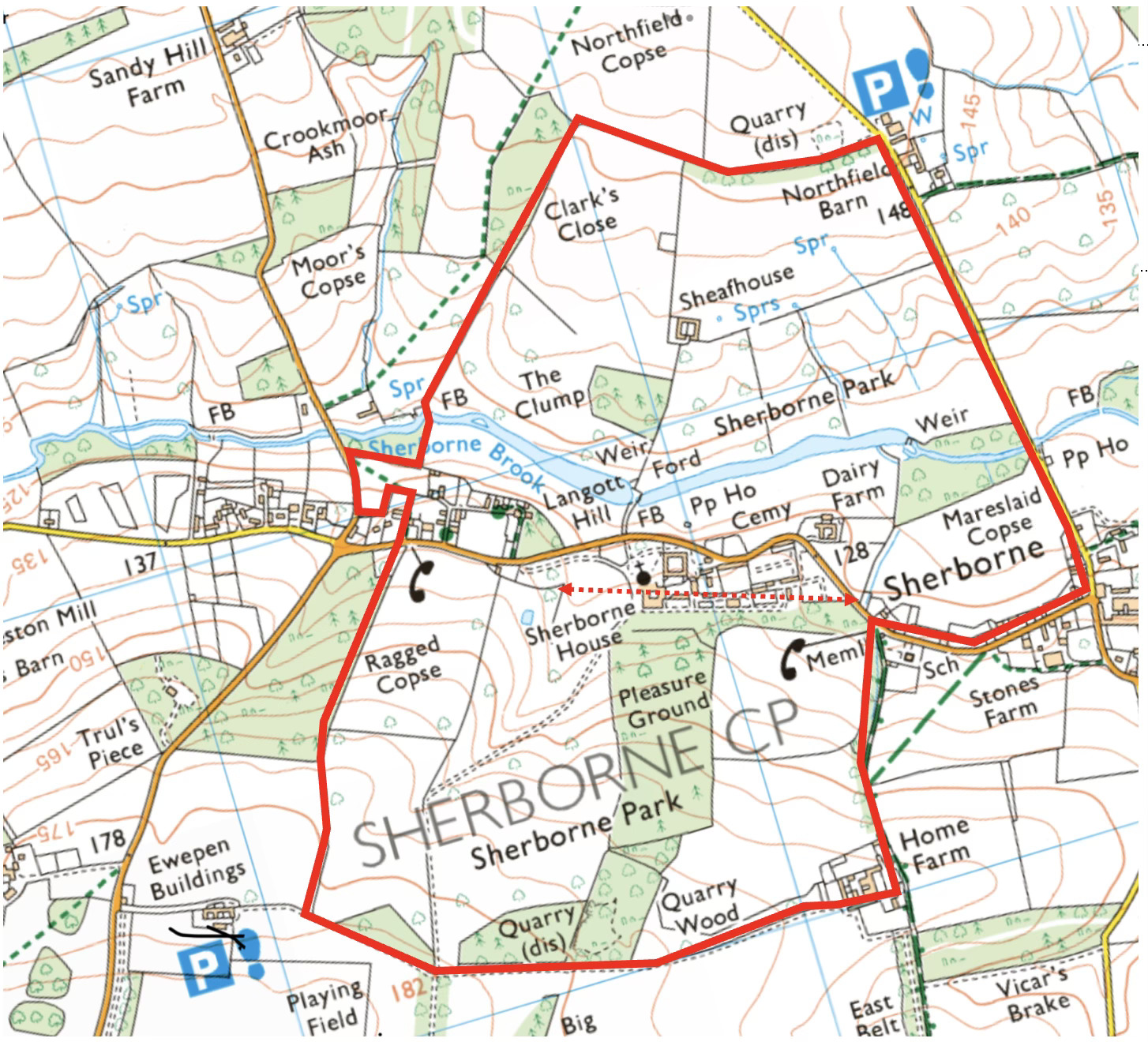
When I connected various park entrances with lines, something remarkable emerged - these gates, doors and stiles align perfectly along multiple parallel lines, all at the same 285-degree bearing:
The Perpendicular Grid: 195 Degrees
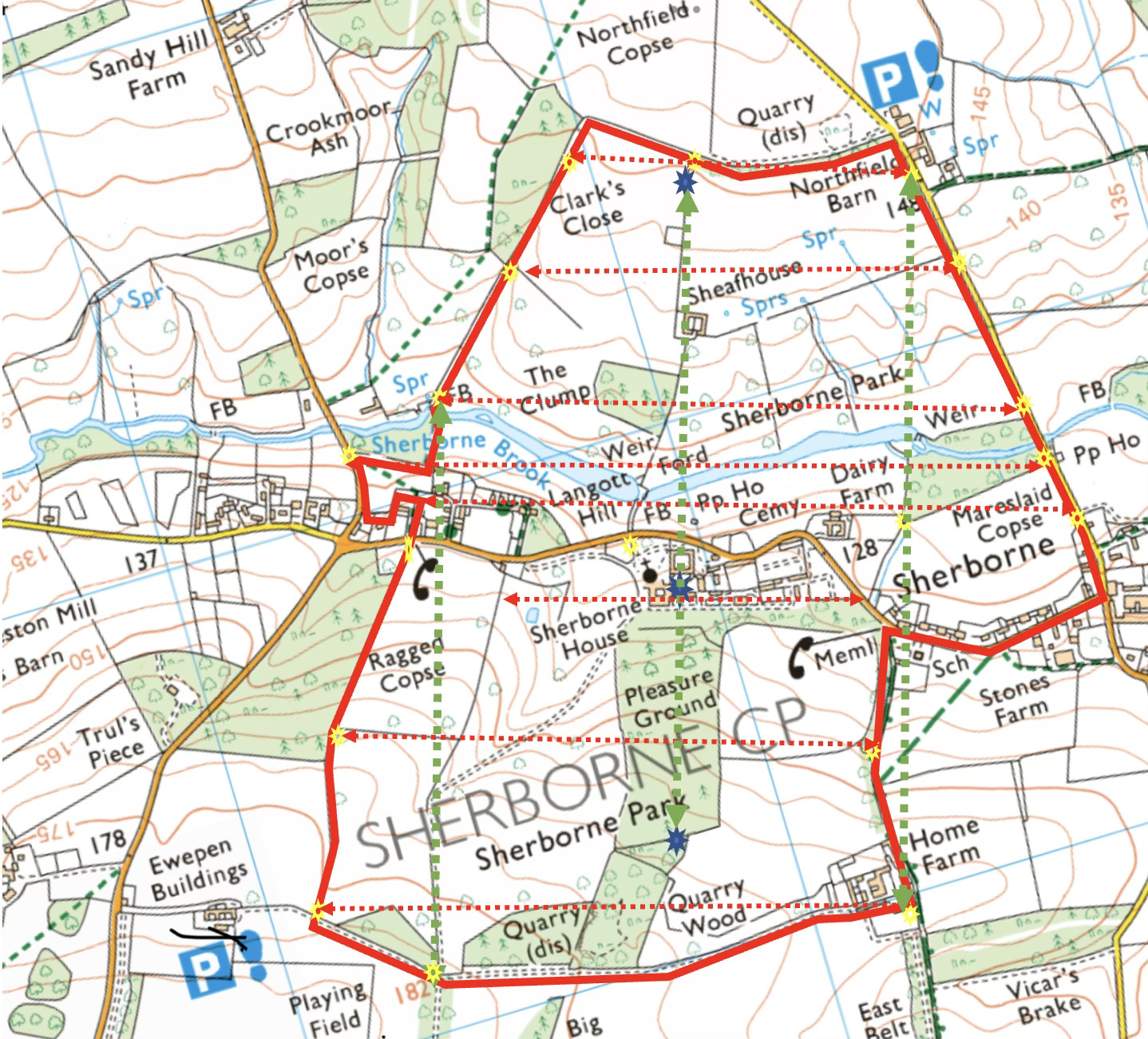
Last year, I noticed another significant alignment running EXACTLY perpendicular to the 285-degree lines - at exactly 195 degrees. This alignment connects three notable features:
- A mysterious octagonal foundation near the North boundary
- The meat house behind Sherborne House
- The Ice House further south
All three are marked with a blue star in the map below. This line also runs directly through the middle of the stables (built c.1770). I believe it originally passed through the position of the stocks visible in the 1710 Kip drawing.
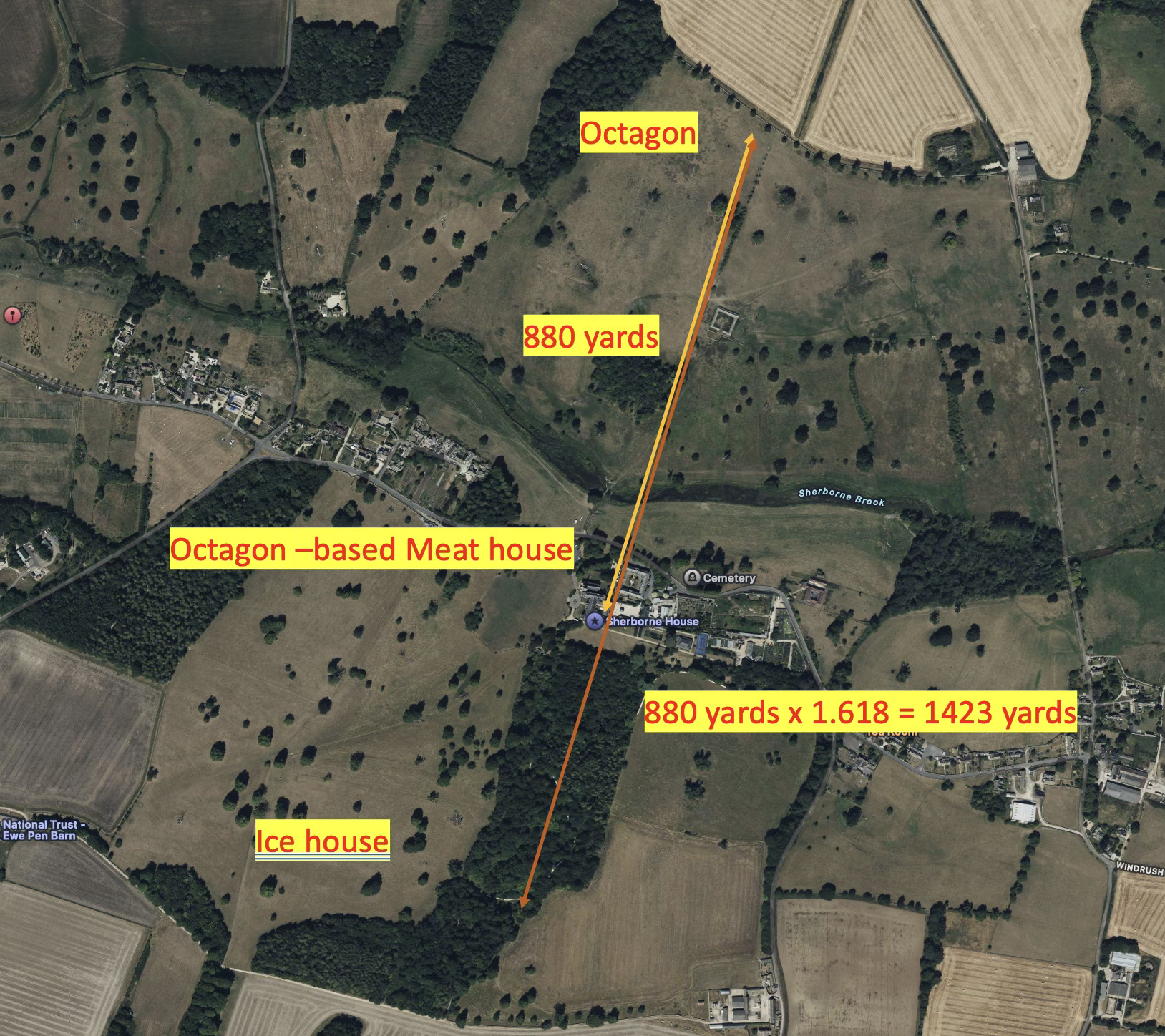
While historians have generally dismissed the octagonal foundation as insignificant, I maintain it was likely a belvedere (viewing platform) positioned to see all corners of the park. Interestingly, this octagon has exactly the same dimensions as the octagon forming the inner wall of the meat house (with which it is aligned).
My newest discovery is particularly exciting - additional gate alignments that run exactly parallel to the 195-degree alignment - see the green dotted lines below. I’ve only put in three but there are more.
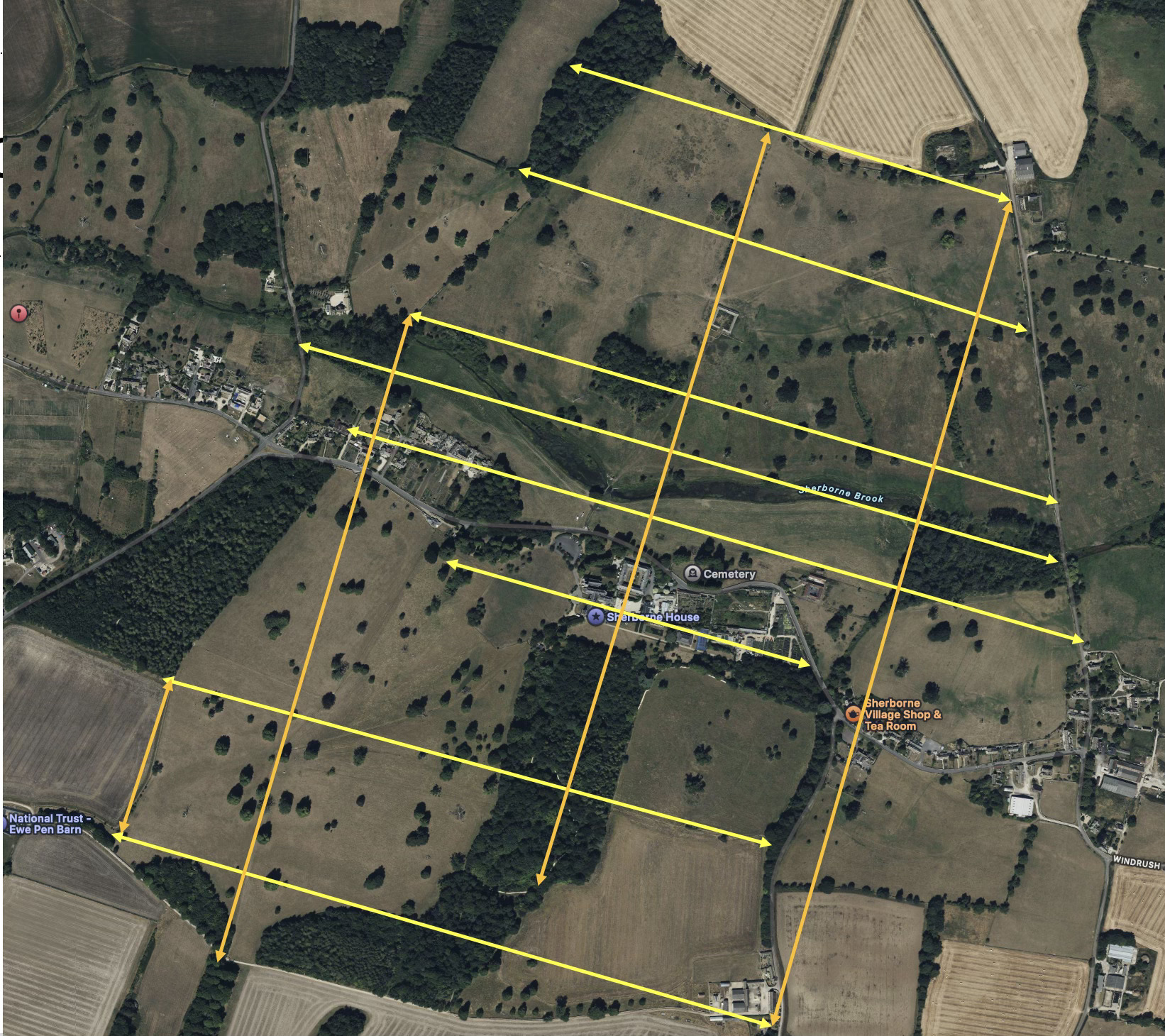
When overlaid on an aerial photo, this geometric grid becomes even clearer. Are the angles perfect? Not quite, but they are pretty close. How accurate would you expect them to be? A reminder at the end of every yellow arrow is a gate, and a few are along lines too. All the yellow lines are at 285 degrees, the brown at 195 degrees.
Precise Measurements Reinforce the Hints of Design
Beyond angles, I've found peculiar, yet precise, distances that maybe strengthen the case for deliberate design:
- From Home Farm Corner to the top NW corner measures exactly 1760 yards (one mile)
- From the SW corner gates to the gate in the middle of the North wall is also exactly 1760 yards
- From the "belvedere" foundation to the meat house measures exactly 880 yards (half a mile)
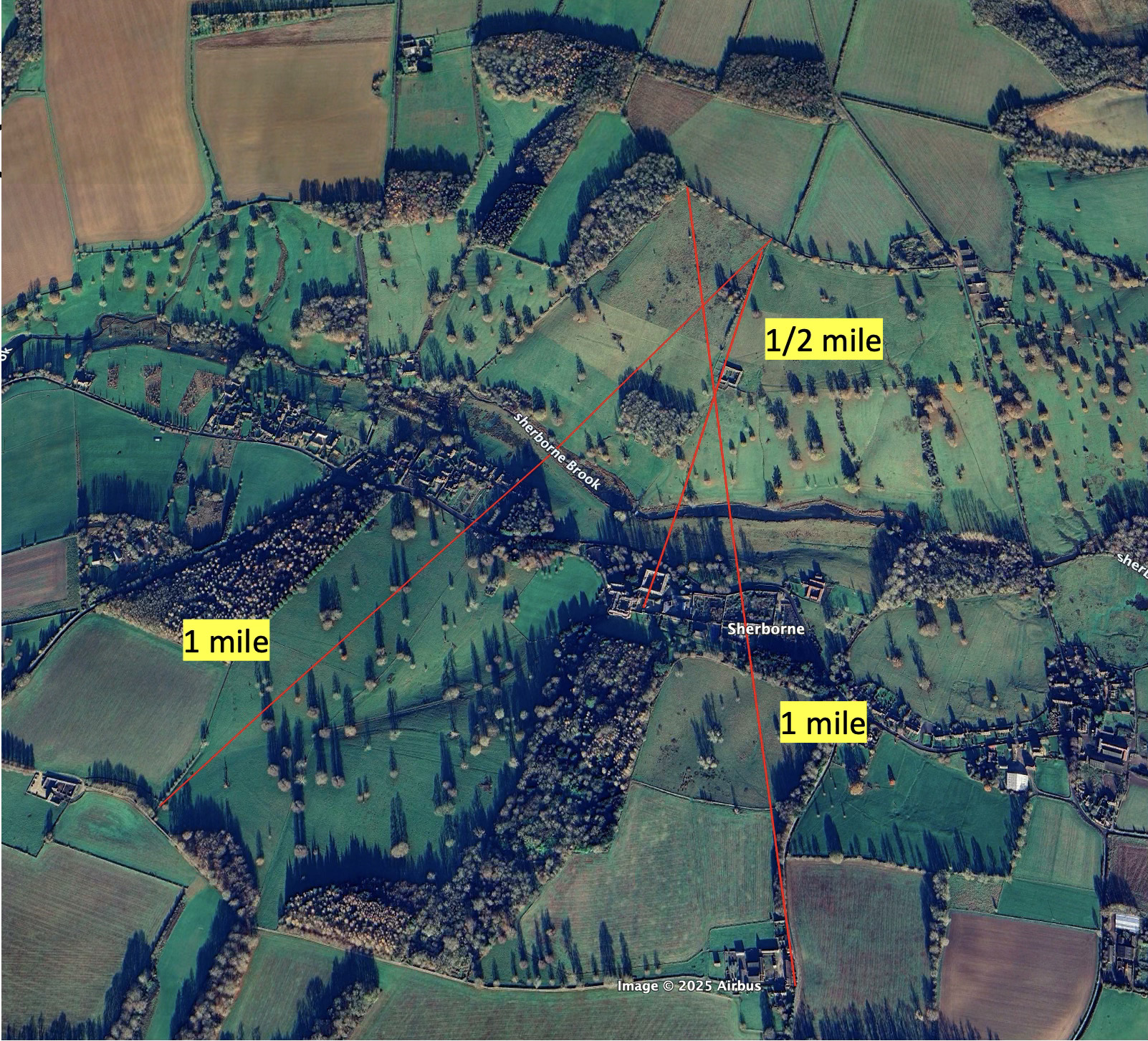
These distances are precise to the yard - remarkable accuracy for a 17th-century or even 18th-century landscape design.
A Profound Discovery
It was at this point that I nearly fell of my chair. That EXACT distance of 880 yards from the octagonal foundation that everyone has dismissed over the years to the octagonal meat house reminded me that at Lodge Park our Vitruvian man had 880 yards as its height and span too. And I have found something similar, also 880 yards at Greenwich Park. Could Sherborne be the same? Surely not… But I gave it a go. Hold on to your hats:
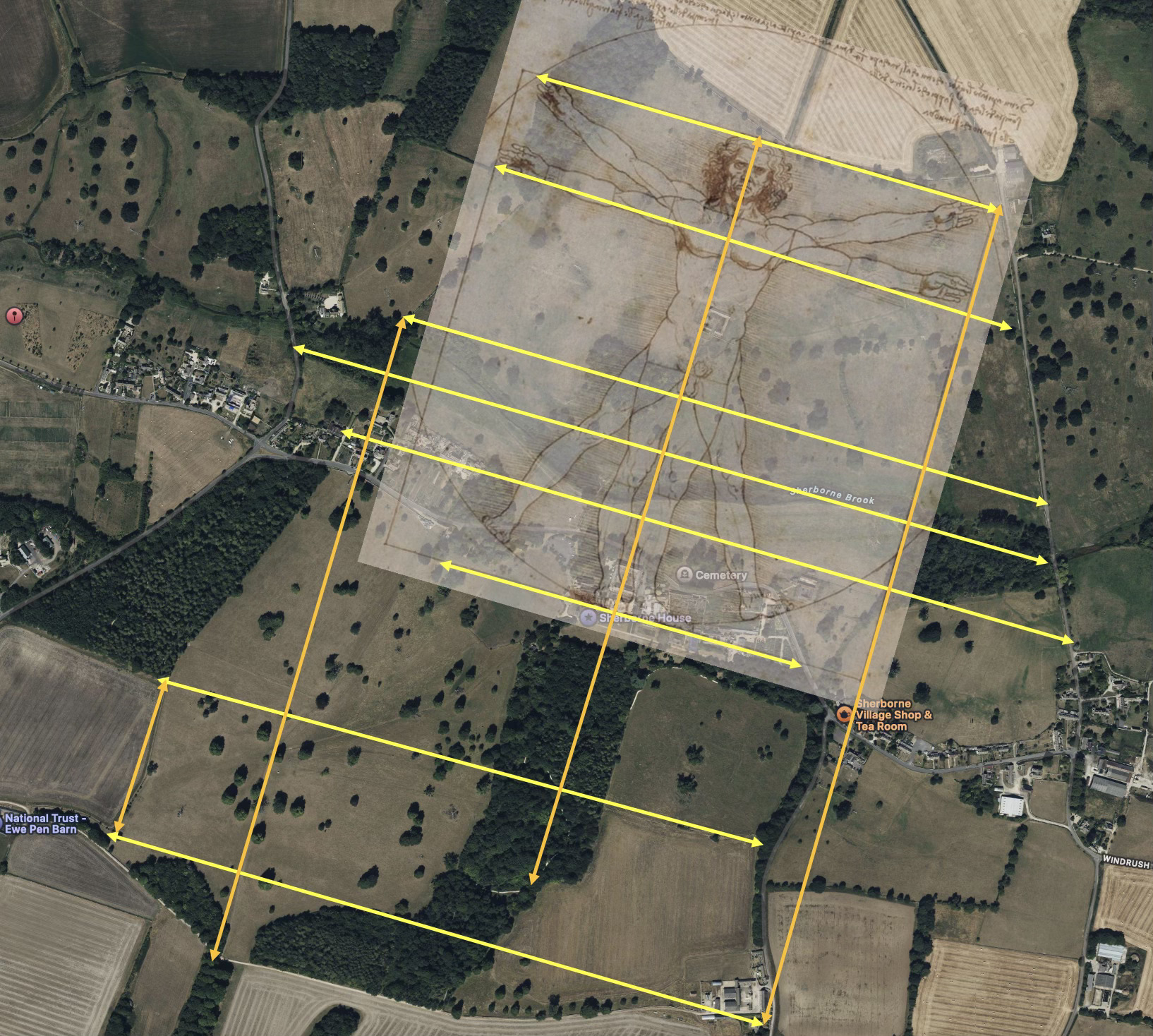
So that’s just a start. as we did at Lodge Park let’s cross link some limbs by drawing down the angles of the extended limbs. But first remember that on Vitruvian man , some of the key proportions at the top of the head, the middle of the chest between the nipples, the navel, and the genitals. Look how they ALL intersect with the gates:
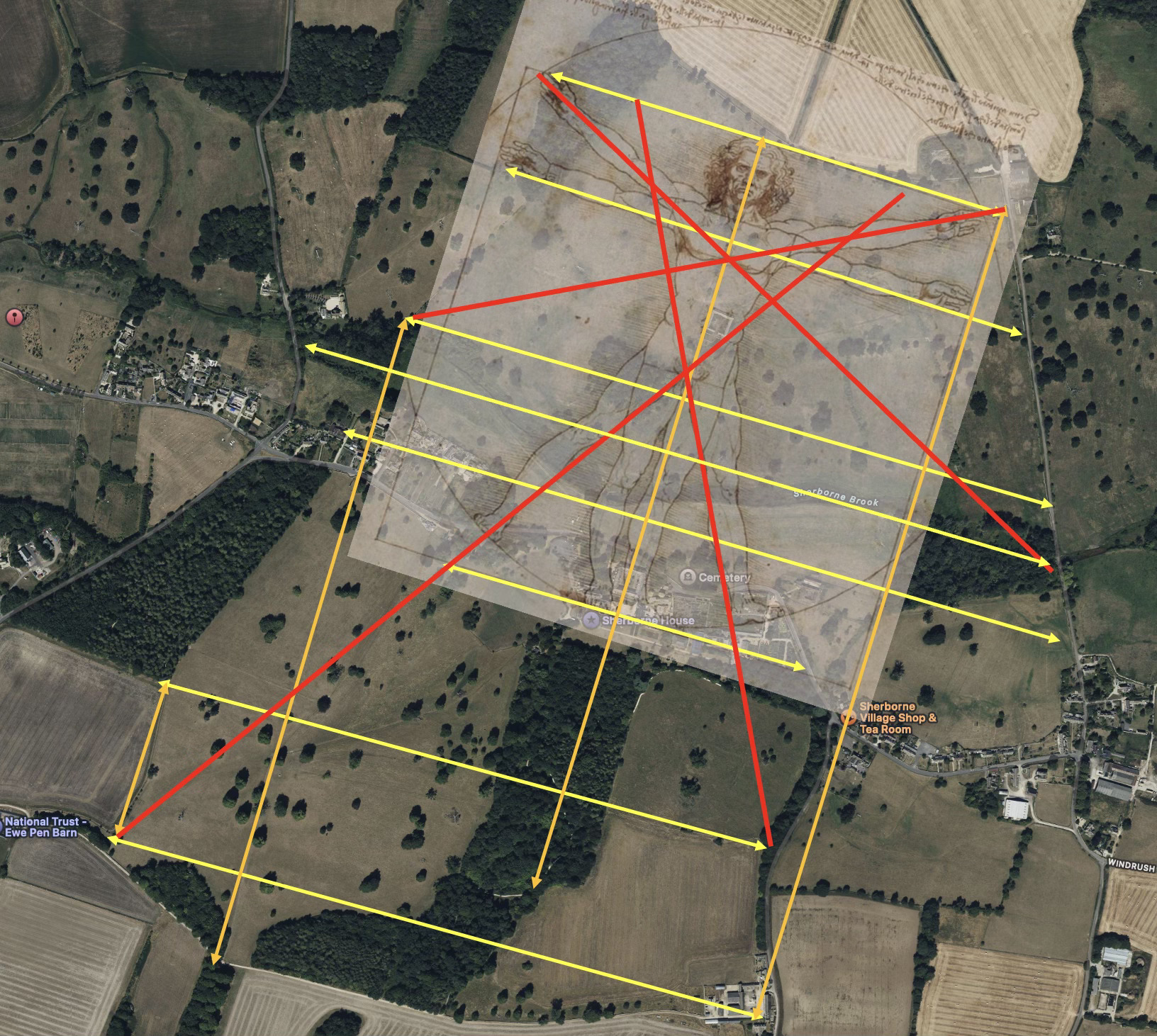
Notice two how the base line under the Vitruvian man’s feet matches our first line. Look how the right side of the square runs along Mareslaid copse.
But there’s more… I can keep going with other cross linked gates - you can play with these intersections all night long. Look at where they cross on the centre line. Here’s just some of them. Every gate is carefully positioned and linked to the Vitruvian proportions.
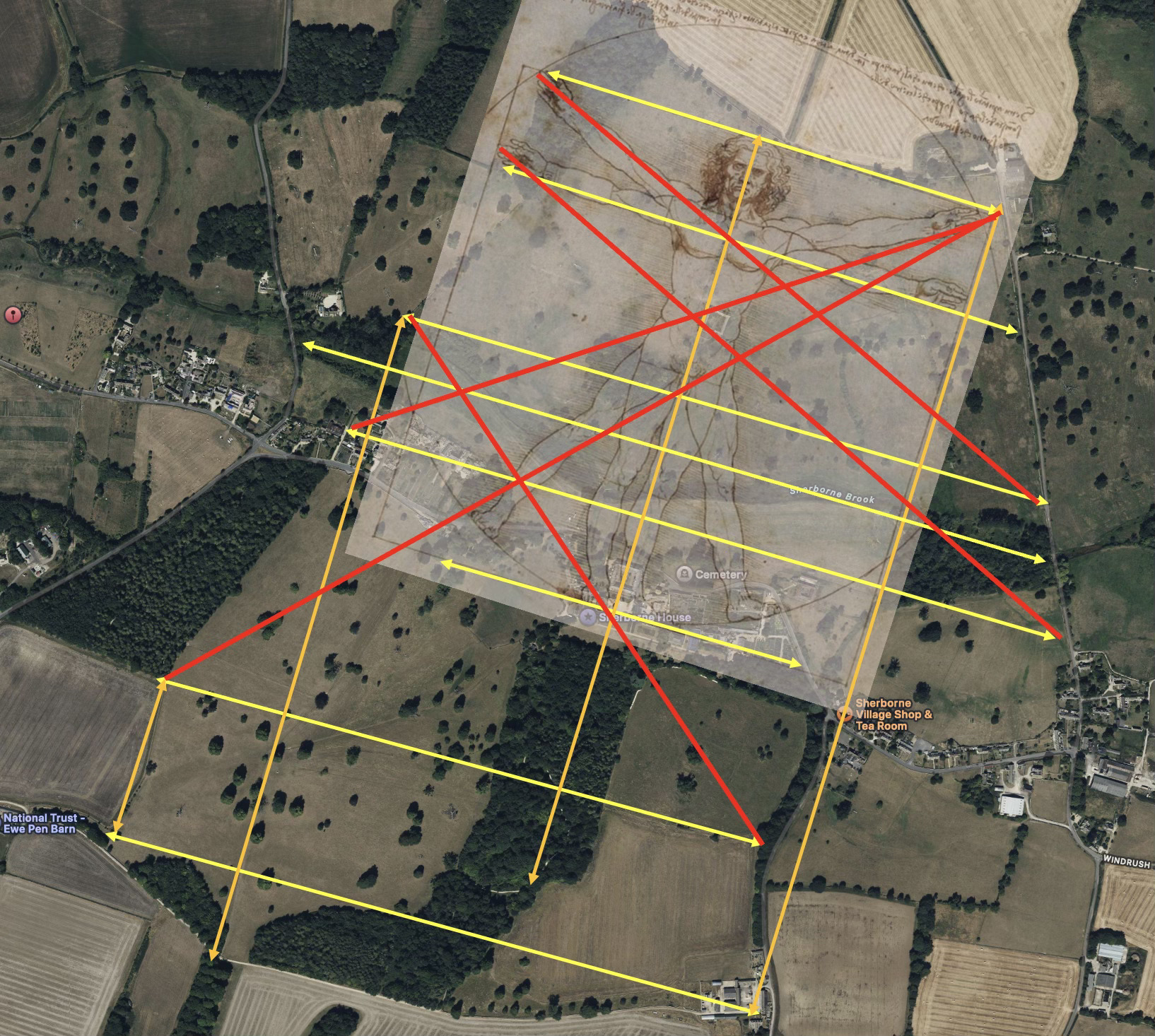
Some of these cross links are parallels too - there’s so much clever mathematics going on. Another piece of fabulous maths is that 880 yard central line from head to toe. Multiply 880 yards by the “Golden Ratio”, that fabulous mathematical construct loved by Palladian designers. You get 1423 yards. And the distance from the top to the ice house? Yep, 1423 yards. Way beyond coincidence?
Conclusion - Just the what.
So this post is just the “what”. Observations only. I haven’t answered the who, the when, the why. There are hundreds of questions to answer such as dates of the meat house (was it built on the site of an octagonal base? ), and many others. There’s a huge issue with the source of Vitruvian man calculations used by the designer here. Da Vinci’s Vitruvian man although drawn in the 15th century didn’t become well known until the 1800s. So the designer used the principles of Vitruvius, but I’m wrestling as to how the designer here appears to have used Da Vinci’s “solution” in terms of the angles of the arms and legs. For a future post. I’m at the end of what I can do in a newsletter. Someone will have to write a book about these discoveries, and Sherborne will have to come to terms with a radical new concept for its landscape. Not easy for anyone, least of all the NT.
But I’m certain it’s the same hand as we see at Lodge Park, the same designer, the same technique using the gates, the same angles, the same proportions, the same 880 yard key. If it’s Bridgeman, then we have a remarkable secret Bridgeman landscape here in Sherborne as well as Lodge Park. That would be quite something. If it’s earlier than Bridgeman (and my money is on that) then we have something really very special here, perhaps a real Renaissance landscape that will need a lot of thought and consideration and we can throw away ideas about Bridgeman’s landscape at Lodge Park and start again. I think it’s possible he was just tinkering around the edges.
I’m very open to refutations about these initial conjectures or alternate explanations for what we see empirically.
Landscape history eh? What a thing! Happy to discuss with anyone - I’m getting some BIG maps done and I’m looking for someone with GIS skills to help. I’m deep into researching Vitruvian proportions (a useful link here) and who was leading the fashion of such things from about 1620 through to 1730 which I think are the outside dates for our landscape here. I’m also comparing the layouts of Sherborne Park, Lodge Park and Greenwich Park, all of which seem to have an 880 yard Vitruvian plan. I have another site up my sleeve too. Stay tuned, more discoveries to come. Sorry this one is a bit complex!
As you walk around Sherborne, as I know many of you do, take a moment every time you walk past a gate or stile . It’s significant, and there is meaning behind the placement there. Sherborne is not some average Cotswold estate. Under the covers of its beautiful nature there is remarkable designed landscape using techniques none of us ever imagined.
