Uncovered! A detailed piece of Sherborne History
An accidental find of 315 year old accounts in the archives gives remarkable insight
I’m very excited by this. Last week I accompanied our very own history professor, Diane Lovell to the Gloucestershire Archives in the expectant hope I’d learn from her archive skills something useful about Sherborne’s history. Boy, has that paid off!
While Diane was examining a package of late 19th C documents, a little leather clad notebook slid out into her hand.
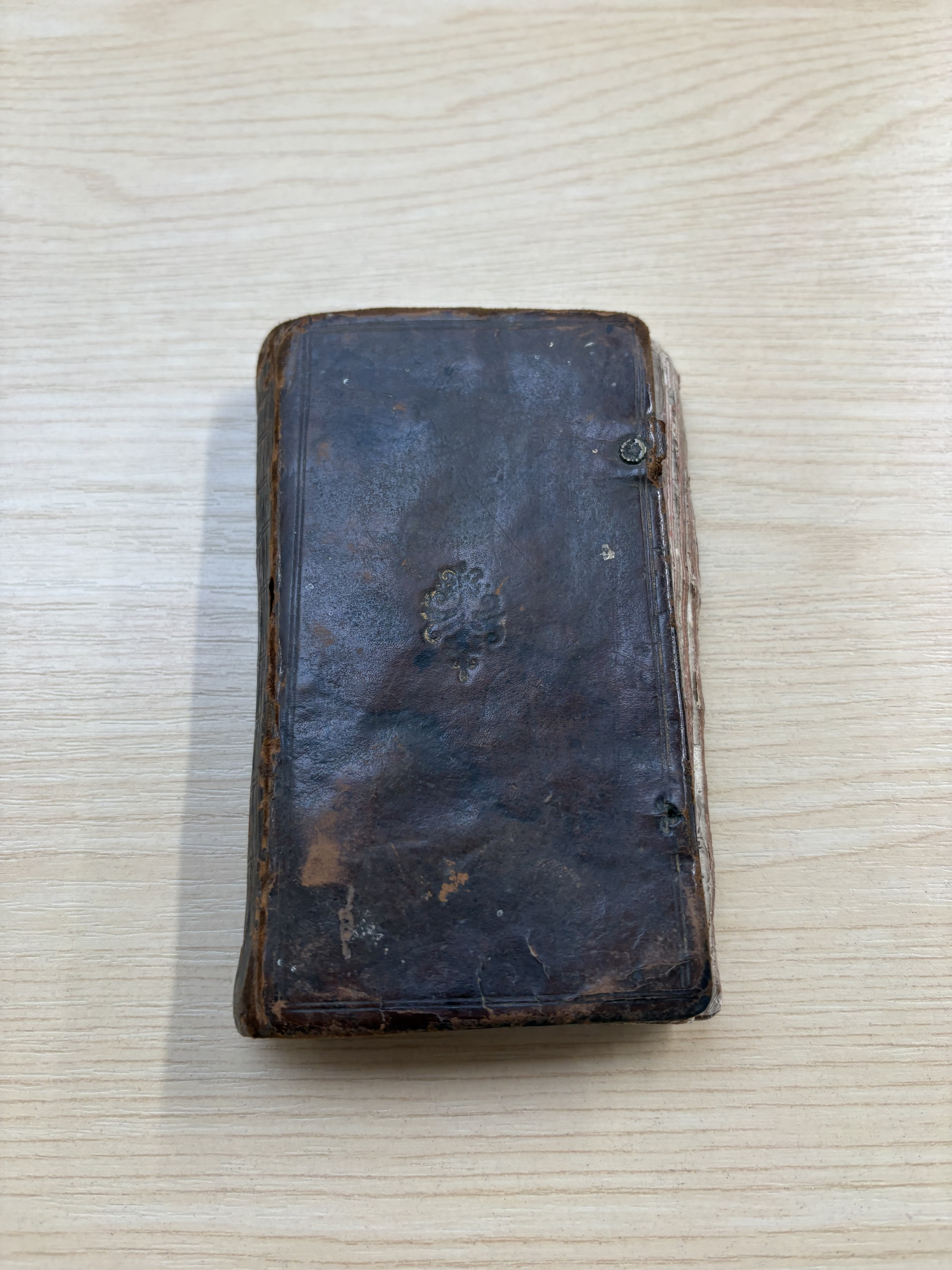
This unassuming notebook is actually a real treasure, giving huge insight about the Sherborne in a period of history we know little about. I don’t think its existence was known about. Let me explain.
In 1710, Sir Ralph Dutton had frittered away much of the fortune of the Dutton family by gambling. In that year (I understand) he signed over the management of the estate to his son, John. John seems like a sensible, reliable chap. When Sir Ralph (pronounced “Rafe”) died in 1721 he inherited the baronetcy, becoming Sir John. But in 1711/1712 he was just “Mister” trying to run the estate for his father who, it seems, was banished to Ireland, and who John maintained financially. This was his pocket book for 1711/1712.
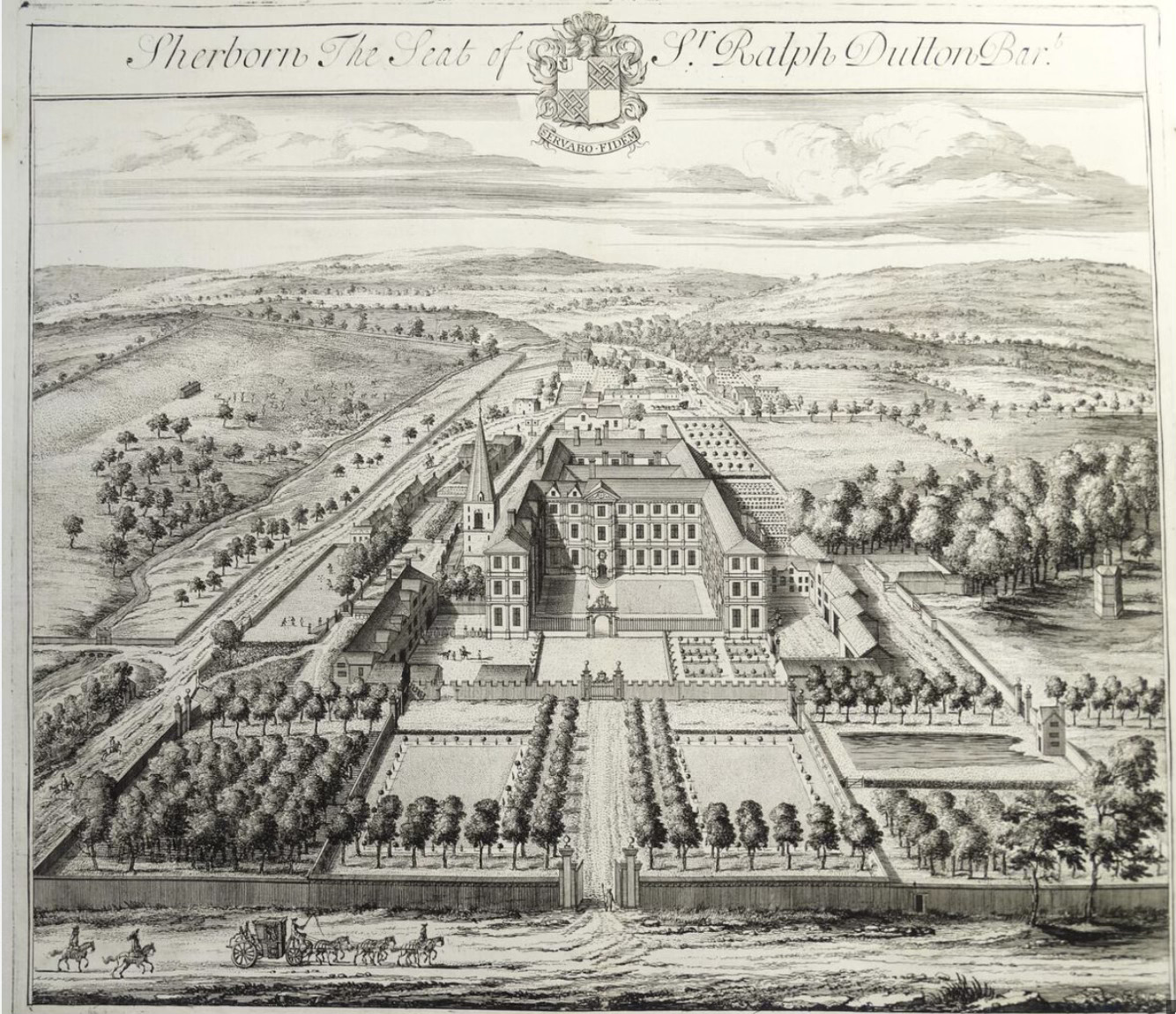
This date is interesting because we have an idea of what Sherborne looked like around that date. In 1709 or 1710 the artist Johannes Kip drew Sherborne House, and the surrounding fields and village to the East.
But until now we haven’t really understood how the estate operated. Records for the whole of the 1700s and into the 1900s are pretty sparse, with many, many gaps. As an example the estate accounts for the period 1720 -1740, which I have used to date the lakes in the parkland are “thin” with barely an entry a month at times.
So what can this odd little pocket book tell us?
The pocket book is remarkable for the detail it holds. Just about every page is filled with detailed accounts for 1711/1712, down to the halfpenny, of the management of the estate and how John Dutton spends and manages the estate. Here’s an example of just a few of the 200 or so pages:
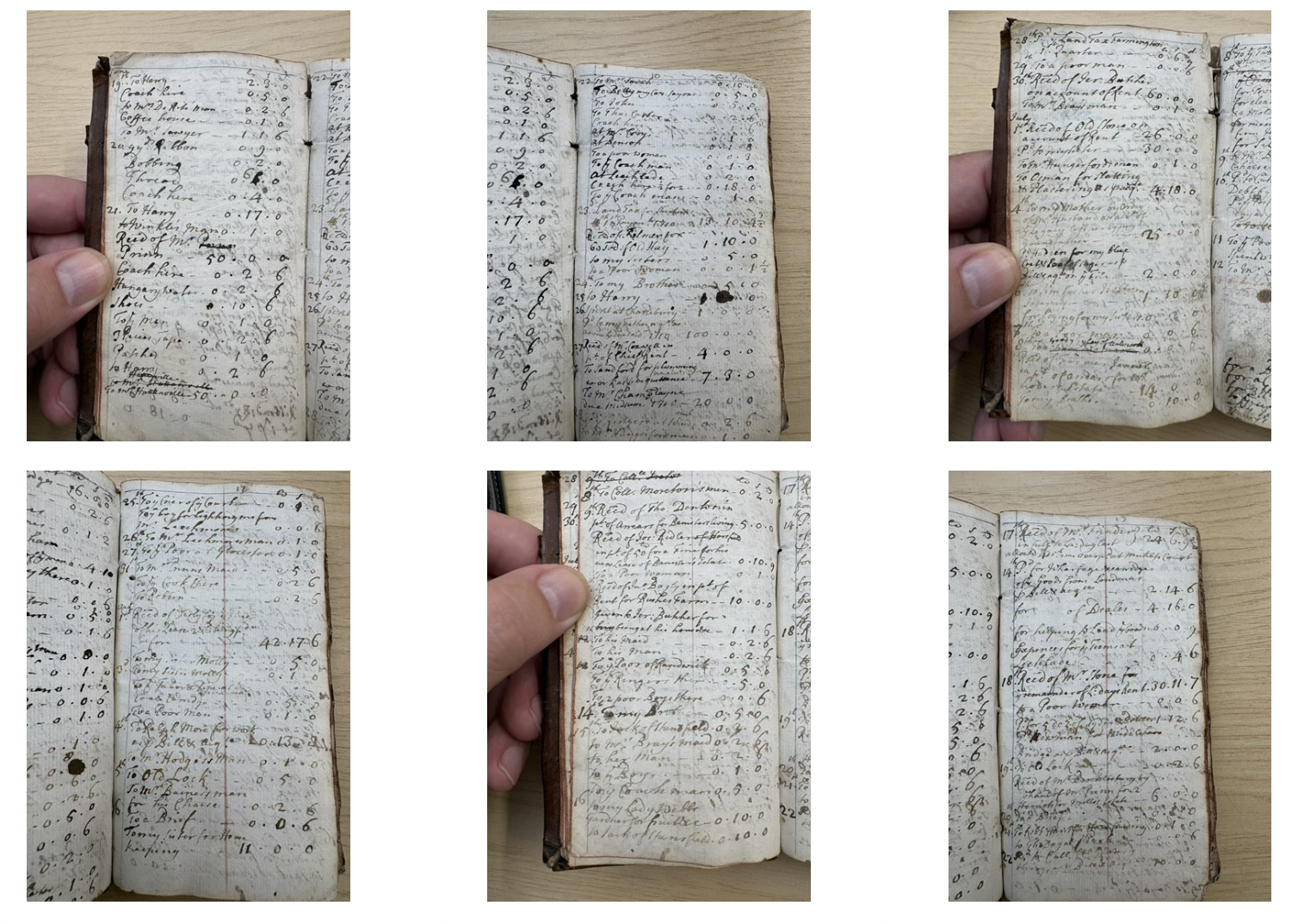
There are daily entries in great detail, sometimes a dozen entries a day. Here’s some reasons why this is important:
- We don’t know a lot about the estate at this time and the way it was left by the roguish Sir Ralph. This gives us immense detail.
- This is not just detail of how the grand owners of the estate spent their money (and made their money). This offers detailed agricultural management accounts involving all our predecessors in the village by name and activity. We can see what John Dutton was spending on - how much he paid for cattle how much he paid for feed (including sain foin, interestingly which I have mentioned in earlier posts). It shows us, to the penny, how much his tenants were paying him.
- We can match what we see in Kip’s picture to expenditure. So for example at the bottom of Kip’s drawing you can see a coach or carriage approaching the gates. From the accounts we know exactly how much John Dutton was paying to hire such a coach for a day in 1711, only a year or two later.
- We can see the names of his staff and contractors and how much they were paid. We can see the names of the villagers he employed, and what services they provided and for how much. So it is a village record as much as a Dutton record. This is heritage for our community.
- It’s not just boring accounts - it gives us a real feel for the personality of John Dutton. We can make a judgment,about him, his character, and what he views as important. For example he records frequently giving money to the poor. He looks after his father, his brothers and sister, and other relations. One entry records 3 shillings paid to a doctor for “bleeding” his sister and buying some medicine.
- We can see all sorts of other details about the local landscape in more certain detail than any other period up to the late 19th and perhaps beyond into the 20th.
- We can literally see to the penny how much it cost to run the estate at Sherbrone in 1711 and 1712 and where that money was spent.
Now, there is one big challenge, of course, in that the manuscript is almost illegible to the modern eye, and furthermore is faded in places. Transcribing these two hundred pages would take too much time and resources. But fortunately modern technology comes to the fore, as Diane showed me. If I enter a photo of each page into ChatGPT and ask for a transcription it does a remarkable job. It’s not perfect and it’s outright wrong in places but it certainly allows one to quickly find and focus on the important detail. Here’s an example:
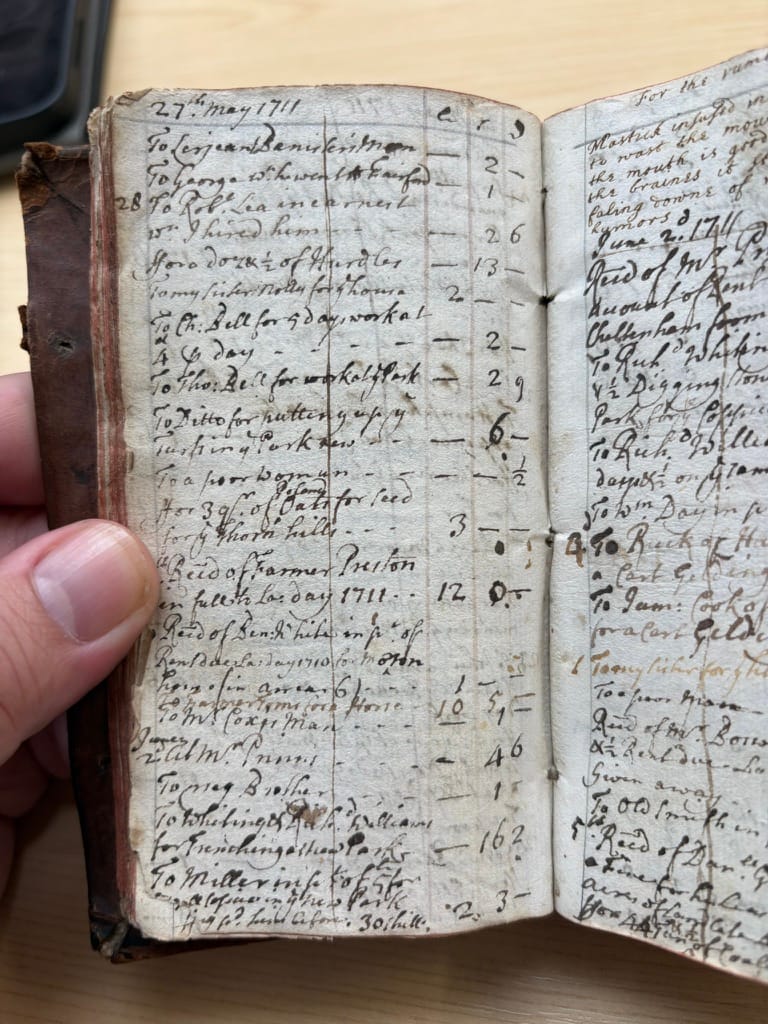
First a photo of a single page covering 27th and 28th May 1711:
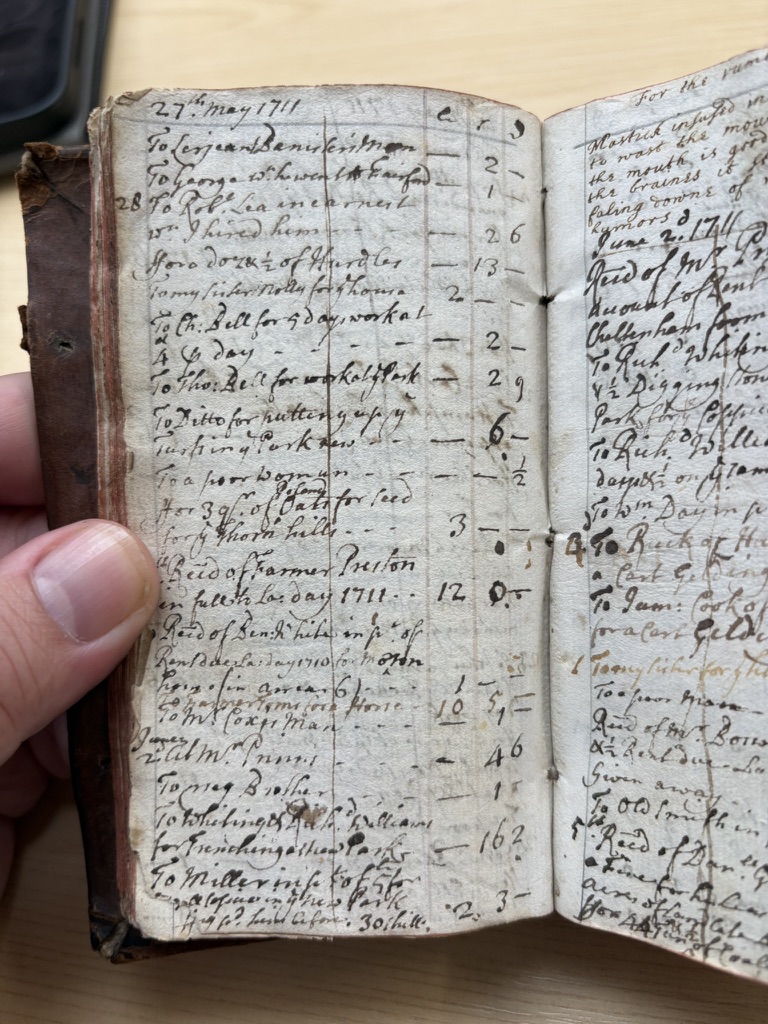
Now here’s the ChatGPT transcription:
27th May 1711
To Serjeant Bannisters men ——— 2
To George who went to Fairford ————
28
To Robt. Lea in earnest 25th I hired him———— 2 6
For a doz: & ½ of hurdles ———— 1 3
To my sister Molly for Louisa?? ———— 2 –
To Ch. Bell for 5 days work at 4 shillings a day—— ————
To Thos. Bell for work at my park ———— 2 9
To Ditto for putting up???? ———— 6 –
To a poor woman——— 1 /2
For 3?? of oats for feed for the Thornhills? ———— 3 –
Recd. of Farmer Preston in full to last day 1711 ———— 12 0 5
Recd. of Ben. ?????for ??? 1710—— ————
etc etc
As you can see it’s by no means perfect, and in some places quite wrong but it’s a huge step in helping us analyse the contents. It gives the gist of each page. Each line will need to be examined still, and where Chat GPT has it wrong, the transcript corrected. We are really pushing the boundaries of AI here. But it gives us a head start and means amateurs like me can play a useful role in this historically important work, showing how Sherborne operated 315 years ago. This data, once extracted, will be able to give us a detailed and accurate picture of our community in Sherborne in the year 1711, to the day. We could theoretically create a modern set of accounts from this amazing document. I think it’s remarkable.
There are other delights in this pocket book that I’ll share in due course.
This also shows the value of “keeping digging” on the history of Sherborne. There is more to uncover. History should never be considered “set” and finished in terms of analysis. But I think this might be one of the most significant historical finds about Sherborne, ever. I expect it will change the way we think about Sherborne’s history and its conservation. Thank you to Diane for her help and shared commitment to our history.
