Vitruvian Twins in Sherborne.
The landscape designs in Sherbrooke and Lodge Park have more in common than meets the eye.
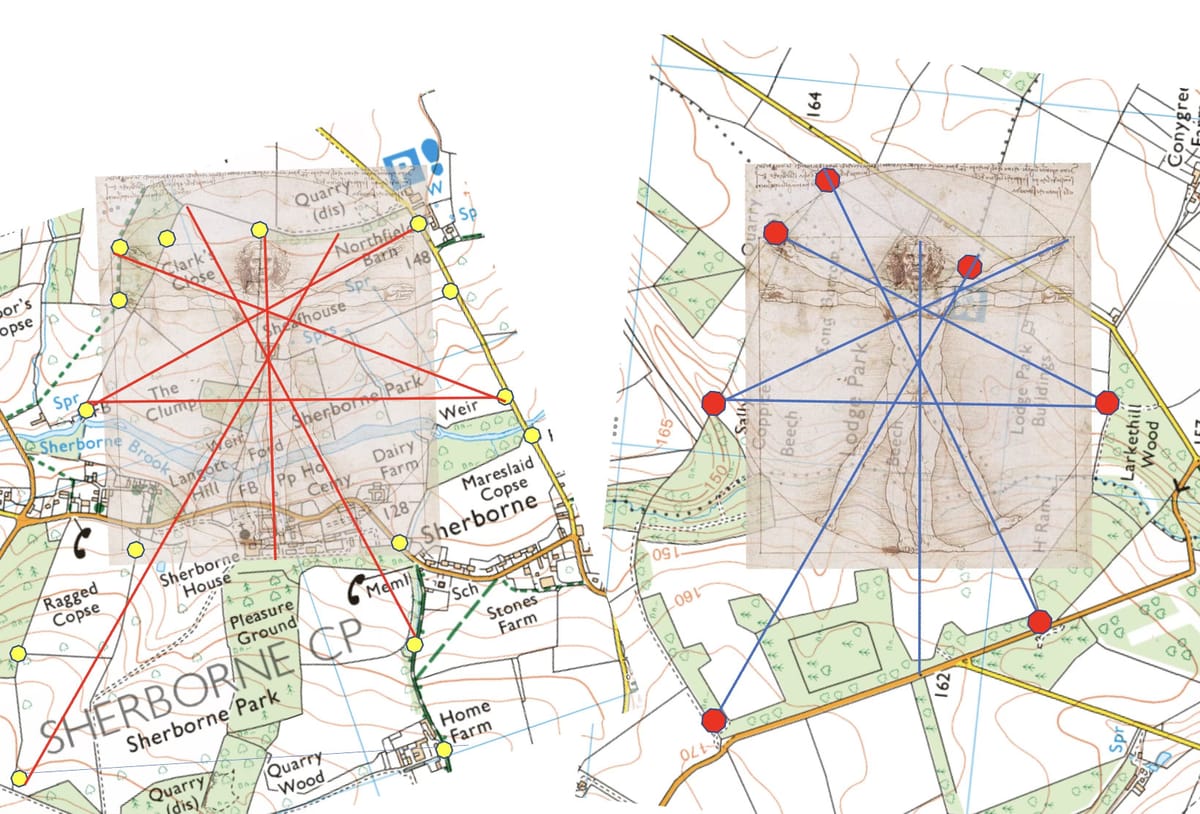
In my two recent posts about Lodge Park and Sherborne Park, I observed that both parks have features, particularly gates on their boundaries, that seem to be based on Vitruvian Man proportionality, scaled to 880 yards. I appreciate that this is a complex suggestion, and I'm flattered by the interest shown by many members of the Sherborne Brook Support Group and Substack subscribers.
Important Clarifications
Before exploring further connections between these landscapes, I'd like to clarify several points:
- Nothing supernatural: These are simply observations of apparent designs in the parkland - mathematical relationships and geometric patterns.
- No Da Vinci involvement: I'm not suggesting Leonardo da Vinci had any involvement. His drawing was effectively unknown until the 19th century, sitting in a private library. The landscape designs here appear to be from the 17th or 18th century. However, Vitruvian proportions were well known in this period, championed during the Italian Renaissance and later in England by Inigo Jones. However I'm struggling to explain why the designer appears to have used proportions matching Da Vinci's particular "solution" to Vitruvius's text, especially the angles of the outstretched limbs.
- Dating uncertainty: I have no definitive designer or date, only a window of perhaps 1615 -1730 for these sophisticated mathematical layouts.
New Discoveries
Since my previous posts, Sherborne residents have identified additional gates that seem to lie on appropriate alignments. More significantly, a number of you noticed remarkable similarities between these two landscapes, situated just a couple of miles apart.
Striking Parallels Between the Parks
Here's the two parks side by side - rotated so each Vitruvian man is vertical, with red and blue lines aligned with the splayed limbs extending to gates on the perimeters. Gates are red in Lodge park and yellow in Sherborne Park. You need to make just a little allowance for my poor graphics tools:
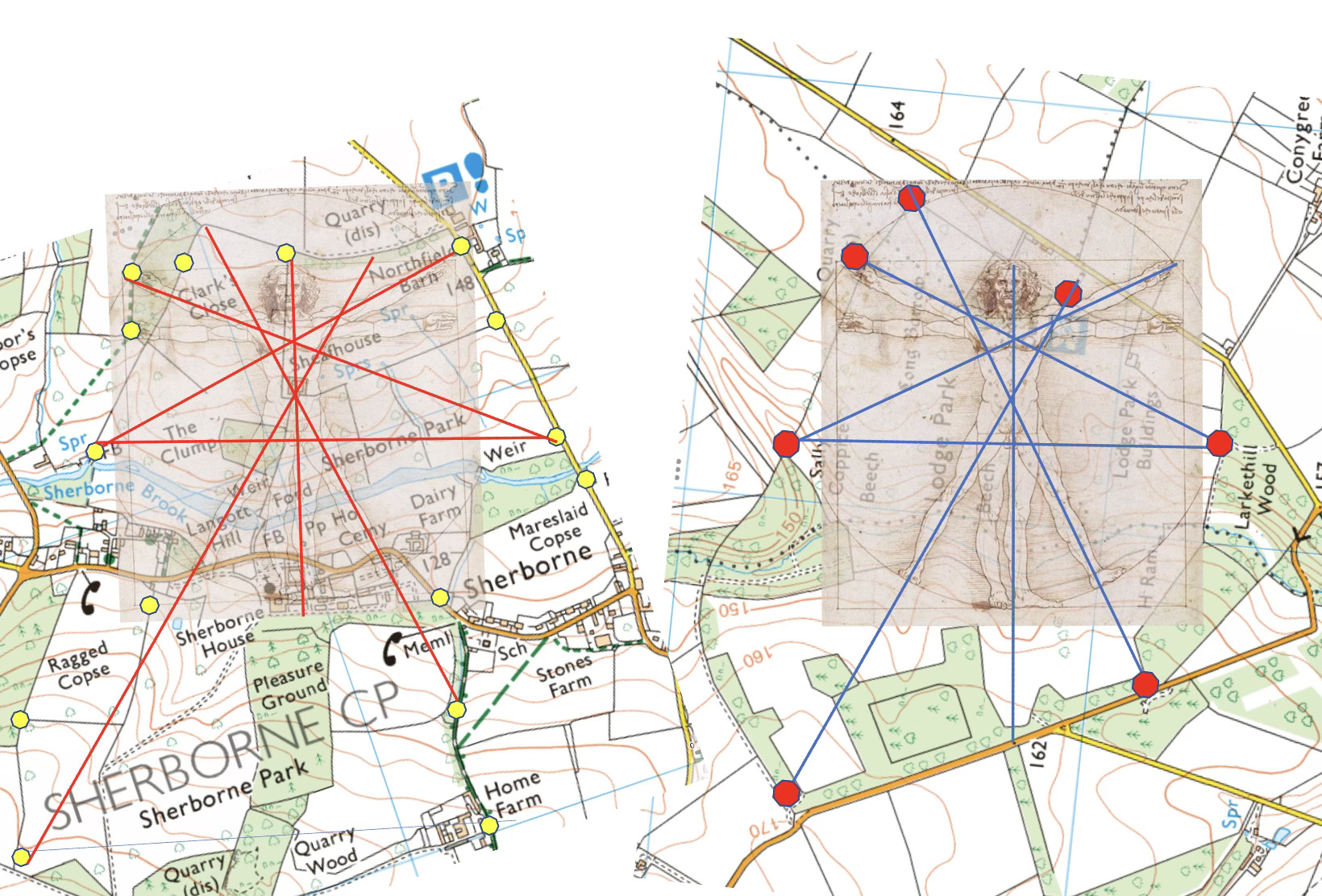
Some noticeable features emerge with this direct comparison:
- Identical mid-height alignments: Both parks have gates that align across the midpoint of the man (at his genitals). This is the "halfway height" of the 880-yard dimension, exactly 440 yards from either the top or bottom.
- Similar extended alignment bottom left: Both parks feature an extended "red line" to the bottom left.
- Water features: Both parks have a serpentine watercourse crossing the lower legs of the figure.
The Solstice Connection
Perhaps most remarkable is how both designs incorporate the summer solstice alignment. I hadn’t worked this out until last night. The Vitruvian man proportions create three geometric shapes:
- A square (side length of 880 yards in both parks)
- An equilateral triangle (side length of 880 yards in both parks)
- A circle (slightly larger)
The triangle runs from the central toe to the outside fingers on the left and right. In Lodge Park, the left side of this triangle aligns at 49 degrees - precisely the angle of sunrise on the summer solstice - and incorporates the ancient Long Barrow.
While Sherborne Park's Vitruvian man is rotated approximately 60 degrees from Lodge Park's, this rotation makes the right side of its equilateral triangle align perfectly with the same summer solstice angle of 49 degrees. This seems beyond coincidental. In the image below I have highlighted the sides
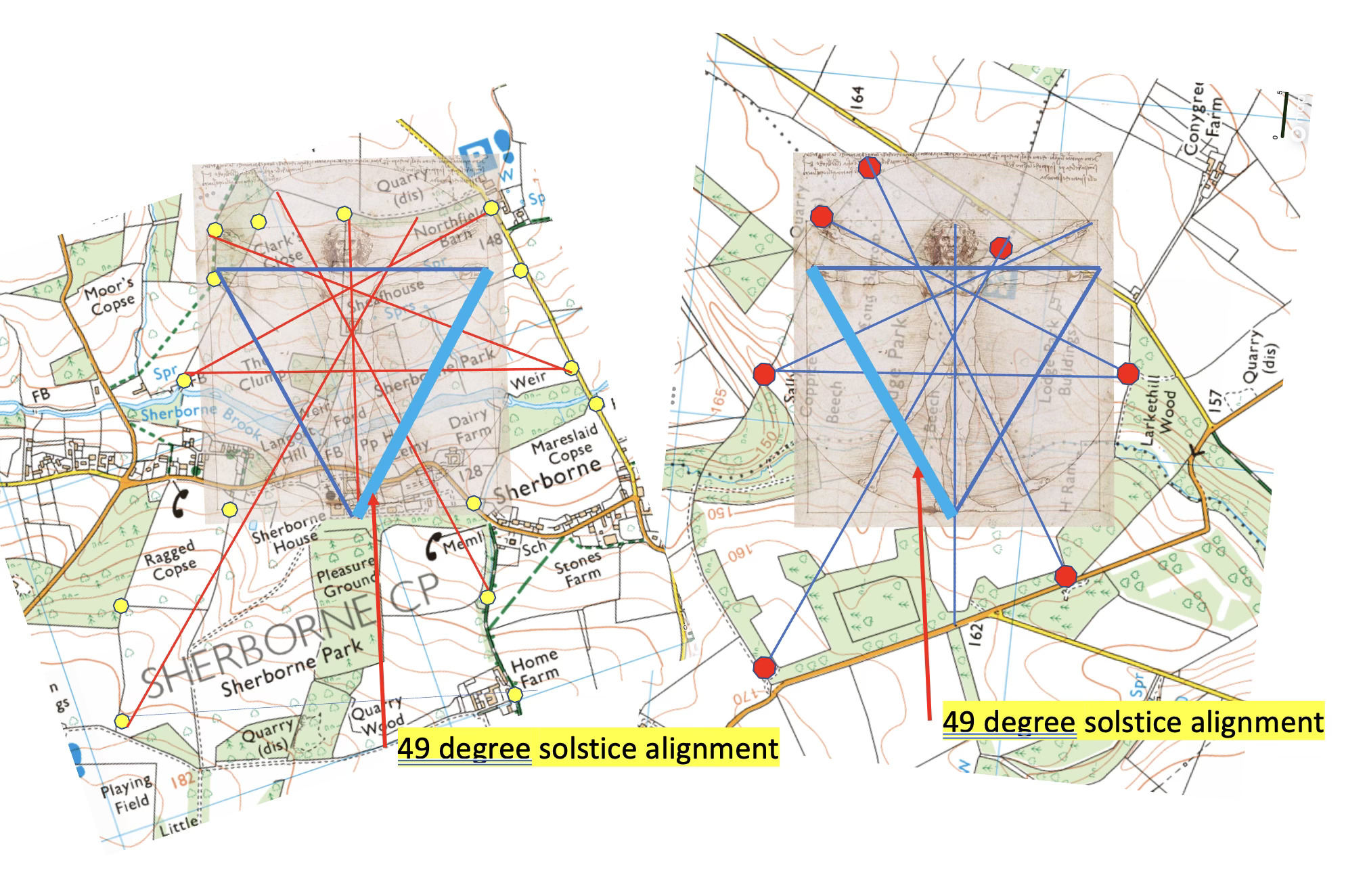
I think that’s pretty amazing. the two parklands are essentially twins, built to a very similar design construct using identical proportions. I would agree I need to prove this now using some better graphic/GIS software but I’m very excited by the prospects. I think there’s enough here using crude graphic software to warrant that deeper dive. What do you think?
A Wider Pattern?
I've identified another potential "Vitruvian landscape" (also using the exact 880-yard scale) where the right-hand isosceles triangle side aligns exactly north-south (180 degrees), at Greenwich Park in London , and I’m in initial discussion with the Royal Parks about that. Here’s an image - note the positioning of the Queen’s House at the centre and compare with the Sheafhouses building in Sherborne Park, itself built on the site of an earlier T shaped building. Both are right on the navel.
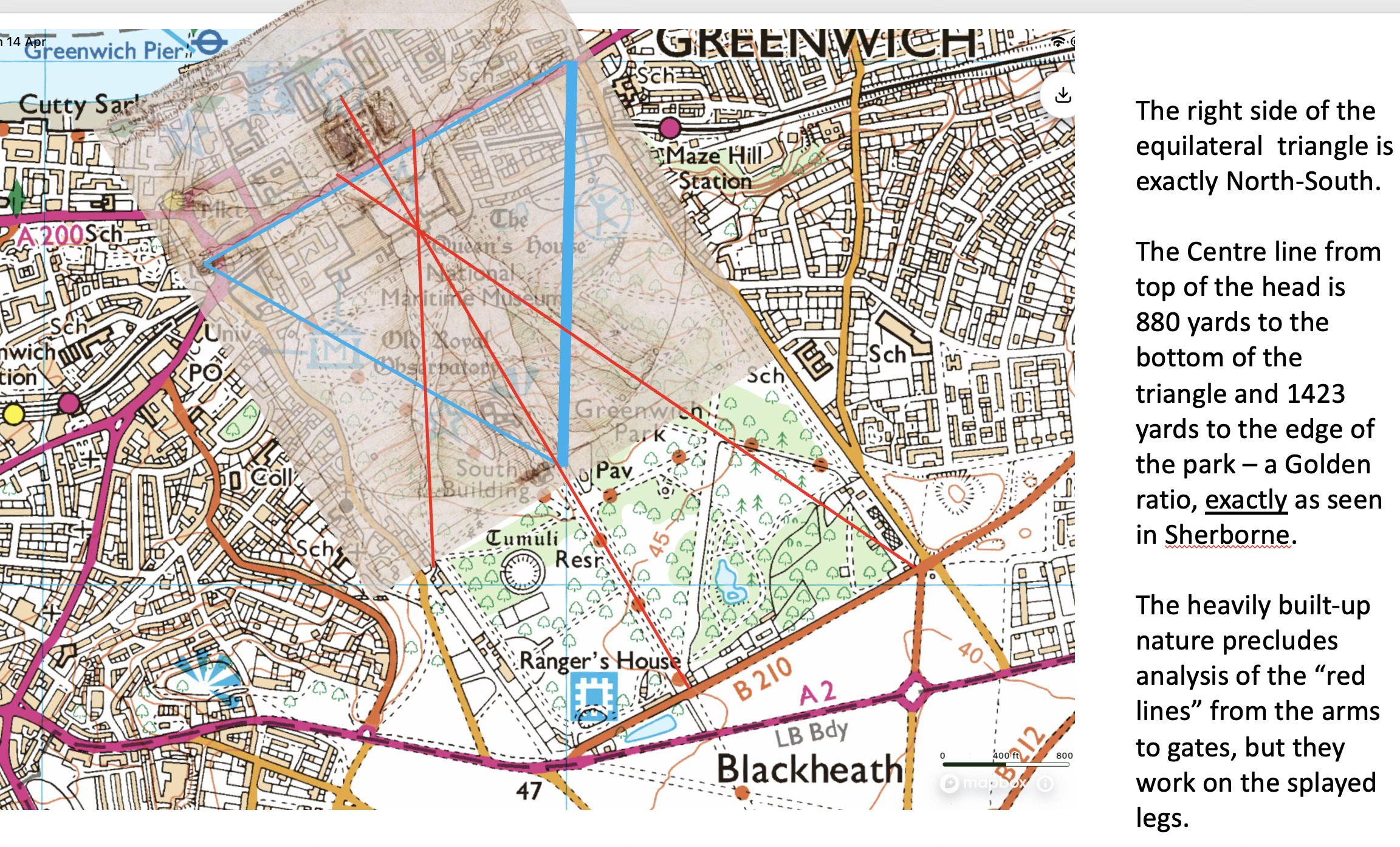
There’s a small prize for any subscriber who spots the VERY weird coincidence about this construct (even weirder than you might initially imagine).
The Inigo Jones Connection?
These discoveries have led me toward investigating Inigo Jones as a potential designer. He positioned the Queen's House in Greenwich around 1617, which appears to sit at the centre of a Vitruvian-proportioned layout. Jones was long thought to have had involvement at Lodge Park although dismissed issued in recent decades), and last year I found gates attributable to his style near Sherborne House shown in a drawing of c 1710. The timeframe would align with "Crump" Dutton's presence in Sherborne. But we are a long long way to go before we can make that as a serious suggestion and there are all sorts of hurdles to surmount. For now all I can do is to point and say “Look!”.
While this remains conjecture rather than proof, the accumulating geometric evidence suggests these three identically scaled landscapes were designed according to sophisticated mathematical principles that have remained hidden for centuries. I welcome alternative interpretations or refutations of this theory. It is the best and logical way of establishing new theories. Working it through accurately on a GIS system is the next step. I’m engaged in initial discussions with the Royal Parks in London and with a TV producer who contacted me expressing interest. So far the National Trust in Sherborne-Lodge Park have not expressed any acknowledgment or interest, and that’s fine, so be it, I’m not bothered by that. They probably think I’m a lunatic. Maybe I am.
