Clearing Sherborne's Broadwater in history
I spent some time today talking to a gentleman called Vaughan Taylor. Vaughan was brought up in Sherborne. The Taylor family go back several generations, and indeed his ancestor was the Sherborne turbine electrician who ran the turbine house down by the lower weir. His parents ran the village shop and telephone exchange for some time. Vaughan worked for the Sherborne estate as a young man. Today he is an expert groundwork contractor.
Vaughan has some fascinating background knowledge of the management of the Sherborne Broadwaters, that is, the upper Broadwater and the lower, Narrow-water. He says both were slightly narrower in his day, and the extra width has happened because cattle have been allowed to degrade the edges.
Until the early 1980s, the vegetation was removed once every five years, and the silt was removed once every 10 years. I picked away at his knowledge to understand how this happened.
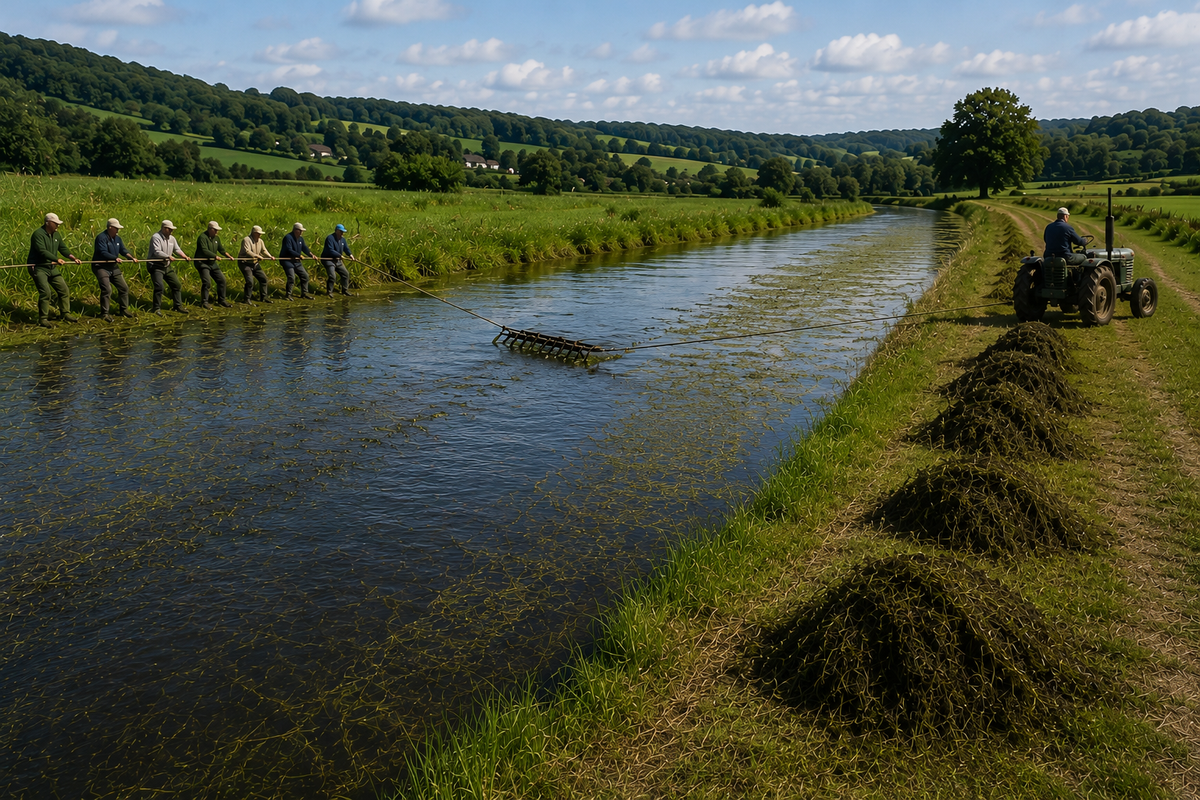
As far as the vegetation was concerned. They often used a small tractor with a cable and a standard agricultural harrow on the end of a cable. A small team of men dragged the harrow to one bank with the cable leading across to the southern bank. They released the harrow, and the tractor then drove across the meadow, pulling the cable and harrow, extracting vegetation quite cleanly from both lakes. The vegetation was left to rot on the lake side. Today, one might use two tractors, one on either side of the lake.
As for the ten-year removal of silt from the lakes, a few comments to make: Firstly, the silt never got as bad as it is now, where it has been left for several decades. Secondly, even in the 1980s, there was no suggestion of any toxic or waste material in the silt. It was, by and large, mineral silt or degraded leaf mould from the leaves all along the valley. What they did was this: Firstly, they opened the sluice on the weir in the centre. Vaughan believes that the mechanism hasn't changed and should still be able to be operated with a little bit of encouragement, the right key and a long lever. They then opened the sluice in the lower of the two sluice channels by the lower cascade, just downstream from the turbine house. If done carefully, this did not release large volumes of silt into the lower river. Basically, the water settles slowly, leaving the mud and the silt standing, and the lake turns into a 2 m wide stream in the middle. The mud and the silt were allowed to dry for several months, maybe four or five months. And then an excavator with a long arm was used to extract that dried powdery silt and spread it on the field immediately to the south of the lakes. That removed all of the silt, which provides the planting medium for the vegetation that was removed in five yearly intervals. The dug-out silt was spread on the fields and very rapidly grassed over. It's a very good planting medium. Vaughan told me how the villagers often went hunting for Roman coins with metal detectors, although he can't remember any being found in that silt.
Once the silt on the bottom of the lake had been removed and the banks reshaped or repaired, perhaps making the lakes very slightly narrower, the sluices were closed again, the lakes filled, and we had large expanses of open water, a spine of open water in the valley bottom, again.
If requested, Vaughan would be delighted to work up a method statement, a modern method statement, describing how it was done until the 1980s. I've heard other stories of a long chain with razors being used to remove vegetation as well, we've seen recently another technique used at the Haycroft Lake to successfully remove vegetation for not much more than £1,000. So this is not a new process, albeit the silt removal that hasn't been done the Broadwater and the Narrow-water for a few decades now.
Vaughan and I also discussed whether carbon is being captured, or "sequestered," in the lake bed. There is an argument that the silt — rich in vegetation-derived organic matter — represents a useful carbon store. With Vaughan's historical knowledge and my more recent fieldwork, we don't believe this holds. A functioning, open-water lake can indeed sequester carbon in stable sediment. But the Broadwaters is no longer that. It has succeeded to a shallow, silted swamp, and that changes everything.
At the bottom of a swamp, oxygen is absent. Without oxygen, the normal decomposition pathway is bypassed, and a different microbial process takes over: anaerobic decomposition, producing methane rather than carbon dioxide. Poke the silted bed with a stick and bubbles rise immediately. This is called ebullition, and it is a recognised field indicator of active methane production. Those bubbles are not carbon dioxide (carbon dioxide dissolves much more easily). The bubbles are methane, which is approximately 80 times more potent as a greenhouse gas than carbon dioxide over a 20-year period (IPCC Sixth Assessment Report, 2021).
The contrast with the alternative is stark. Spread that same silt on a field, and aerobic decomposition takes over. Carbon dioxide is released slowly, and plants establish, taking up carbon as they grow. The carbon re-enters the productive cycle. Leave the silt waterlogged in a swamp, and it produces methane continuously, with no productive offset whatsoever. It is not a good ecological situation at all.
So the Broadwaters is not sequestering carbon. It is generating one of the most damaging greenhouse gases we know, quietly and persistently, while sitting behind a heritage dam.