Lines in the landscape
In a number of recent posts and my research more generally I have observed what appear to be alignments of prehistoric features across our local landscape. I know that quite a number of my readers are attracted by this idea, and many of you believe in the existence of ley lines. At the risk of alienating some of my readers, who I am very loyal to, I think it's worthy of discussion.
Sadly, I'm an engineer by training and a scientist by instinct, so let me be clear about my own position first. Some readers of this blog believe ley lines carry a real, detectable energy through the landscape. Many believe that they can be traced by dowsing. Some suggest mysteries that seem a little mystical, perhaps. I respect that view, but I don't share it. There's a comprehensive wiki article here that gives a reasonable background to ley lines. I'd emphasise that ley lines were unheard of before the 1920s, then lost some fashionability, and then, with the new age mystical theories that appeared in the 60s and 70s, reappeared, but in general terms this has died off again. There has, in past decades, been much discussion of ley lines around Sherborne, with perfectly respectable people suggesting there are a number of them. I personally don't subscribe to that view.
My own approach here is more evidential, closer to engineering than to esotericism. I know of no empirical evidence for such an energy in the ground or across the landscape. In my world, the real world, energy has a unit and it has a form. People who talk about "Earth energies" on ley lines have no units, cannot define the source of the energy or the work it does, and can't explain how extremely sensitive scientific meters cannot detect their presence. There is no empirical evidence to point towards, seeking explanation for a phenomena. And I'm very aware that the human brain sees things it wants to see. I'm also very aware of the ideomotor effect, which many of the dowsing proponents resist. The psychology of the ideomotor effect or the ideomotor phenomena is fascinating and worthy of lots of attention, but doesn't make ley lines real. I don't doubt too that the romantic aspects of something, perhaps just a little bit unknowable, are very attractive too. Thus, I'm a great believer in the importance in social histories, of ghost stories or the supernatural, of things slightly mysterious and all that sort of stuff. I've even told the odd tale myself. It's really important from a social history perspective, but from a scientific perspective, I'm afraid you'll get a shake of the head from me.
Dowsing itself has been tested directly. The largest trial ran in the 1980s, funded by the German government. It covered over ten thousand double-blind tests on five hundred dowsers. Early analysis claimed success. A later, more rigorous review by Jim Enright found the results no better than chance, and not reproducible. I've observed similar tests (double blind, fully randomised with controls) in a specific area during my working career, and frankly, the results were laughably bad, all the proponents were willing to bend themselves in knots to explain their poor performance. I felt that they were fooling themselves more than they were trying to fool me. If you've seen dowsing occurring, by all means reference it, but for me to take interest, it needs to be a formal scientific double-blind test with a randomised control. Ideally peer reviewed in a scientific journal too!
I have seen the same problem myself more recently. A dowser was invited onto a field to find water, using a pendulum he said could trace ley lines too. He marked a spot and predicted water at four feet down. They dug there, and found water at exactly that depth.
That looked convincing, until twelve more holes were dug at random across the same field. Every single one struck water, at a similar depth. The field simply sat on a shallow water table. Water was everywhere, so finding it there proved nothing about his method.
The same logic runs through this whole piece. Finding one line proves little, when almost any three points would produce one.
The question this piece asks is narrower and more mundane. It is whether a geometric alignment between real, dated monuments reflects design or coincidence.

Look at the image above. Is it a map of prehistoric sites, or fifty crosses placed at random?
It is the second. Every cross was positioned by a random number generator, with no pattern intended at all.
Try tracing lines through it anyway. Three or four crosses will fall into a near-straight row. A few more will line up with a nearby church tower or hilltop, if you had one to add. The eye is very good at finding alignment, even where none was built.
That is the real problem with alignment archaeology, not ley lines or dowsing. This part of the world holds an unusual density of genuine prehistoric monuments: barrows, mounds, and standing stones, scattered across a few square miles like the crosses above. With that many points on the ground, some alignment is almost guaranteed by chance alone.
So a real alignment needs more than a straight line on a map. It needs evidence that has nothing to do with geometry: a document, a dated construction phase, or something physically built to mark the line. (Maybe a pair of oak trees?)
One qualification softens this scepticism. Not every bearing is equally likely to matter to past builders. Solstice sunrise and sunset held ritual significance across Neolithic and Bronze Age Europe, from Newgrange to Stonehenge. An alignment on that exact azimuth is not drawn from the whole compass at random. It is drawn from a small set of bearings those cultures are known to have prized. That narrows the field considerably, and makes a solstice match harder to dismiss as chance than an arbitrary bearing would be.
Some alignments here sit very close to a true solstice azimuth, tighter than chance would easily explain. That precision does not prove intent. But it makes intent more plausible than an arbitrary bearing would, given how few directions mattered this much to these builders.
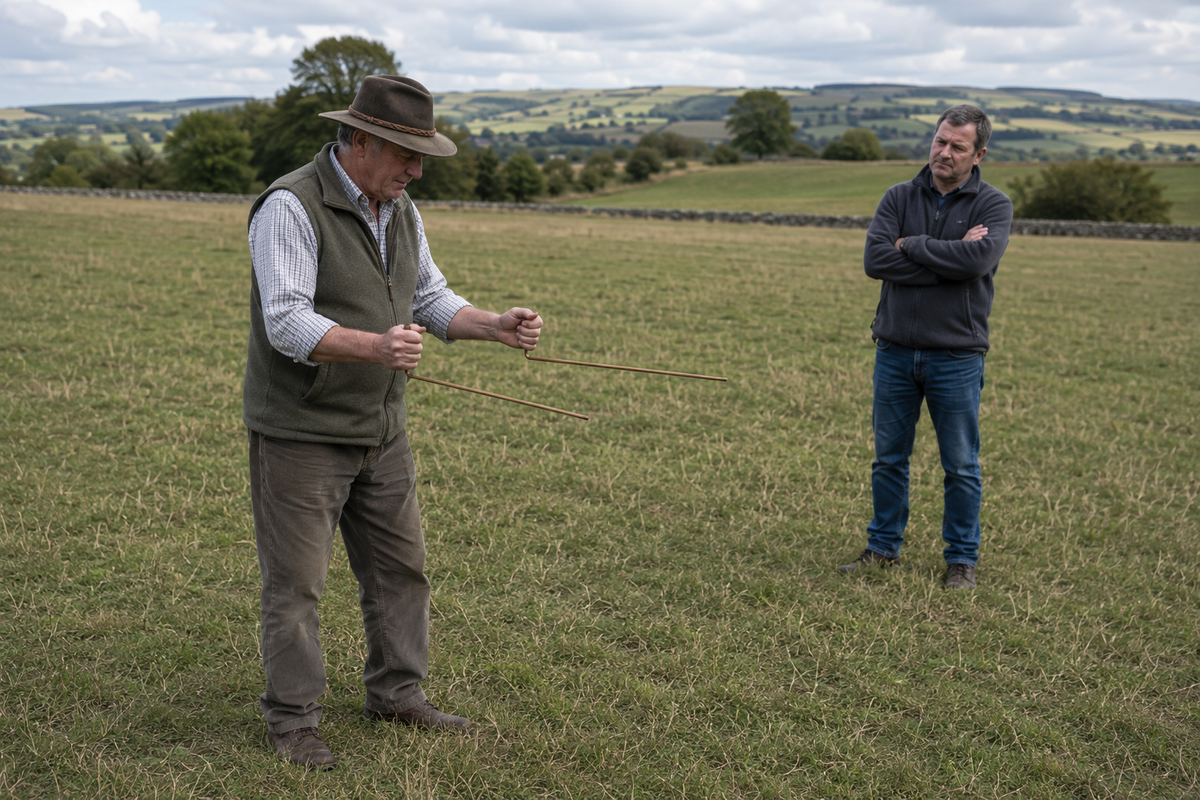
A line on a map proves nothing alone. A tight fit to a significant astronomical bearing earns a stronger conjecture, not yet a finding. I'm going to be doing some statistical work on prehistoric sites in the local area over the next couple of months that will help us understand the probabilities, as a mathematical number, of our alignments along solstices being chance or deliberate. Of course I welcome dialogue from you, the recipients of these emails ,who may hold very different opinions, and that's absolutely fine. But don't turn up with a pair of welding rods and suggest a walk in the field, because that is not a double-blind randomised test. :-)
Source: Enright, J.T. "Testing Dowsing: The Failure of the Munich Experiments." Skeptical Inquirer, 23:1 (1999), 39–46.