Sherborne's Annual Meeting
Next Wednesday , 27 May is the date of the annual Parish meeting. It's at 7 p.m. in the village club.
This meeting is important. It's the chance for the entire village to get together to discuss what's important to us and see what the Parish Council's priorities will be for us over the next year and maybe influence them as well. If nothing else, it supports the volunteers on the parish council and allows them to listen to concerns. It gives the Parish Council the power that a village community stands for. If they know what's important to us, they can represent it with vigour and confidence. I really would urge you all to attend.
Two reminders:
The village cricket match is still looking for players, and I really hope that the players will get an audience too. I know the teams are not just looking for secret professionals, but enthusiastic amateurs of any ability as well. All will be welcome. This promises to be a great community event and hopefully will bring us all together. Fancy opening the bowling? Make a maiden test century in your own village? Fumble a catch in the slips to the cheers from the crowd?

The exhibition by the Sherborne Archives on the 31st of May is also important. Sherborne Brook Support Group has provided them some information posters on the historic mills of Sherborne that you may find interesting too.

Removing vegetation from lakes on there Sherborne Brook
Last Friday, I was invited up to look at some work going on at Haycroft Lake, just a couple of hundred yards upstream of Waterloo Bridge. The lake is part of the Sherborne Brook, and of course I'm interested in everything on the Sherborne Brook, and most of you are too.
You will recall that Haycroft dredged the lake and spread the resulting silt onto some nearby fields, where they grassed over within a matter of weeks and that is now invisible. That was about three years ago.
Yesterday they had a machine on rental that came from Cardiff, and I managed to speak to the operator and see how it works. To be clear, this is just addressing vegetation and not silt.
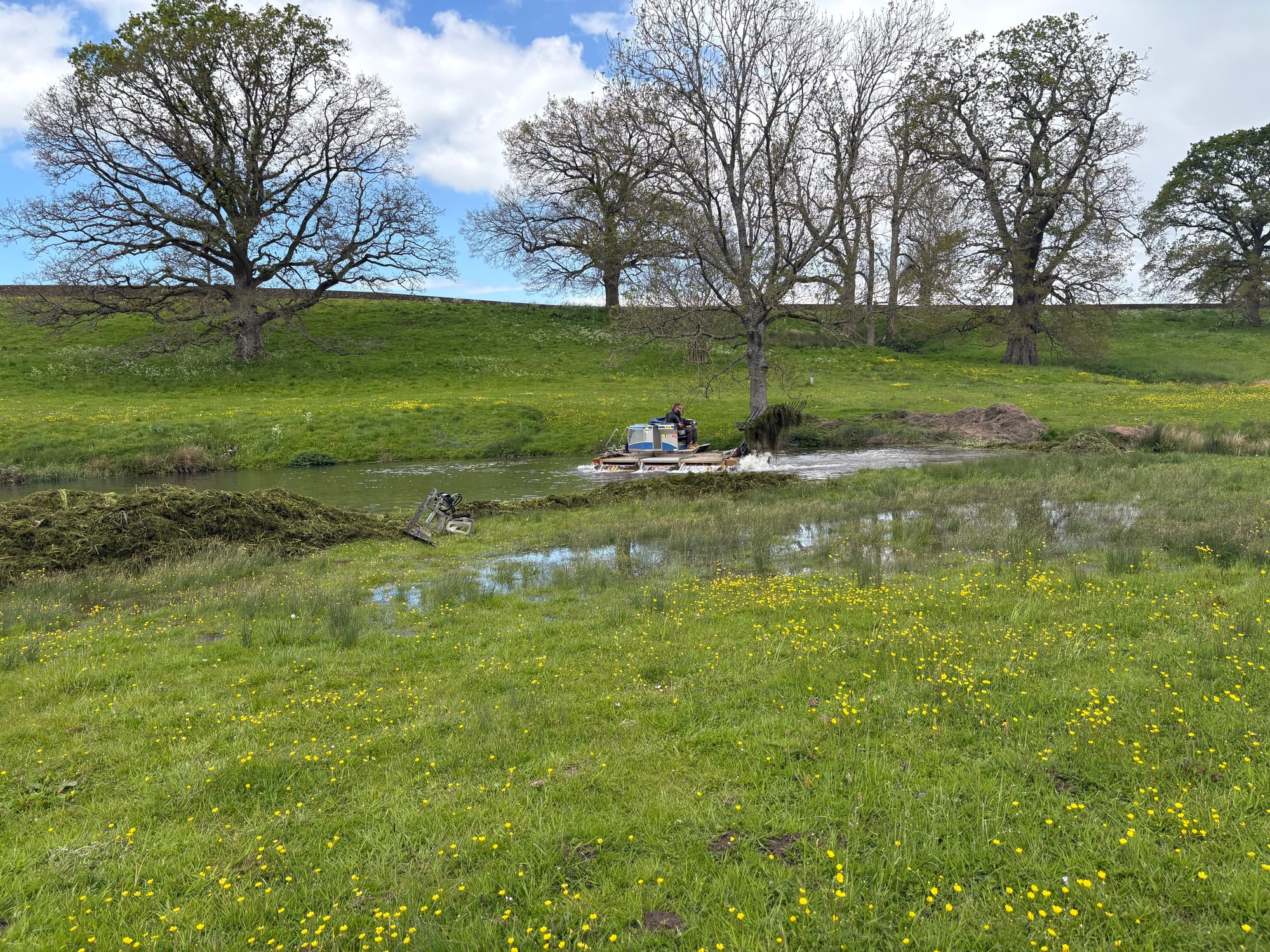
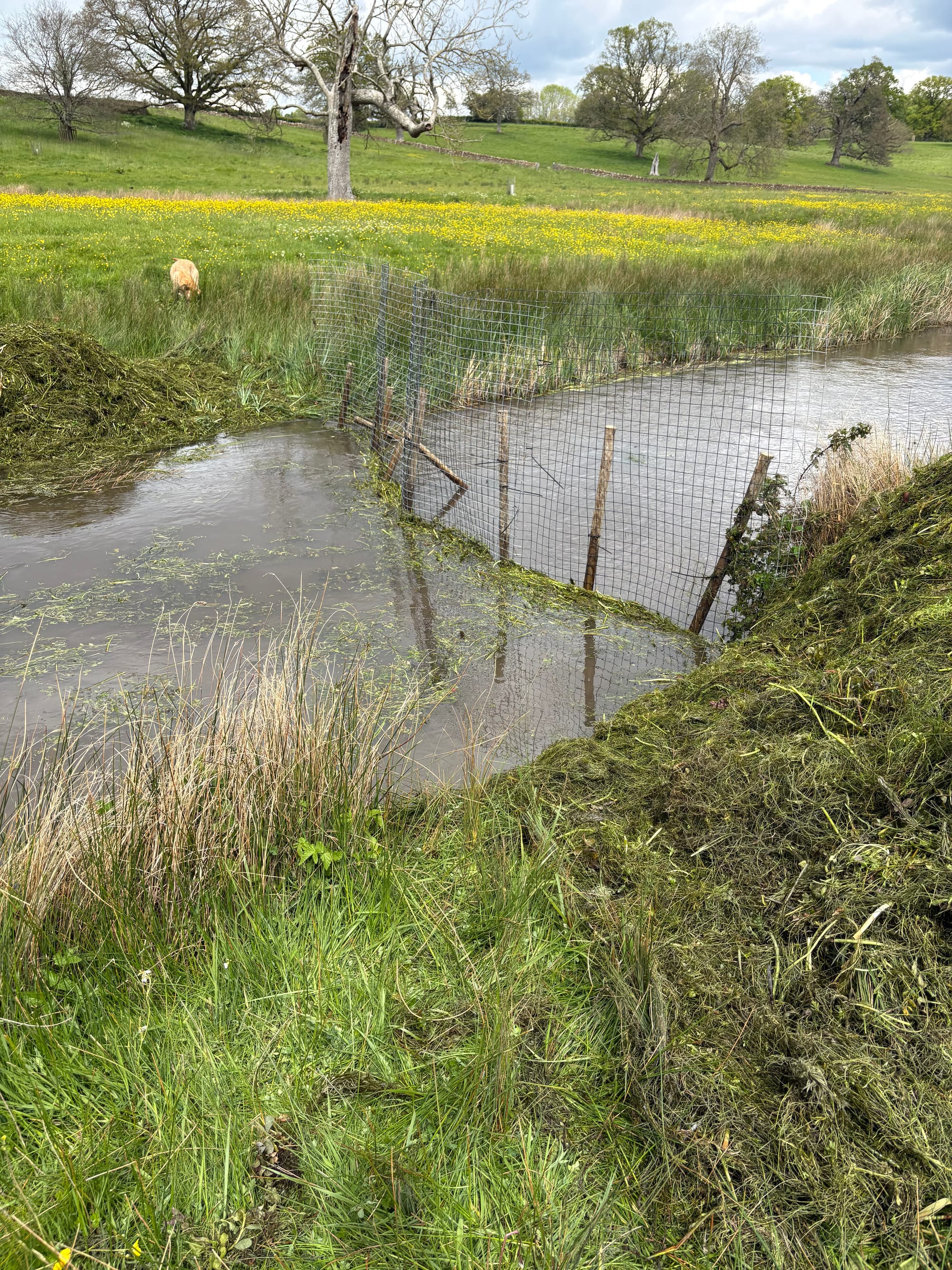
This is the machine. Think of it as a mechanical floating rake. The man operating it was quite expert, and helpful in his explanation of what happens, as were our friends at Haycroft Farm. In the morning, the mechanical rake cuts the weed, and most of it drifts down to a dam.Below the dam, the Haycroft team had set up a number of grills and grids to catch any vegetation that came over the dam and prevent it clogging up the waterway downstream. In the afternoon, the mechanical rake piles that cut weed onto the banks on either side.
Here's one of those grills with the weed piles on either bank.
I spoke to the operator, and he reckons that in one day's work he can cover an area three times the area of the lake at Haycroft. I tried to get an idea of the cost, and the operator said it was somewhere in the region of £1,000 a day. Perhaps a little more, perhaps a little less.
Clearly, it needs a 'home team' to pull any weed that drifts downstream out by the grills, but otherwise the machine piles the weed on the bank. By golly, will that make some good compost!
To me, as an amateur, this is very low impact in terms of any damage it causes, and the mitigation measures are pragmatic and effective. It's cheap and it's simple. I have to say the lake at Haycroft looks stunning.
Thanks to Nina, Michael and Sam for giving me permission to observe. I'm pretty sure that today's Haycroft lake stands where the mill pond stood to power the fulling mill set up by the monks of Winchcombe in the 1190s, so there's a lot of history here, a lot of heritage, 800 years worth, that's being maintained.