Sherborne’s Economic Transformation
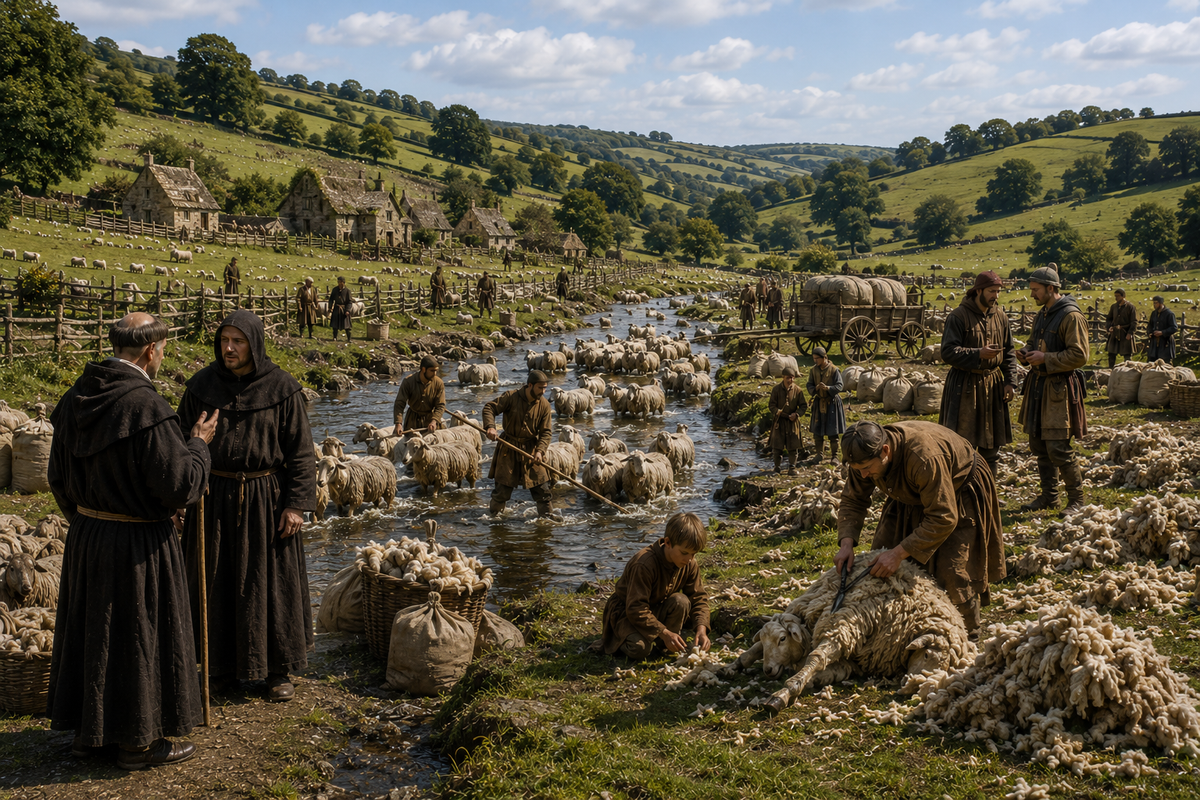
If you had stood beside Sherborne Brook on a June morning in the year 1250, you would scarcely have recognised the village. Our peaceful brook would have been alive with noise. Droves of sheep stretched across the hillsides, arriving from every direction. Some belonged to the monks of Winchcombe Abbey, whose vast flocks grazed the Cotswolds. Others belonged to local flock owners who had brought their sheep to Sherborne because the Abbey offered something far more valuable than simply grazing land. It provided expertise, organisation and access to one of Europe’s greatest markets.
The monks had travelled from Winchcombe to oversee what had become one of the great annual events in the agricultural calendar. This was not simply shearing. It was medieval industry, the beating heart of a nation’s economy. Thousands of sheep were driven through the cool waters of Sherborne Brook to wash the fleeces before shearing. Strong villagers thrust reluctant sheep beneath the surface while boys scrambled amongst the flocks gathering dags and discarded wool. On the northern bank, the animals stood drying in the summer sunshine before teams of shearers moved methodically through the waiting flocks. Everywhere there was movement. The air echoed with shouting, barking dogs, the bleating of sheep and the clatter of carts carrying away tightly packed fleeces. Labourers sorted the wool into grades while experienced monks supervised the quality of every bale.
Among the crowds were merchants and agents who had travelled from Flanders and Lombardy, drawn to the Cotswolds in search of some of the finest wool fleeces in Europe. Having journeyed hundreds of miles to buy Sherborne’s fleeces, it is easy to picture them watching the shearing, handling the newly shorn wool and bargaining with the monks and their local merchants over prices. They sent those raw fleeces in huge wool sacks over to Europe to turn into cloth. Sherborne was not famous because it made cloth. It was famous because it produced exceptional wool.
For the monks of Winchcombe Abbey, Sherborne was the engine room of a remarkably sophisticated business, easily the biggest holding in their broad estate. They owned sheep, organised shearing, graded wool, marketed fleeces and maintained commercial relationships that stretched across Europe. They also appear to have provided a valuable service to neighbouring flock owners, whose sheep could be washed, shorn and whose wool entered the same well-established trading network. The business enterprise of an Abbey was in many ways even more important than their religious enterprise. But this time it was one of the most important industries in the country. The Abbey had created what today we would call a vertically integrated business. Everything happened here. They bred the sheep. They arranged for the shepherds. They owned or controlled the land and rented farms out specifically to farmers to run sheep. They offered a service to other land owners and sheep owners. They employed Sherborne villagers, our predecessors to wash and shear the wool. They marketed the wool and sold the wool through a network of merchants to international customers in Northleach. This was the top and the bottom of the wool trade, all in one place, controlled by Winchcombe Abbey. The economies of scale pushed them towards detailed coordination, and it was Sherborne’s resources that allowed that economy of scale. In the Middle Ages, only the church's large Abbeys had the clerical ability to run such a sophisticated international business. Winchcombe Abbey turned the handle, and we, the Sherborne Villagers, were just a cog in their machine.
Then, almost overnight in historical terms, everything changed. The Dissolution of the Monasteries swept away an organisation that had taken centuries to build. The monks disappeared. Their commercial networks vanished with them. The great seasonal gatherings around Sherborne Brook became quieter. England itself was changing. But the business fundamentals were also changing. Increasingly, wealth came not simply from producing fine wool but from turning that wool into finished cloth. Government policy encouraged the export of manufactured cloth rather than raw fleeces, while the rapidly developing textile communities of the Stroud valleys became centres of weaving, fulling, dyeing and finishing. I think it’s also important to recognise that the pre-eminent position of English wool in the european market changed. The high quality of Spanish merino wool became very competitive with the English Costwold Lion wool in the 15th Century. In part this squeezed the market for fleeces, and in part it encouraged the production of cloth as the end product rather than fleeces.
It would be easy to conclude that Sherborne declined. I am beginning to think that it did something far more interesting. It adapted.
A remarkable county survey carried out in 1608 provides an extraordinary snapshot of Sherborne during this period of transition. It records more shepherds than any other village in Gloucestershire. Husbandmen are plentiful. There are several millers. Many men are employed directly by the Dutton estate. These are not anonymous figures from history. These shepherds in Sherborne in 1608, are not anonymous figures from history - we know their names. Here they are.
Richard Arther
Ralph Buntinge
Richard Clarke
Ralph Cooke
Nicholas Crypps
Thomas Hankins
Thomas Lawrence
Thomas Sansome
Richard Smith
What is almost entirely absent are weavers, tuckers, fullers, dyers and clothiers. Sherborne was still producing wool fleeces. It simply was no longer where most of the value was being added. Meanwhile, communities such as Minchinhampton, Woodchester, Rodborough, Horsley, Painswick and Bisley were becoming something entirely different. Their occupational lists from 1608 are dominated by weavers, tuckers, fullers, dyers and clothiers. This was not an agricultural revolution. It was an industrial one. The fast-flowing streams of the Stroud valleys powered mills. Skilled craftsmen clustered together. Entrepreneurs invested in cloth manufacture. Wealth increasingly came from adding value to the raw material rather than simply producing it. At the same time, national economic policy was encouraging cloth export and not fleece export.
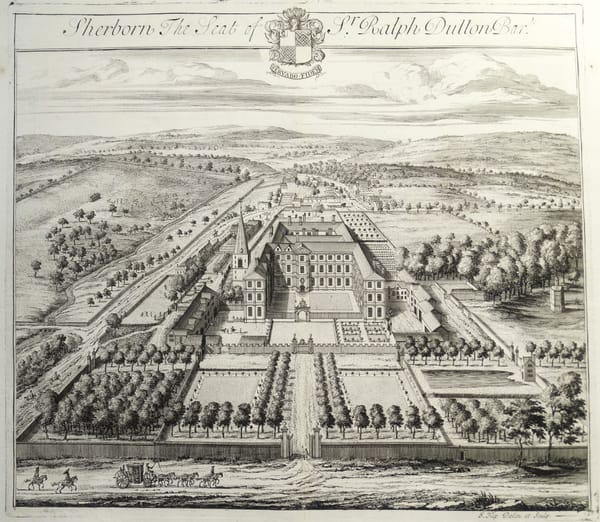
This is where John “Crump” Dutton enters the story, in 1618. The former lands of Winchcombe Abbey had passed into the hands of the Dutton family, who went on to become one of the wealthiest families in the country. At first glance, this seems surprising. The surviving estate records contain remarkably little about marketing wool, running sheep flocks or manufacturing cloth. Instead, they are dominated by leases, rents and estate management.
Perhaps that was precisely the point. Rather than attempting to recreate the monks’ vast commercial enterprise, John "Crump" Dutton who inherited the estate in 1618 may have recognised that the economy itself had changed. The Abbey had managed every stage of the business. But it needed a huge team of clerics to run the complex business. Dutton no longer needed to. His estate owned the land. His tenants farmed it. They bred the sheep. They sold the fleeces. Merchants handled the trade. Manufacturers elsewhere transformed wool into cloth.
The estate increasingly became a business of collecting secure rental income rather than trading wool, probably requiring no more than one or two people to do it. It was now the farmers, his tenants, that carried the risk. If the wool trade didn't generate enough income the farmer diversified into other agricultural outputs.
Today we would call this risk management. Instead of exposing himself to fluctuating wool prices, trade wars, uncertain overseas markets and the growing costs of manufacturing, Dutton concentrated on owning the one asset that remained indispensable: the land itself. He reduced commercial risk while preserving the long-term wealth of the estate. Given the rise of the Dutch Republic in the early 1600s and then the Thirty Years' War, these produced real business risk - Europe was often in turmoil. Dutton washed his hands of the business risk and concentrated on owning the land. That required remarkably little clerical support - very low overheads compared to a Benedictine or Cistercian monastery!
Other people would then manage the riskier side of that production chain to produce and sell woollen cloth or do other things with the agricultural land. It was, in many ways, an extraordinarily modern business strategy. Perhaps that is Sherborne’s real story. Not one of decline after the Dissolution, but one of reinvention.
The monks maximised profit by controlling every stage of production. Dutton maximised security by controlling only the land. Both strategies reflected the economic realities of their own age. A large Benedictine abbey had dozens of literate monks who could keep accounts, negotiate contracts, correspond with merchants across Europe, and manage complex estates. After the Dissolution, even a wealthy landowner rarely maintained anything like that administrative apparatus. In other words, the abbey’s business model wasn’t just difficult to continue—it depended on a type of institution that no longer existed. Sometimes the greatest transformations are not about doing more. Sometimes they are about understanding that the world has changed—and having the wisdom to change with it. Modern Sherborne still underneath is a reflection of that change in business, a village surrounded by farm estates, one without many sheep. Crump Dutton's business risk reduction created the village we live in today. And the Sherborne Brook still runs down the middle, reminding us of our ancient heritage.