Ancient geometry at play in our landscape
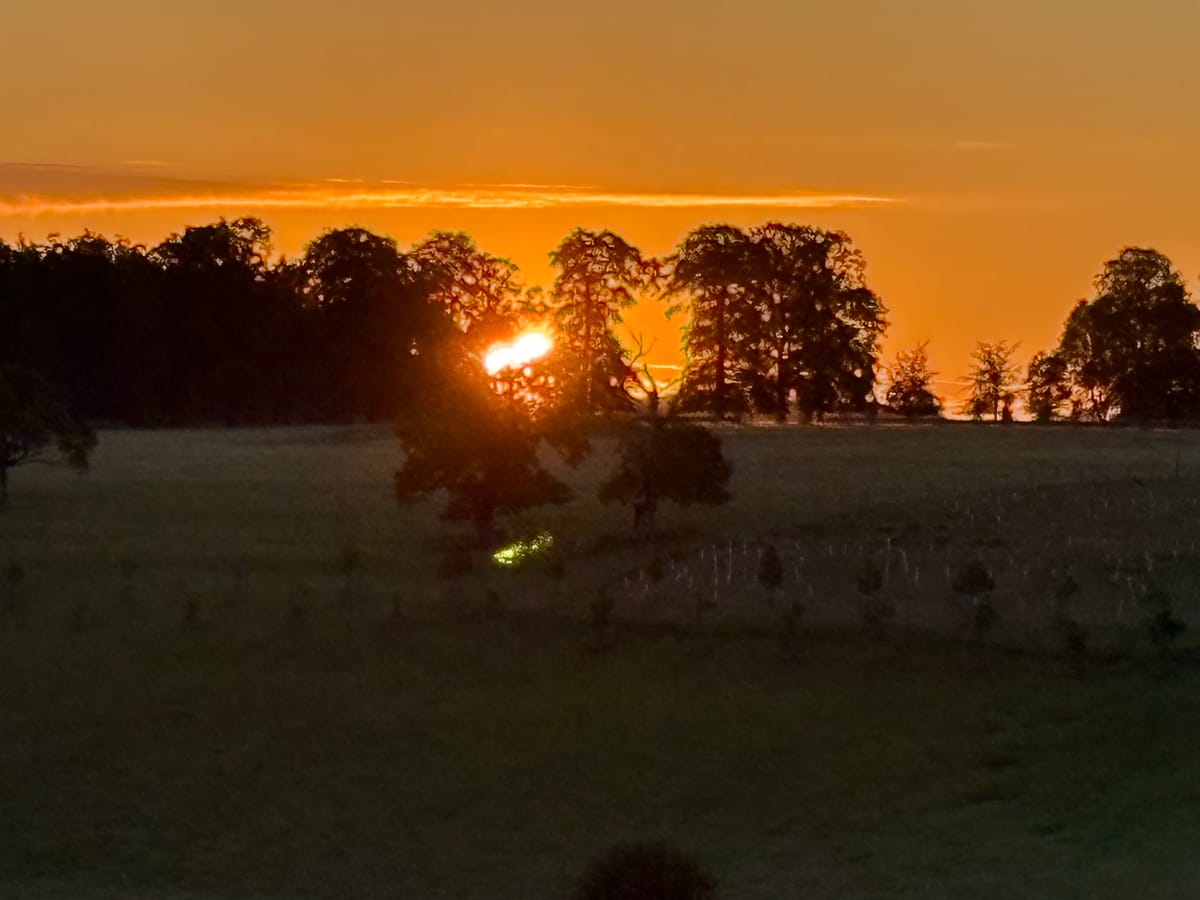
In my last post about Lodge Park, I promised to explain the link between Charles Bridgeman, his 1729 design at Lodge Park and the summer solstice.
On Midsummer's Day last week I measured the midsummer sunrise at Lodge Park and pinned the solstice line with a theodolite app and GPS. If you missed it,start there, because this post sits straight on top of it.
Today I want to show you something that is impossible to explain away. Charles Bridgeman knew about that solstice line, and he built his design on it. I'm going to show you how we know that. Let me take it slowly. There is some geometry, but I will keep it gentle.
This is Bridgeman's own plan of the "New Park", aka Lodge Park, drawn in 1729. For awareness, I undertook this examination on a modern computerised geographic information system, but I'm using Bridgeman's plan in this blog post to show how he used the geometry on his own work. It all matches perfectly on a modern day GIS system. Here's Bridgeman's plan and I have laid my measured solstice line over it, in yellow. Now look at where that line leaves the park. It exits at one precise point. And that point is exactly where Bridgeman's transverse avenue ends.
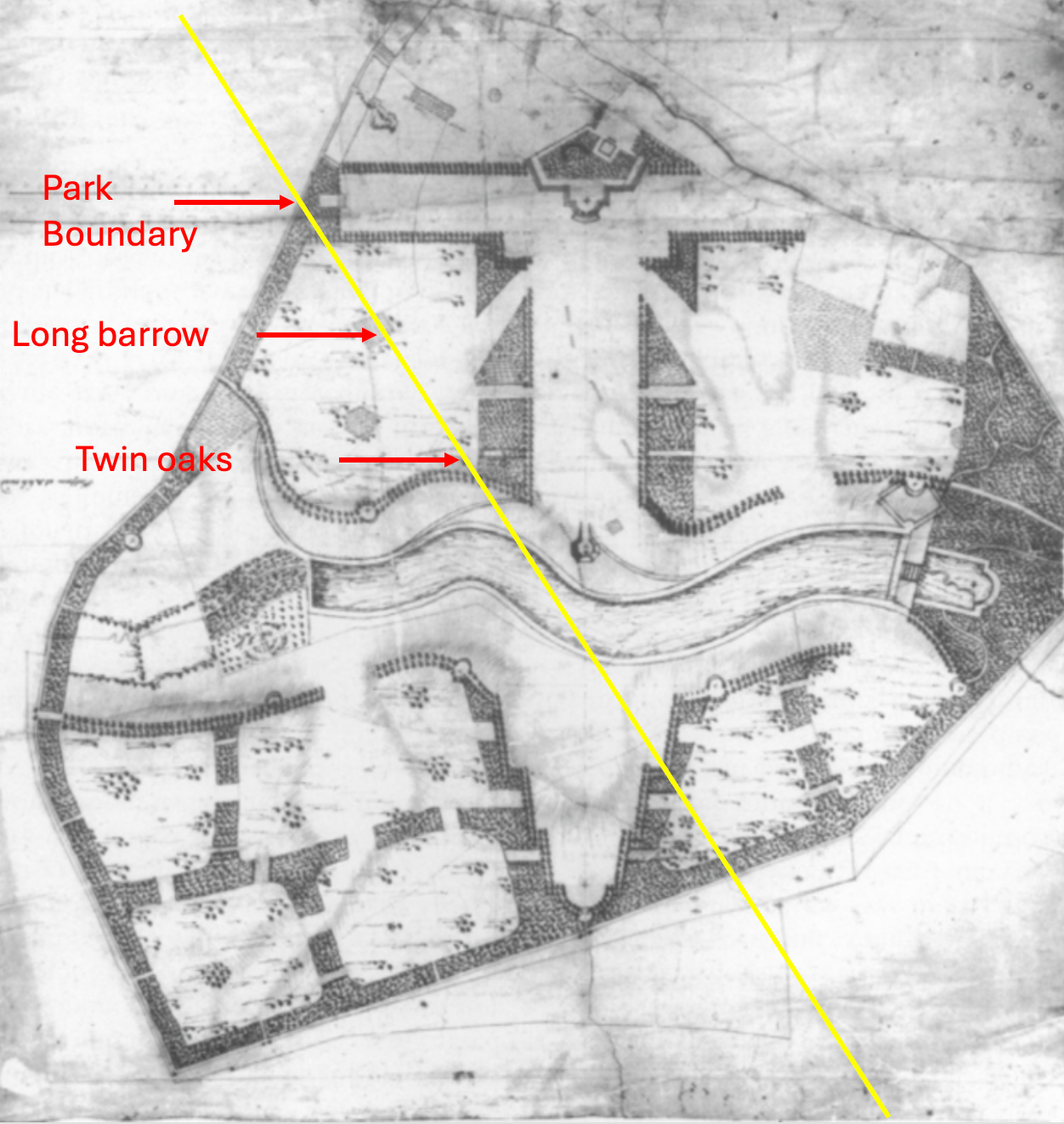
He drew that avenue. I did not move it. The end of his own line sits on the sunrise line, geometrically. On its own, that is striking. It gets better, but I stumbled on the way to this discovery.
Firstly a line along the transverse avenue to the centre of the main avenue measures 440 yards exactly. In fact, such an exact figure that I expected to find other mathematically related numbers elsewhere. But when I plotted that yellow line at 49.8 degrees, it didn't fit. Only from my observation this Midsummer did I calculate that actually the differences in height between my observing point and the horizon meant that the solstice was delayed slightly, and that increases the angle. It comes out at 52.3. So, this is where I got excited. When I plotted that 52.3° azimuth against the transverse axis, it creates, as I show below, an internal angle of exactly 60°. What does that mean? It means that Bridgeman was using an empirically observed angle and not the calculated solstice angle as I was using the 49.8 angle originally.
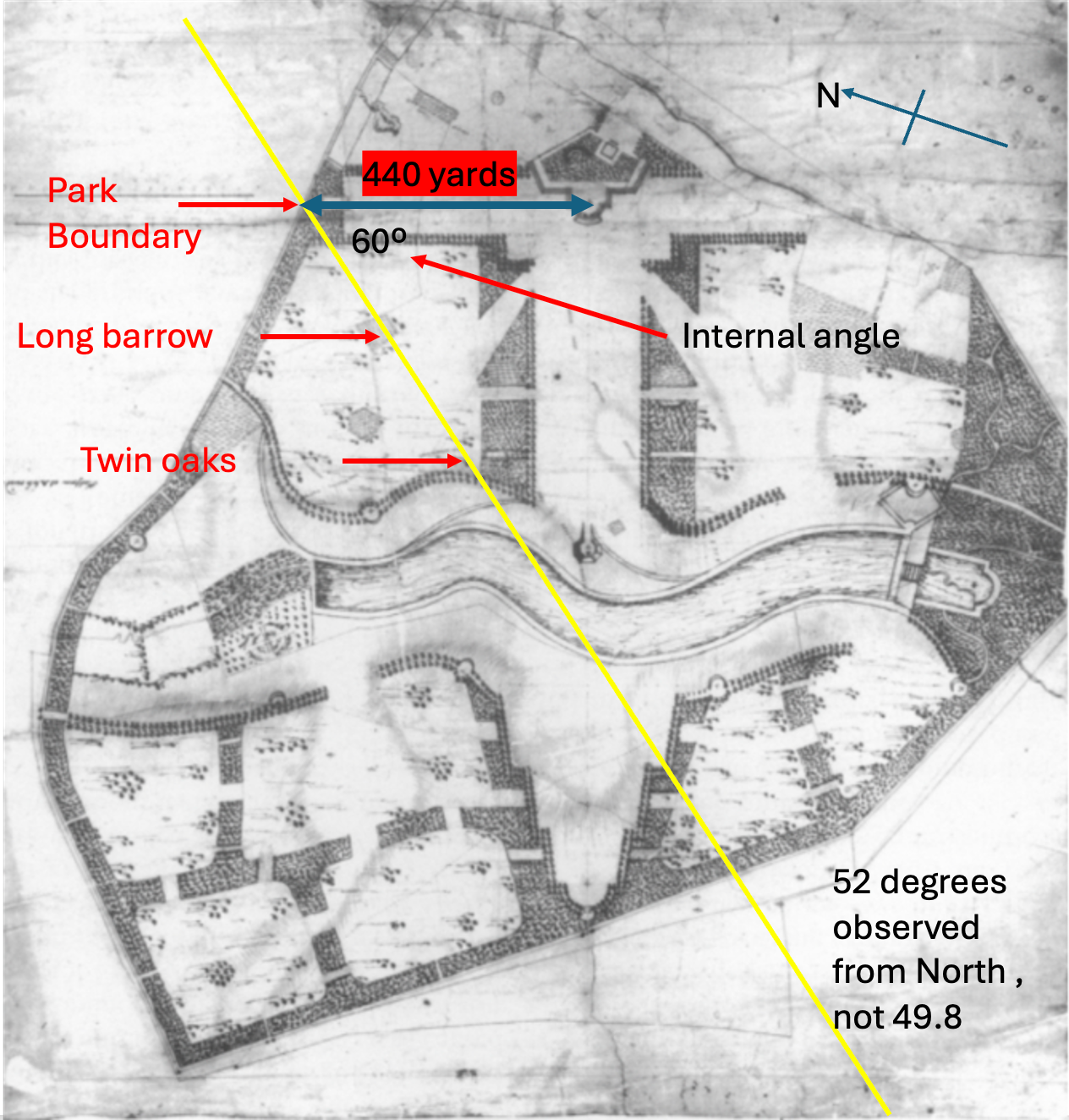
Now I have two sides of a triangle: the solstice line, and Bridgeman's transverse avenue. That avenue measures 440 yards. Hold that number. I then drew a line straight up and down the centre of the main avenue. And the distance from the park boundary, down the yellow line, to where it intercepts that central avenue is a remarkable 880 yards.
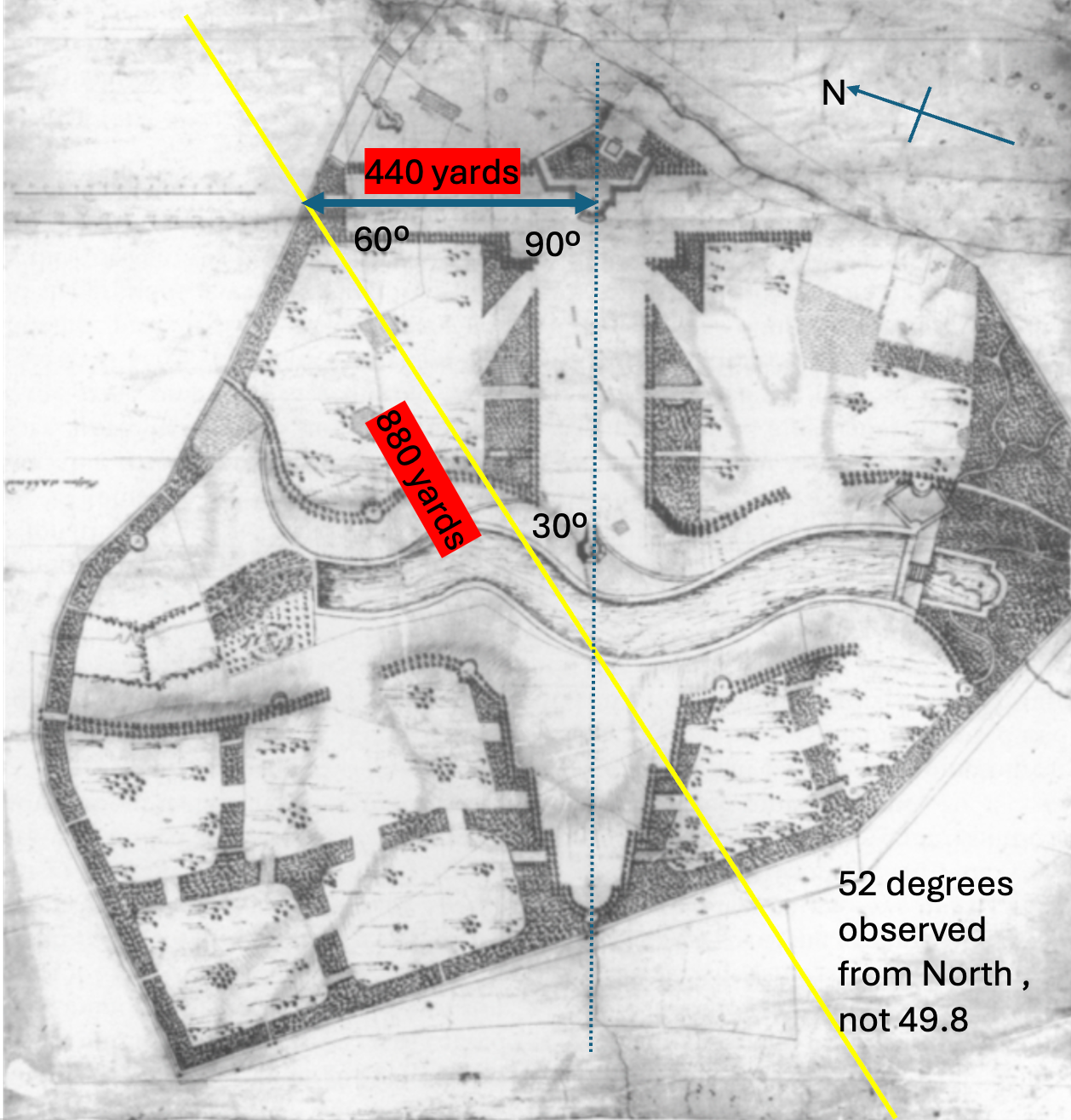
When I close it in my GIS system and read off the angles, they fall out very clear. Thirty degrees, sixty degrees, ninety degrees. Not roughly. Cleanly.
A thirty-sixty-ninety triangle has one defining habit: its shortest side is exactly half its longest. And there it is. The 440-yard transverse avenue is exactly half of 880. A quarter mile and a half mile. The longest side, the hypotenuse, is the solstice line itself, running at the bearing I watched at sunrise.
But hidden in Bridgeman's design is another 880-yard feature that appears to be very significant. This runs from the top of what I'm calling the crown (the little bit of woodland that surrounds the grandstand) from the very top of that crown down to where the solstice line crosses, which is another 880 yards. Isn't that a thing! This is very nice geometry.
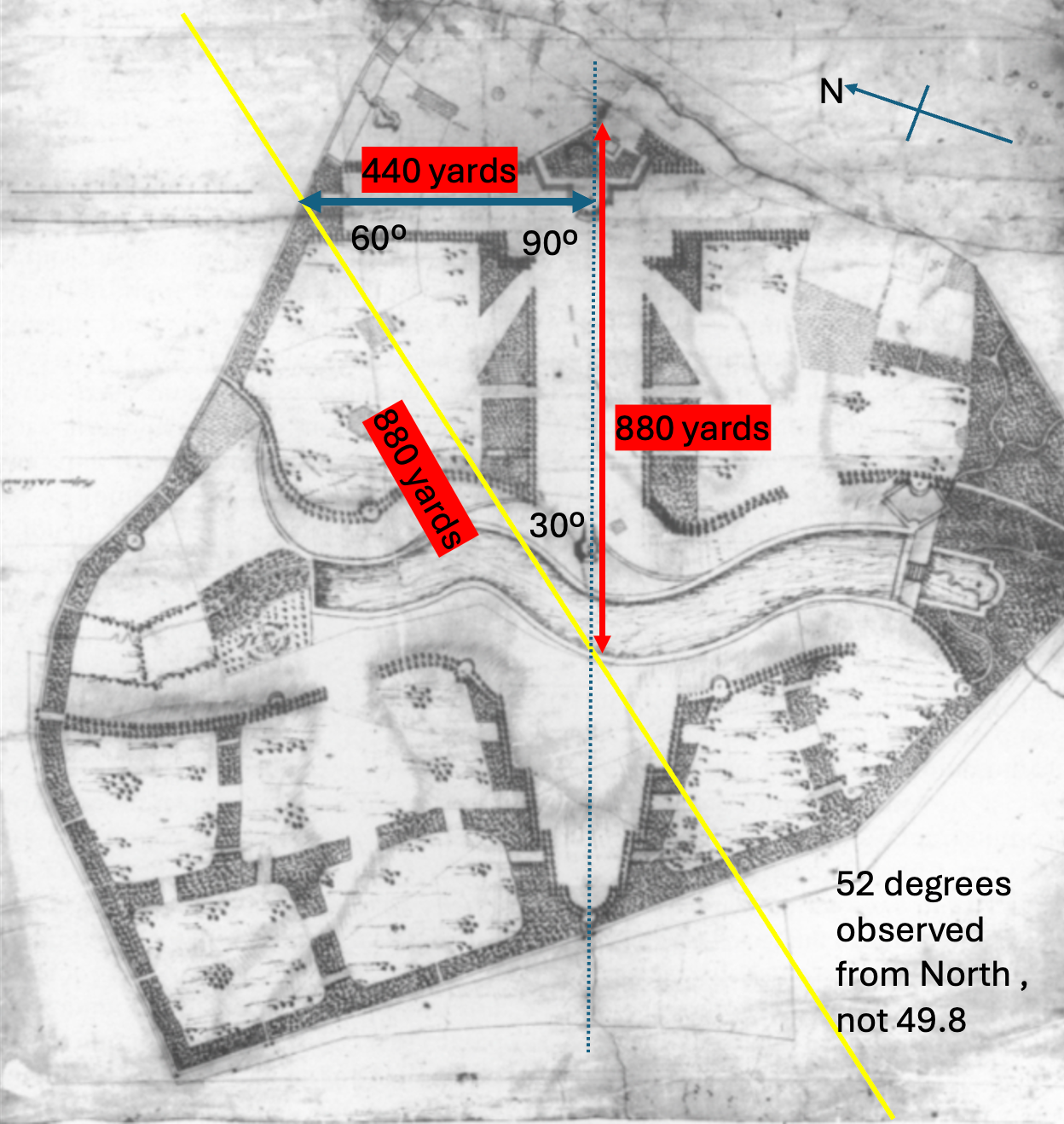
So the solstice line is no decoration to be admired but then ignored. It is the hypotenuse. It is the baseline, the side everything else is set against. Bridgeman hung his whole triangle, and from it his avenues, derived off the measured, observed sunrise on Midsummer's day 300 years ago And the Twin Oaks and the Long Barrow sit on that yellow hypotenuse exactly.
Step back and think what that takes. To end his avenue on that line, and to set his angles to thirty, sixty and ninety against it, Bridgeman had to know where the pre-existing, astronomically observed solstice line ran. You cannot build on a line you cannot see. He knew. It cannot be chance.
And he was not the first to know. Someone planted the two oaks either side of that line around 1490. Crump Dutton enclosed the park along it in the 1620s, his grandstand aligned with the oaks on the solstice. Neolithic people set the long barrow at a specific point so that it appears on the horizon with the sun rising behind it five and a half thousand years ago. Bridgeman simply joined a very old club. In a sense, all are using geometry.
There is one more thing significant thing hiding in this geometry, or rather growing out from it, a thing that turns out to carry a meaning older, greater and stranger than Bridgeman's right angled triangle. But that is for the next post. Hold your breath.