Mystery machine used on Sherborne Broadwaters?
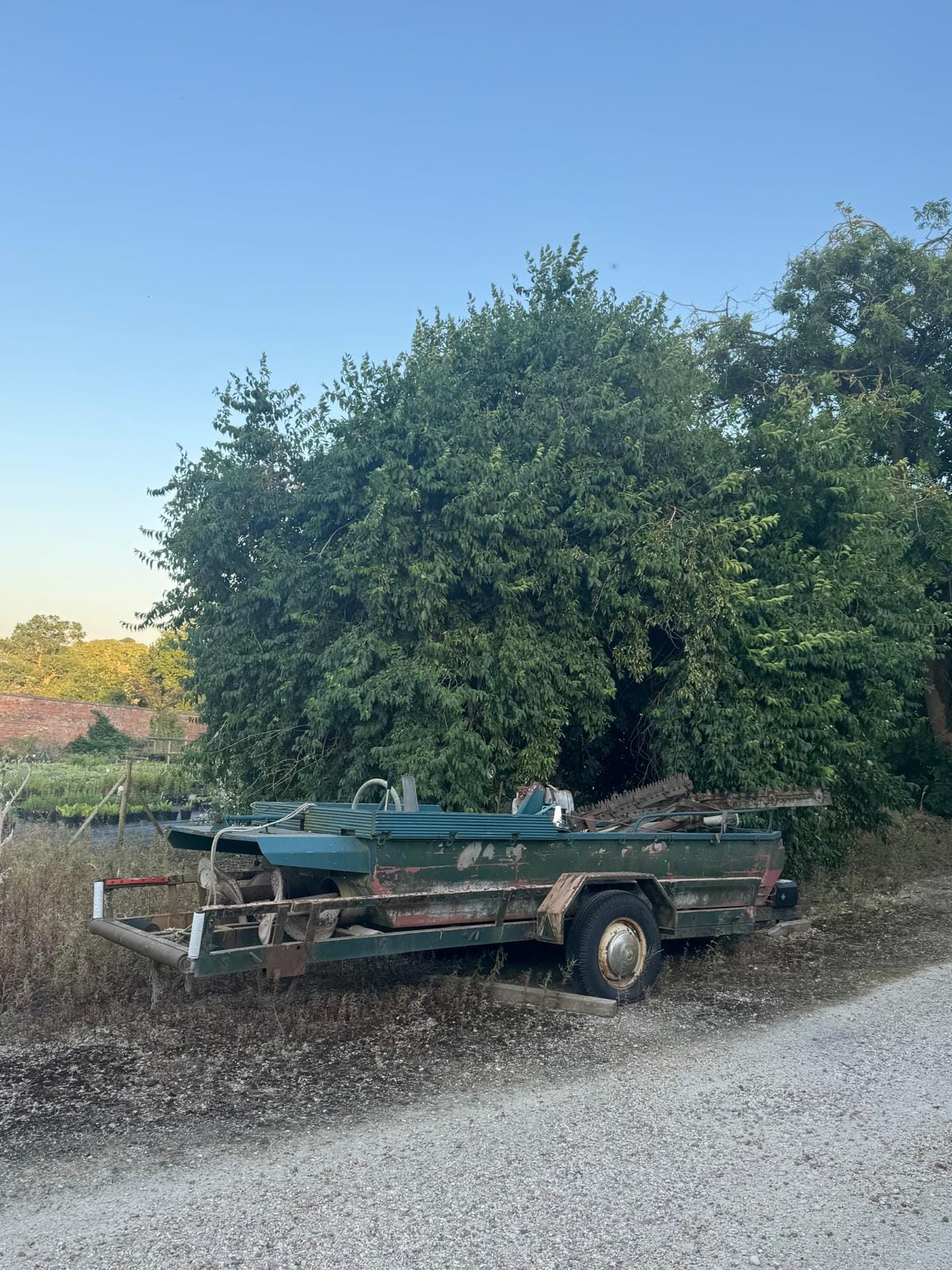
This image is interesting. I don't have the full facts or pretend that I do. The object on the trailer sits abandoned in Sherborne on National Trust property. I suspect it was used in the 1970s or 1980s. The object, a strange amphibious machine, is fitted with twin auger worm drives and deployed the reciprocating weed cutting blades seen rusting on the back. Very intriguing! It would have required an additional team to pitchfork the cut material that would drift downstream out on to the banks or a separate machine to lift the cut weed out. It's not clear why it has been abandoned here.
If this was used to cut the weeds on the Broadwater and Narrow water a few decades ago, it is not the only mechanism used. The others are:
a. The methods used by the team coordinated by Jonathan Benson a few years ago until it got too much and access for the boat was prevented by silt. This team used grappling hooks on ropes to pull clumps of weed from the lakes.
b. The tractor and harrow method described to me by Vaughan Taylor in the recent article I shared.
c. I'm also aware of a long chain fitted with razors that was manually strung across the water and with a back and forth motion up and down the lakes cut the weed. This chain still exists somewhere in the village.
d. Opening the sluices and draining the water so the vegetation dries out and can be removed with the silt. The keys to the sluices still exist and it's not an impossible engineering task.
All the above have occurred within living memory.
As we continue to politely encourage the local National Trust to address the twin issues of excessive vegetation and excessive silt in these heritage bodies of water it is important that we provide these historical contexts – there's a history of management of these lakes going back centuries that can easily be forgotten and ignored. In the meantime two silted lakes producing year-round methane ebullition represent a quantifiable and unnecessary greenhouse gas source within the parish. Unlike agricultural or traffic emissions, this source could be substantially reduced by dredging. The methane output is almost certainly larger than the NT's carbon accounting acknowledges, possibly by a considerable margin, because they have not, as far as I am aware, measured it or even acknowledged the issue.
Separate issue:
I'm currently somewhat immobile, on crutches. Given the excessive dry conditions can I ask locals in Sherborne to keep an eye on the Ancestor oaks we planted last winter in case we need to get an emergency watering activity. There is the avenue at Haycroft, two at the crossroads, three at Sherborne House and two with Dawn T. last time I looked all were well, but by golly the sun has been beating and not a drop of rain.