Smallpox comes to Sherborne in December 1711
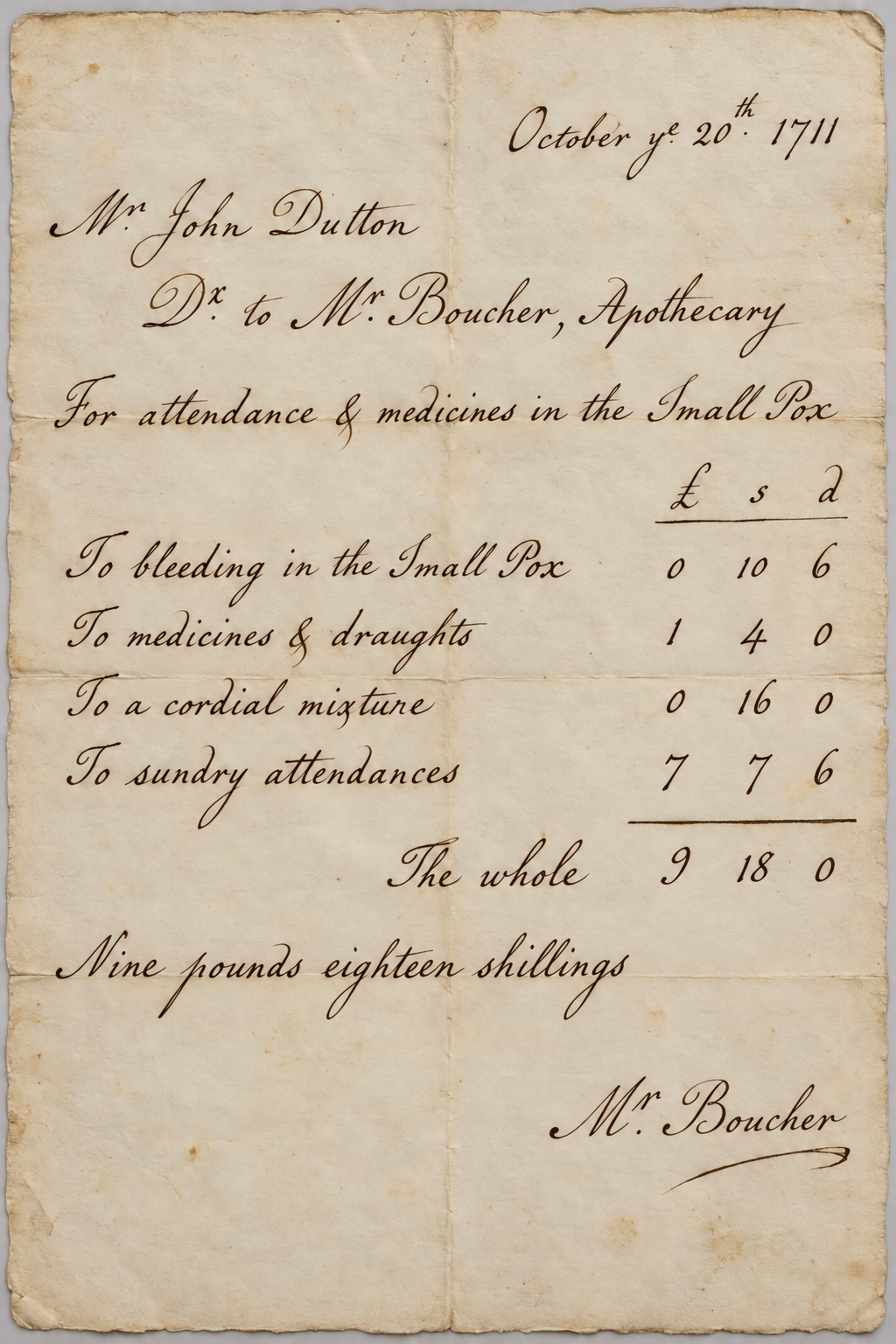
A thorough examination of John Dutton's notebooks from the period 1710 to 1713 shows that smallpox arrived in Sherborne in December 1711. John Dutton himself his mother and his three sisters contracted the disease. Quite an outbreak across the whole family.
In the early part of the 1700s, smallpox evolved in England and became a much more virulent disease than it had been previously. About 25 - 30% of people who contracted the disease went on to die from it.
John Dutton himself reports on the 20th of December 1711 that he called Dr. Green, who came out to him to treat him. Dr. Green's bill for the day was £5 7s 6d. That's quite a lot and is the equivalent at the time of 5 guineas. The local doctor, Mr. Compere, who came out for routine visits, would charge 5 shillings for a visit. This is a significant difference and perhaps indicates the seriousness of the disease. Dr. Green returned on the 6th of January to treat John Dutton again. This time, £6 9s was the bill, and John Dutton also gave a man accompanying him, perhaps his coachman, 5s. Then later in January, John Dutton pays for two nurses to look after him and his sister Mary/Molly for a period of six weeks. It would appear that two other sisters were nursed in Cheltenham when they contracted the disease. John Dutton pays for this, of course. By the time they had all recovered, John Dutton had paid over £50 for medical treatment. Quite a sum in those days. Several doctors and apothecaries provided treatment. Interestingly, John Dutton took 16 months to pay the apothecary, Mr Boucher. Apparently, that was not unusual, but it indicates that all involved kept detailed records and accounts, which, in itself, is interesting

John Dutton's sister Molly was first treated about four weeks after Johns Duttons first treatment by Mr. Compere, with a series of visits. Smallpox, with an incubation time of about 2 to 3 weeks, suggests, frankly, that Molly caught it from John her brother. John Dutton had been in London three weeks earlier. One can perhaps draw a conclusion that maybe he caught the disease there. Smallpox outbreaks in cities tended to be more virulent.
This notebook is pretty matter-of-fact about the visits, just simply recording the payments. It doesn't give any indication of any drama associated with the contraction of the disease.
The county of Gloucestershire has some historical links with smallpox. It was here that Dr. Jenner came up with the vaccination, but also here in Gloucester in 1896, a significant outbreak occurred, killing 434.
For John Dutton and his sisters, the treatment was pretty crude. They were probably "bled", isolated at home or in the case of his sisters somewhere in Cheltenham and advised to stay in cool rooms with the windows open. That was about it. I can find no record of any Duttons being buried in 1711 and 1712, so I think they all survived. Nor is there any particular note of others in Sherborne with the disease, although John Dutton paid for one of his servants , Robert Lea to be bled. The church records are quite useful for cross-referencing to John Dutton's notebook because it gives a good range of the names of the broader population in Sherborne. Fortunately, the church records are much easier to read, and I don't need AI to help me.