The Economics of Sherborne's Landscape Today
Third in a series.
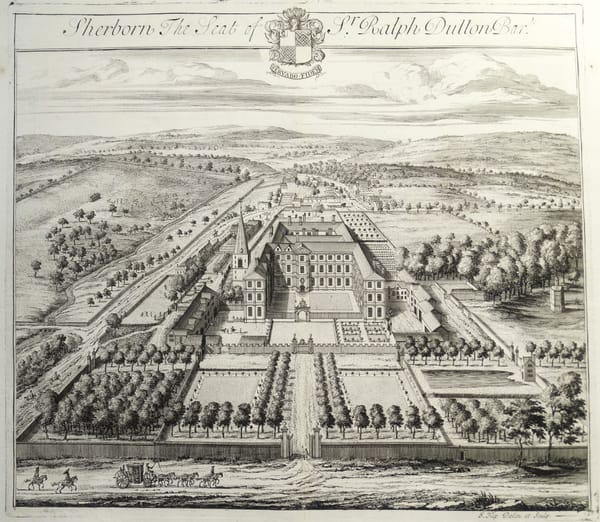
In the last two pieces on Sherborne's historic economics I argued that Sherborne's landscape has always been chosen but driven by the economy of the estate. Winchcombe Abbey built a working valley of mills, leats and washing pools, handsome because it worked. The Duttons then spent four hundred years turning it into a composition, and paid in every generation to keep it.
Four eras, then. The unrecorded centuries before 806. The Abbey, to 1539. The Duttons, to the 1980s. And the National Trust since.
This piece is about the fourth, and it is the hardest to write, because it is the only one whose intention I cannot properly examine.
The phase we cannot read
I am not saying there is no intention. But there does not seem to be a composition.
The Trust states that a Conservation Management Plan exists and guides its decisions. I have no reason to doubt it. But it has not been shared with us, so we cannot read the reasoning, test it, or agree or disagree with it. The delay in sharing with us is so long now it must be deliberate.
That is what separates this phase from the other three. For the monks, the working landscape and its records survive. For the Duttons we have plans, wills, payments and often named designers. Three centuries on we can still reconstruct why a lake was dug and what it was meant to do.
Forty years into the present phase, we cannot. Where a rationale is not available for inspection, all that remains is observation.
The fourth kind of beauty
The Broadwaters were last dredged in the 1990s. Thirty years of silt have followed. Reed and marsh now stand where open water was. There may be a plan to clear some vegetation, and perhaps to lift some silt, but we have been given little encouragement to expect it, little detail of the extent.
I want to be fair about this, because there is a real aesthetic here.
A landscape allowed to follow its own course has a beauty of its own. Reedbed in October light is lovely. Wet woodland has a depth that mown grass never reaches. Birdsong thickens. The pleasure is different in kind, not lesser. It comes from process rather than composition. You are looking at something happening rather than something arranged.
This is a serious school of thought, with advocates and a literature, exactly as the Picturesque once was. Call it the ecological aesthetic.
The monks made a landscape that worked. Dutton made one to be watched. The eighteenth century made one that pretended to be wild. We may be making one that genuinely is. I have no quarrel with that as an aesthetic.
But look at what is actually failing
The difficulty is that “letting nature take its course” describes only part of what is happening here. Walk the estate and the changes are not general. They are specific, and they are structural.
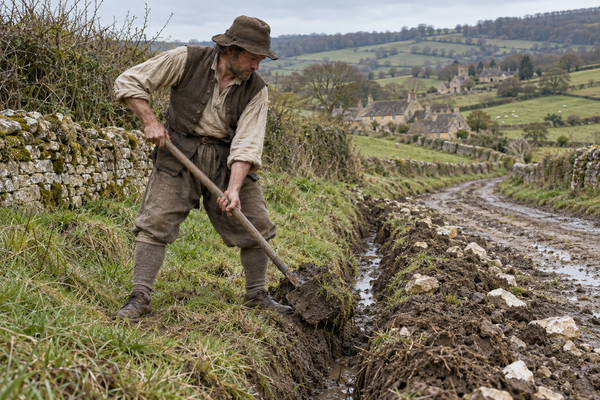
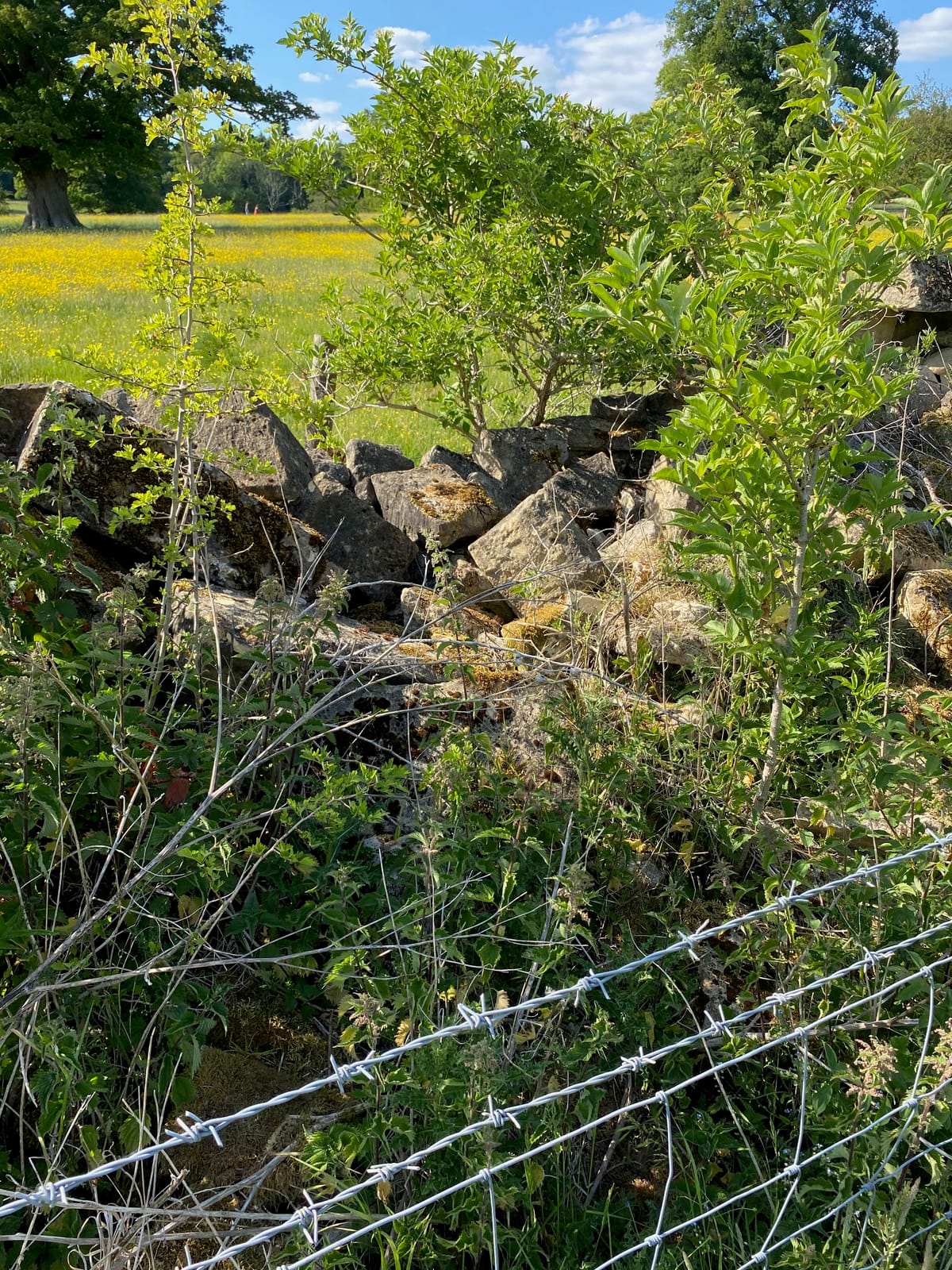
The Sheafhouses on the northern slope are listed. Their roofs are unmaintained and look ready to fail. A length of wall in the parkland several hundred metres long and roughly three hundred years old, itself listed, now has barely one stone standing on another, and that has happened within the last twenty years. Across the estate the same impression accumulates. Not wilderness, but wear.
This distinction is the crux. Vegetation returning to a lake could conceivably be a choice. Someone might genuinely prefer reedbed to open water and argue it on ecological grounds. I would disagree, but I would recognise it as a position.
A listed roof failing is not a position. No school of landscape thought requires a building to lose its cover, and no ecological benefit depends on a wall falling over. These are not aesthetic decisions in disguise. They are the visible arithmetic of money not spent. The built features are the control case, and they tell you, unequivocally, which explanation is operating.
There is a further point, about how we see. A designed landscape is a composition, and its parts are load-bearing and have a meaning within a context. Let a roof go, or a wall, and you do not get wilderness. You get a broken composition, and the eye goes straight to the break. The Picturesque writers and designers did admire ruin and roughness, but a picturesque ruin was placed. Chosen, framed, sometimes built new for the purpose. An accidental ruin reads differently. One says considered. The other says abandoned. Most people can tell at fifty yards without knowing why.
So when villagers say the park looks sad, they are not being sentimental about tidiness. They are reading the landscape accurately. And we remember longer than the people currently making the decisions.
The Duttons were the anomaly
There is a pattern here older than the National Trust, and it is worth stating plainly, because it explains a great deal without requiring anyone to be at fault.
Composed landscapes are made by resident families with something to prove. That is who shaped Bodiam's setting in 1385, and Kenilworth, Theobalds and Holdenby in the 1570s. It is who made Sherborne in the 1620s.
Corporate owners of remote holdings do not compose landscapes. They manage them. Winchcombe Abbey held this valley for seven hundred and thirty years and never made a picture of it. Not because the monks lacked taste, but because Sherborne sat fifteen miles from their door and had a job to do.
Now test the present owner against that. A corporate body with perpetual succession. No dynasty to advertise. Not resident here. Sherborne one property among hundreds.
On every measure it resembles Winchcombe Abbey a good deal more closely than it resembles the Duttons.
That is a description, not an accusation. But it suggests the four hundred years of maintained composition were the exception rather than the rule. One family looked at this valley out of their own windows, every day, for four centuries. Of course they kept it dredged.
Nobody looks out of a window at Sherborne now.
This is recent, and it has a cause
It would be unfair to call the whole phase neglect. In 1998 and 1999 the Trust restored the Lodge Park grandstand, stripping later alterations and reinstating the banqueting room. That was serious, expensive, scholarly work, and the building survives because of it. It must have cost hundreds of thousands of pounds. At Lodge Park the reinstatement of Bridgeman's plan is under way now, again at considerable expense. It's now open a few weekends of the year. No one looks at it on a daily basis to admire the design and the features within it.
Which is exactly why the direction in Sherborne Park is worth noticing. Decline is not inherent to National Trust ownership. The change is recent, so something caused it, and the likeliest candidate is money. Here in Sherborne, we sit in the landscape 365 days a year, and it's not being maintained in a manner which many of us feel comfortable with.
Dredging a lake is expensive and earns nothing. Rebuilding a wall is expensive. Reroofing a listed farm building is expensive. None attracts grant funding, and all compete with everything else a national charity must pay for.
That is not a scandal. It is arithmetic, and every landowner has faced it. The Duttons faced it too. They chose to spend.
So the economic argument I made about the sixteenth century applies again in the twenty-first. Ownership changed, the money changed, and the landscape followed. Slowly then. Rather faster now.
But is anyone choosing it?
Here is my actual question, and it is a question rather than an accusation. Each of the earlier changes was a decision. Someone commissioned it, someone drew it, someone paid. You can find the accounts, and you can sometimes name the designer.
What is happening now looks different. A lake that is not dredged silts up. Silt becomes reed. Reed becomes marsh. A roof nobody mends lets in the weather. The end state may resemble a designed wetland, but nobody designed it, and nobody drew the buildings failing.
From the road, neglect and intention look identical. The sense is that the lack of money has come first, and any justification follows that and maybe disguises it.
So the question is simply this. Is the third great change in Sherborne's history a chosen aesthetic, or an unchosen consequence that will later be described as one?
It matters, for two reasons. The park is registered Grade II, and Historic England confirmed to us in 2021 that the listing anticipates a spine of open water along the valley. Five years later, at this time of the year, there's no sign of that spine at all. The Trust's own Statement of Significance of 2013 described the Brook as an eighteenth-century formal landscape of lakes and cascades, and said such views should be considered especially significant. That document is no longer available to review, and we were told it would be rewritten. But the judgement it recorded was made, and it was the Trust's own. The community's own statement of heritage significance still stands.
The second reason is less technical. For four hundred years the answer to “who decides what this valley looks like” was clear. It was the family that owned it, living in it. Today the land is held in trust, which means held for us the people of the nation
If we are moving from one aesthetic to another, that is a legitimate thing to do. If the composition is not going to be maintained, that may be defensible too. But either should be a decision, and a decision can be explained, argued with, and agreed. Three previous phases left a record of what they intended. The fourth should be willing to do the same.
The features in disrepair, though, settle one thing. Whatever is happening at Sherborne, nobody chose that.
A decision made by default is still a decision. It is just one nobody has had to defend.
Which raises a last question, and it is the one I have been avoiding for three pieces. Nobody in Sherborne has ever had a say in this landscape, not once in twelve hundred years and probably much longer. So what makes us think we should have one now? That is where I will finish in the next post.