Sherborne's Historic Economics affecting landscape
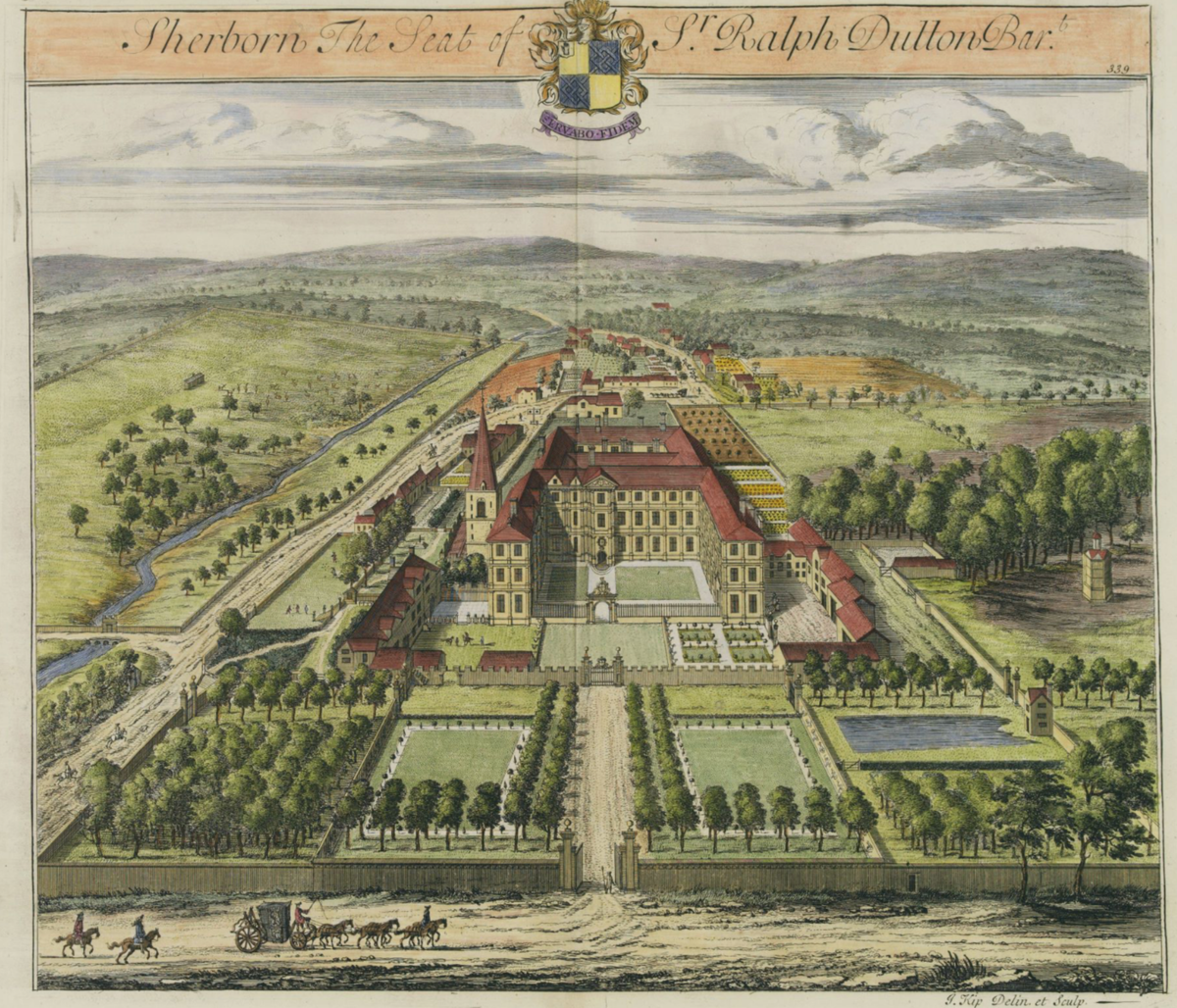
Second in a series.
My recent piece on Sherborne's economic transformation after the dissolution of the monasteries drew quite a number of cogent responses. Thank you. It also left a question hanging, and it has nagged at me since.
Economics tells us who owned the land. It does not tell us why they chose to make it look like this. So, stand on the village road through Sherborne and look north. Water, meadow, trees, deer. It looks like countryside that simply happened.
It did not happen. Almost everything you can see was decided, paid for, and maintained. Someone chose the line of the water and the wall. Someone planted the trees. Someone dug the lake, and someone kept it dug.
Four phases of decision
The pattern only shows at length over time. Sherborne has had four eras of landscape decision-making, and they are not equal.
Before 806. There are barrows on the ridge at Lodge Park and Roman material at the east end of the village. People were here. What we cannot recover is intention although we have had fun recently with guessing the Neolithic and Bronze Age influences. They left no record of what they wanted the valley to look like other than the odd bump in the ground.
806 to 1539. Winchcombe Abbey holds Sherborne for seven hundred and thirty years. The decisions are legible, and they are commercial. Mills, leats, ponds, washing pools, sheephouses. The landscape is a working area designed to make produce.
1539 to the 1980s. The Duttons hold it for over four hundred years, and treat the valley as art. Deer park and grandstand in the 1620s, formal geometry surveyed to the chain, Bridgeman's lakes in the 1740s, Gilpin's planting in the nineteenth century. Taste changes repeatedly inside the phase. The proposition never does. The valley is composed, and the composition is maintained.
The 1980s to now. Charles Dutton, seventh Baron Sherborne, dies at Christmas 1982. After extended negotiation with his executors, some 4,144 acres pass to the National Trust later in the decade. Around forty years so far.
This piece is about the second change, from the Abbey to the Duttons. It is the moment the valley stopped being a workplace and became a view. The fourth phase I will come to separately.
The monks built a business, not a view
Winchcombe Abbey built infrastructure. Mills, leats, ponds, sheephouses, washing pools. Four mills by Domesday. A fulling mill before 1221, among the earliest in England.
It would be wrong to say they cared nothing for appearance. Benedictine houses shaped precincts, watercourses and approaches with real deliberation, and at Fountains the monks plainly understood the visual effect of their hydrology. But the distinction holds. Appearance was the by-product. The pond was dug for fish and for power. The medieval landscape at Sherborne was handsome because it worked.
The Duttons made it art
In the 1620s that reversed. John “Crump” Dutton enclosed parkland here and made a new deer park at Lodge Park, and within a few years he had built the grandstand there. Lt Hammond saw it in September 1634 and called it “lately built”, standing on a high hill, “commanding and overtopping her own shire”. Its whole function is watching. No wool, no water power, no grain. When a man spends a fortune on a building whose purpose is looking, something has changed.
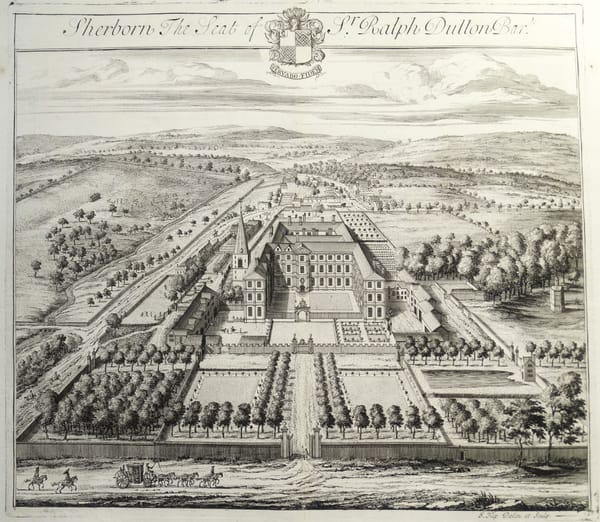
The same period gave Sherborne Park its geometry. The main alignment runs dead straight through the front door of the house, and boundary gates sit on the same bearing at measured intervals. This was surveyed, not grown. Kip's engraving of 1709 shows the result. Ruled avenues, clipped edges, deer on the north bank. A landscape composed like a drawing.
But Sherborne was late
Here is what surprised me when I looked into it. Crump Dutton was not doing anything new.
England had been building landscapes to be looked at for centuries. At Bodiam in Sussex, in 1385, the ground around the castle was shaped to increase its effect, and the moat is now generally read as ornament rather than defence, holding the viewer at a distance and flattering the building.
By the 1570s it had become a competitive sport among the political elite. Robert Dudley's garden at Kenilworth was one of the wonders of the age. William Cecil elaborated Theobalds from 1573. Christopher Hatton's Holdenby was near complete by 1580 and survives as earthworks: a terrace ninety-five metres by seventy, knot gardens, five ponds and a mount four and a half metres high. Thomas Tresham raised his snail mounts at Lyveden in the 1590s.
So Dutton was fifty years behind the fashion, and several centuries behind the idea.
Which raises a better question than the one I started with. Not why did landscape become art, but why did it take so long to happen here?
Why so late?
The obvious answer is ownership, and it is half right.
Winchcombe Abbey was a corporation. It did not die, did not marry, and had no heir to impress. It shaped its landscapes with care, as Benedictine houses did, but for use and devotion rather than to advertise a family. There is no monastic equivalent of a grandstand, because there was no dynasty to sit in it.
More to the point, Sherborne was not its seat. Winchcombe lies some fifteen miles away. This was the engine room of the business, and nobody who needed impressing lived in it. Designed landscapes cluster around front doors, because their whole purpose is to be seen by somebody arriving.
But that only takes us to 1539, and what follows is awkward.
The Duttons acquired Sherborne in 1552 and lived here. Crump Dutton was at an earlier house on the site from 1618, and built the present one in the 1650s. The family stayed until 1971. Yet for roughly seventy years after they arrived, nothing aesthetic appears to have happened at all.
Thomas Dutton died in 1581. He lived through the very decades when Hatton was raising Holdenby and Cecil was elaborating Theobalds, and he did not follow them. The 1608 survey still shows a working valley: three mills, and more shepherds than any other village in the county. No composition anywhere in it.
So residence alone was not enough either. It seems to take three things together. An owner who lives here. A family with something to prove. And money spare, beyond what the estate must earn.
Winchcombe Abbey had none of the three at Sherborne. The early Duttons had the first only. By the 1620s, Crump Dutton had all three.
The farm rent paid for the frame
This is where the economic story and the landscape story meet.
The last piece argued that Dutton's real skill was knowing what not to do. He did not try to rebuild the Abbey's vast wool enterprise. He owned the land, let his tenants farm it, and took secure rent while they carried the risk.
That decision freed something. A landlord who is not running an industry has attention and surplus to spend elsewhere. Also he has no Abbey infrastructure as an overhead to pay for. The monks' landscape had to earn its keep. Dutton's did not, or at least not all of it.
So the deer park is not a detour from the economic story. It is the consequence of it. Once the valley stopped being a factory, it could become a picture.
What “formal” actually meant
That formality was deliberate in a way we have half forgotten. A seventeenth-century garden was understood as art, governed by the same rules as architecture and music: proportion, symmetry, the square and the circle. Straight lines announced that reason had ordered unruly creation. Nature makes no rectangles, so a straightened sheet of water was a boast.
From the 1720s taste turned towards the natural, and Sherborne has the hinge figure. Charles Bridgeman was paid in 1729 for journeys and a plan. He kept the axial bones and softened the edges, and the serpentine began to replace the straight.
Here is the part that is easy to miss. The natural style was not less design. It was more. Across England lakes were dug to look like rivers and clumps planted to look self-sown. The artlessness was costly artifice, drawn on paper first.
Sherborne's own accounts show it. Around 1739 and 1740 they record a lower pond at Lodge Park, logically part of a Bridgeman plan, with piles driven for a stone weir, and masons building sluices and grates for a new pond (aka lake) in Sherborne Park. The masonry is still visible on that sluice today. That is the Narrow-water below the Broadwater. Not a river that happened to widen, but a designed sheet of water, engineered and expensive. The Sherborne lakes are essentially an 18th C designed landscape, like it or not.
Four centuries of it
What strikes me most is not any single decision, but the persistence.
Taste changed repeatedly across those four hundred years. Formal gave way to naturalistic, naturalistic to Picturesque, and Gilpin adjusted the planting again in the nineteenth century. Yet the underlying proposition never moved. This Sherborne valley was a composition, and a composition has to be maintained.
Every generation of Duttons agreed to that bargain, and paid for it. The lakes were dredged. The walls were rebuilt. The roofs were kept on.
The monks made a landscape that worked. The Duttons made one to be watched. Both choices followed the money, and both left a record of what they intended.
What happened when the family finally let go is a different question, and a harder one. I will come to it next.